Best Reptile Mercury Vapor Bulb Guide for Healthy Heating and UVB
If you’re shopping for a reptile mercury vapor bulb, you’re seeking a reliable heat source that also delivers UVA/UVB radiation for bone health and coloration. This guide covers five top options, highlighting who each bulb is best for, and where they fit in a terrarium setup. Choose according to the species, tank size, and desired basking intensity. The table below compares the selected products at a glance.
| Product | Wattage | Best For | Key Benefit |
|---|---|---|---|
| Mega-Ray Mercury Vapor UV Light Bulb/Lamp for Reptile and Amphibian Use | 160 W | Large terrariums, tortoises, bearded dragons | Balanced UV, UVA/UVB, and heat for robust basking |
| REPTI ZOO Full Spectrum UVA + UVB Sun Lamp | Self-ballasted (varies) | Versatile enclosures needing UVA/UVB with heat | Integrated thermal protection and no external ballast |
| Mega-Ray Mercury Vapor Bulb | 100 W | Medium tanks, smaller reptiles needing UVB | Long-lasting UVB production and Vitamin D3 support |
| Arcadia D3 EVO UVB Basking Lamp 100W | 100 W | Bearded dragons, tortoises, snakes | Focused heat with UVA/UVB and infrared output |
| Zoo Med PowerSun UV Bulb, 160 Watt | 160 W | Large enclosures and bird aviaries | Self-ballasted, emits UVA, UVB, and heat in one lamp |
Mega-Ray Mercury Vapor UV Light Bulb for Reptile and Amphibian Use
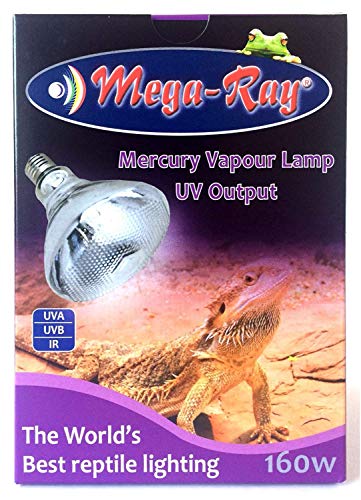
Best for large terrariums and species requiring strong UVB output. This self-ballasted mercury vapor bulb provides UVA and UVB with heat, supporting appetite, activity, and calcium absorption via Vitamin D3 production. Suitable for tortoises, bearded dragons, turtles, snakes, iguanas, and more. A potential limitation is that high wattage may require careful fixture compatibility and heat management in smaller setups. Use for long basking periods in appropriately sized enclosures.
REPTI ZOO Full Spectrum UVA + UVB Sun Lamp

Best for enclosures needing both UVA and UVB with built-in heat. The lamp delivers sun-like radiation, aiding Vitamin D3 production and calcium absorption. It has integrated thermal protection against overheating and does not require an external ballast. Choose this if you want a simple, self-ballasted solution for mixed reptile setups; avoid if your fixture isn’t compatible with its base type.
Mega-Ray Mercury Vapor Bulb

Best for medium tanks and bearded dragons requiring strong UVB output. This 100 W self-ballasted bulb has a proven history of long UVB production, supporting Vitamin D3 synthesis and bone health. Limitation: may provide intense heat, so monitor basking distance to prevent overheating in smaller enclosures.
LUCKY HERP 100 Watt UVA+UVB Full Spectrum Lamp

Best for bearded dragons, tortoises, and small to mid-sized reptiles needing a combined UVA/UVB and heat source. This self-ballasted lamp provides a full spectrum with no harmful UVC. Caution: heat output can be high; ensure fixture clearance and enclosure compatibility to avoid overheating the animal or habitat materials.
Zoo Med PowerSun UV Bulb, 160 Watt

Best for large terrariums or bird aviaries needing a robust, all-in-one UVB/ UVA/heating solution. The 160 W lamp projects UVB at distance and fits standard sockets, simplifying setup. Limitation: larger size may require a sturdier fixture and more careful heat management in compact enclosures.
Arcadia D3 EVO UVB 100W Basking Lamp

Best for focused basking zones in bearded dragons, tortoises, and snakes. The Arcadia D3 EVO delivers UVA/UVB with stable heat and infrared output, encouraging natural basking behavior and color perception. It’s easy to install with a standard E26 base. Limitation: ensure the fixture supports a 100 W Mercury Vapor style lamp, as some fixtures differ in ballast compatibility.
Aiicioo UVB Reptile Light 100W

Best for versatile setups needing an all-in-one lamp with safety features. The lamp includes overheat protection and aims to balance UVB with UVA and heat. Choose this if you want a compact 100 W option with built-in safety; avoid in fixtures that cannot accommodate its ballast requirements or fitment size.
Buying Guide
What kind of reptile or amphibian are you keeping? Species vary in UVB and heat needs. For larger species or bigger enclosures, higher wattage (like 160 W) can be beneficial, while smaller setups may prefer 100 W bulbs.
Is self-ballasted or external ballast preferred? Self-ballasted bulbs simplify installation but require compatible fixtures and safe mounting to prevent overheating.
How close should the lamp be to the basking site? Mercury vapor bulbs produce intense heat and UV; follow fixture and species-specific basking distance recommendations to avoid stress or burns.
Do you need an all-in-one solution? Some bulbs combine UVB/ UVA and heat in one unit, which is convenient for simple terrarium setups but may limit fine control of separate UVA/UVB exposure and temperature management.
Fixture compatibility matters. Ensure your socket type (E26 or other), ballast requirements, and enclosure size align with the bulb’s wattage and base to prevent electrical or thermal issues.
FAQ
- What’s the difference between UVA and UVB? UVA supports natural behaviors and color vision; UVB drives Vitamin D3 synthesis for bone health. Many mercury vapor bulbs emit both UVA and UVB along with heat.
- Can I use any mercury vapor bulb for my reptile? Not all fixtures are compatible. Check wattage, ballast type, socket size, and enclosure heat tolerance before purchasing.
- Is higher wattage always better? Not necessarily. More heat and UVB require more space and careful distance management. Match wattage to enclosure size and species needs.
- How do I know if a bulb is self-ballasted? Self-ballasted bulbs indicate no external ballast is required; the bulb contains the ballast inside. This simplifies installation but requires compatible fixtures.
- Are mercury vapor bulbs suitable for all enclosures? They work well in larger terrariums and outdoor-style enclosures; smaller or highly humid setups may require different UVB/heat solutions and ventilation considerations.
- How should I position the lamp? Position the basking site at the recommended distance from the bulb to optimize UV exposure while preventing overheating. Allow for a cooler gradient in the enclosure to encourage natural behavior.