Best Multi-Circuit Power Monitor Solutions for Home and Workshop
Keeping track of electrical consumption across multiple circuits is essential for safety, efficiency, and cost control. This article highlights five versatile power monitoring options that suit different needs—from home automation and solar grid management to DIY projects. Each product is evaluated on display capability, ease of installation, data retention, and notable safety features. Below is a quick summary of the selected models to help you compare at a glance.
| Product | Brand | Key Feature | URL |
|---|---|---|---|
| MORNING GROUP 2 Pieces AC Current Voltage Panel Meter | MORNING GROUP | Split-core current transformer for easy installation; simultaneous voltage, current, power, energy, frequency, and power factor | Link |
| MORNING GROUP AC Current Voltage Panel Meter | MORNING GROUP | Split-core CT; overload alarm; automatic data storage on power loss | Link |
| Emporia Vue 3 Home Energy Monitor | EMPORIA | UL certified; panel-installed with clamp sensors; supports solar/net metering and multi-phase setups | Link |
| 150A High Precision Power Analyzer Multi Meter | HTRC | High-precision DC power analysis for batteries and DIY projects; comprehensive parameter display | Link |
| Hosyond AC 80-260V 100A LCD Power Monitor | Hosyond | Split-core CT; large LCD; one-button backlight control; preset power alarm | Link |
The following sections describe each product, highlighting what makes it suitable for multi-circuit monitoring and what to consider when choosing a system for your environment.
MORNING GROUP 2 Pieces Power Monitor Set

This dual-pack power monitoring kit uses a split-core current transformer (CT) to simplify installation across multiple circuits. It displays voltage, current, active power, energy, frequency, and power factor simultaneously, enabling a comprehensive view of electrical performance in real time. An overload alarm uses a backlit flash to alert users when a preset limit is exceeded, helping prevent electrical strain. The automatic data storage feature preserves the most recent measurements if power is interrupted, reducing data loss during outages. Suitable for panel or switchboard installations in residential or small commercial settings, this model is ideal for users who want immediate insight into how different loads behave over time.
Key considerations: ensure the CTs are properly seated on the main feed(s) and verify whether a single-phase setup or multi-wire branch circuits are supported by your panel. The user interface emphasizes essential metrics; for deeper energy analytics or solar integration, pairing with a more expansive system may be beneficial.
MORNING GROUP AC Current Panel Meter With CT

This second MORNING GROUP model emphasizes a comprehensive digital readout that includes voltage, current, active power, energy, frequency, and power factor. The split-core current transformer continues to simplify the installation on existing panels without disconnecting lines. An automatically stored dataset supports continuity of information after a power outage, which is especially useful for ongoing monitoring in fluctuating power environments. Users can customize a power-limit threshold to trigger visual and audible warnings, which aids in preventing overloads and protecting connected equipment.
Key considerations: assess the length of CT leads and the proximity of the monitor to the main panel to minimize measurement noise. This unit is well-suited for users who want a robust, all-around meter with reliable data retention and alerting capabilities.
Emporia Vue 3 Home Energy Monitor

The Emporia Vue 3 is a UL-certified home energy monitoring hub designed for modern smart homes. It installs in a standard electrical panel and uses clamp-on sensors to measure real power, offering 24/7 visibility of household energy usage. The system supports single-phase and multi-wire configurations and can extend to 3-phase or larger arrangements with optional accessories. Solar and net metering interfaces help homeowners track production and consumption, enabling smarter energy management and potential cost savings. A one-year warranty provides additional assurance on long-term reliability.
Key considerations: if you plan to monitor a multi-phase system or require detailed historical data and integration with energy-saving apps, verify compatibility with your panel model and whether additional sensors are needed. The UL certification is a notable safety and reliability advantage for many buyers.
150A High Precision Power Analyzer Multi Meter
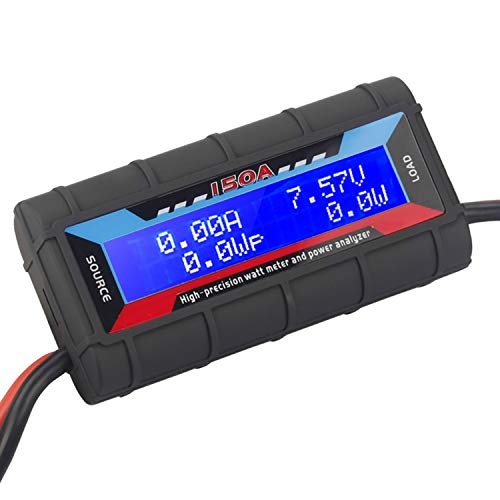
This high-precision meter is geared toward DIY projects and professional testing of DC power systems. It measures current (0-150A) and voltage (0-60V) with high resolution, along with wattage, amp-hours, and watt-hours. The large blue backlit LCD makes readings easy to read in various lighting conditions, and the device is compatible with 12-gauge wire for higher voltage and current capacity. It is particularly suitable for battery testing, solar power setups, and charger evaluations where accurate DC measurements are essential.
Key considerations: designed for DC applications, this model is not suitable for standard AC mains without appropriate AC-to-DC conversion contexts. Ensure your project matches the DC measurement capabilities and wiring support to avoid misreadings or overloads.
Hosyond LCD Multi-Function Power Monitor

The Hosyond meter offers a broad set of monitoring parameters, including voltage, current, active energy, frequency, and power factor, all visible on a large LCD. Split current transformers ease the installation process, making it practical for retrofit projects. A one-button control toggles the backlight and initiates energy reset or power alarm presets. The overload alarm feature, paired with adjustable thresholds, helps protect devices and circuits from damage due to excessive loads. This model suits users who want a straightforward, dependable monitor with alarms and a clear display.
Key considerations: verify the maximum current and voltage ratings align with your circuit demands. The ability to preset alarm levels adds a safety layer, but the user should ensure the environment remains compliant with local electrical codes when installing panel meters.
Buying Guide: Key Factors To Choose A Multi-Circuit Power Monitor
- Measurement scope: Determine which metrics you need—voltage, current, power, energy, frequency, and power factor. Some models emphasize 6-in-1 readability, while others focus on DC specifics or solar integration.
- CT design and installation: Split-core CTs simplify retrofit installs by avoiding wire disconnections. Check CT ratio, conductor size, and the number of monitored circuits supported by the device.
- Safety and certification: UL-listed or equivalent certification provides safety assurances in home environments. Consider devices designed for panel installation and certified for US electrical standards.
- Data retention and alarms: Look for automatic data storage during outages and adjustable overload or power-limit alarms. This helps maintain continuous monitoring even during disturbances.
- Display and usability: A clear LCD with backlight improves readability in various lighting. Ensure the screen shows all required metrics simultaneously if you want a quick snapshot.
- Connectivity and integration: For smart homes, check compatibility with solar inverters, net metering, and consumption apps. Some models work well with modular add-ons for expanded monitoring.
- Application context: DC meters suit battery and charger testing, while AC meters are better for general household energy monitoring. Choose according to whether you need mains or DC-specific readings.
- Warranty and support: A solid warranty and accessible customer support help address installation questions and device reliability over time.
Choosing a multi-circuit power monitor involves balancing installation complexity, measurement needs, and long-term data usability. For quick, safe installations in typical homes, meters with split-core CTs, clear displays, and reliable data storage offer a practical starting point. For solar-focused households, prioritize models with solar and net metering compatibility and UL safety certification. DIY enthusiasts seeking precision for battery or charger testing may favor higher-resolution DC meters with broad current and voltage ranges.