Best Remote Battery Disconnect Switches for Cars and RVs
Finding a reliable remote battery disconnect switch can safeguard your vehicle’s battery life, deter theft, and prevent parasitic power drain during long-term parking. This article reviews five top-rated options, detailing how each model handles voltage sensing, standby current, and installation. Ready for a quick, practical guide to protect your battery across cars, RVs, boats, and trucks?
| Product | Brand | Key Feature | Voltage/Current |
|---|---|---|---|
| Matell DC 12V Remote Battery Disconnect Switch | matell | Smart voltage control with auto shutoff | 12V, up to 120A (500A cranking), 2400A peak |
| Remote Battery Disconnect Switch 12V 240A | TAINECTC | LED voltage display, ultra-low standby | 12V, 240A |
| Remote Battery Disconnect Switch 12v, 250A | DZSSCY | High-quality copper wiring, simple install | 12V, 250A |
| Nilight 360A Remote Battery Disconnect Switch | Nilight | LED voltmeter, wireless control options | 12V / 24V, 360A |
| Csyibeielec Kill Switch for Car | Csyibeielec | Smart voltage with auto cut-off | 12V, 240A |
style=”display:none;”>Intro continuation
Across these options, you’ll find varying levels of automation, endurance, and ease of installation. The common goals are to prevent battery drain during long storage, deter theft by disabling starting circuits, and provide a dependable manual override for safety maintenance. The following sections break down five top choices and how they measure up against real-world needs.
Matell DC 12V Remote Battery Disconnect Switch

The Matell unit is designed for long-term parking and energy conservation. It uses a smart voltage control system that monitors battery health and can automatically disconnect when voltage drops below a preset threshold. With remote control coverage around 30-70 meters, it supports a wide range of vehicles, including cars, boats, RVs, and motorcycles. Its safety profile includes an instantaneous peak current of 2400A and a robust cranking current of 500A, making it suitable for both routine starts and high-demand bursts. In smart mode, the switch intelligently disables remote control when voltage readings show the battery is in a healthy state (above 13.3V during operation), and only auto-disconnects after a 5-minute delay when voltage falls too low (below 11.9V). Installation typically involves connecting to the battery’s negative/ground circuit, with a straightforward setup that balances reliability and security.
Key features:
- Remote control range: 30–70 meters
- Rated voltage/current: 12V / 120A (500A cranking)
- Smart voltage detection with auto-disconnect
- Suitable for cars, boats, RVs, travel trailers, and more
TAINECTC Remote Battery Disconnect Switch 12V 240A

TAINECTC emphasizes energy efficiency with a stand-by current near 0.001A. The device features an LED voltage display for quick battery checks and supports auto-disconnect when the voltage dips below 11.8V (after 300 seconds) to avoid deep discharge. When voltage rises above 13.6V, remote control becomes unresponsive, forcing manual operation to prevent inadvertent shutdown during driving. It’s designed for easy integration with negative-ground connections and includes considerations for installation alignment with various battery post sizes, including adapters for classic setups. The unit balances protection and simplicity for RVs, trucks, and marine applications.
Key features:
- LED voltage display
- Low standby current
- Auto-disconnect thresholds to protect battery health
- Manual override option
DZSSCY Remote Battery Disconnect Switch 12v, 250A
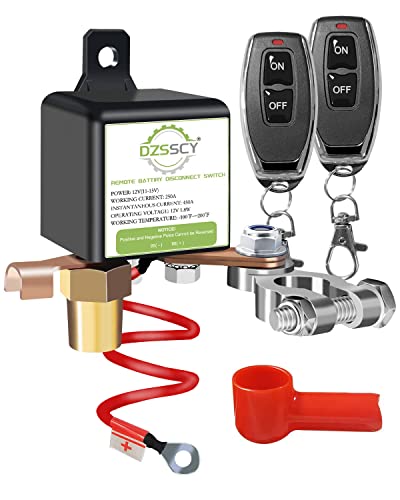
DZSSCY markets this model as a robust solution for preventing battery drain while adding a layer of circuit protection. It provides up to 250A continuous current, with an instantaneous capability around 450A, and is built with high-quality copper wiring for reliable signal and durability. The installation is described as straightforward: connect the negative lead to the battery terminal and attach the red wire to the positive post, with a more streamlined design to reduce extra cabling. This makes it a strong choice for cars, trucks, RVs, and boats where straightforward wiring and dependable performance matter most.
Key features:
- High-quality copper wiring for better conductivity
- Instantaneous current up to 450A
- Simple, direct negative-ground installation
Nilight 360A Remote Battery Disconnect Switch

Nilight presents a heavier-duty, 360A-rated solution suitable for 12V and 24V systems. It includes an LED voltmeter display to monitor battery status at a glance and uses a magnetic holding relay to minimize standby power consumption. The standby current is notably low, helping reduce parasitic draw when the vehicle is idle. The system is designed for seamless operation across various vehicle types—cars, trucks, boats, RVs, and trailers—while enabling quick, wireless-style control with an emphasis on reliability and energy efficiency.
Key features:
- LED voltmeter display
- Standby current around 5 mA
- Wireless-style control adaptability for multiple vehicle types
Csyibeielec Kill Switch for Car 12V

Csyibeielec emphasizes protective shutoff logic with a smart voltage-based mechanism. When the battery voltage falls to about 11.8V, the remote control can fail safely, and the circuit cuts off after a defined delay to preserve battery life. If voltage rises above 13.2V, driving conditions disable the remote function to prevent unintended shutdown during operation. The unit’s standby current is low, and its rated current capacity is 240A, positioning it as a balanced option for everyday vehicles and recreational setups. The design also highlights durability for broader temperature ranges and typical automotive environments.
Key features:
- Voltage-based auto-disconnect with safety margins
- Low standby current
- Manual control option for emergencies
Buying Guide: Key Purchase Considerations
When choosing a remote battery disconnect switch, consider these factors to match your needs:
- Voltage and current ratings: Ensure the unit supports your battery system (commonly 12V, with 240–360A continuous and higher peak currents for quick cranking).
- Standby power consumption: A lower standby current reduces parasitic drain during storage.
- Voltage monitoring: Smart voltage sensing helps protect battery health and avoid accidental shutdowns while driving.
- Auto-disconnect thresholds: Look for adjustable or clearly defined cutoffs (e.g., 11.8–12.0V low, 13.2–13.6V high) to suit your usage pattern.
- Remote range and control method: Consider practical distances and whether a wireless-like remote or manual override is preferred for security and reliability.
- Installation complexity: A straightforward negative-ground connection and minimal extra cabling speed up setup and reduce failure points.
- Multi-vehicle suitability: If you own cars, boats, RVs, and trailers, choose a unit rated for diverse environments and currents.
- Build quality and wiring: Copper conductors and corrosion-resistant components extend lifespan under harsh conditions.
Performance considerations: In real-world use, automatic shutoffs reduce the risk of deep discharge but may require manual intervention when driving or charging cycles are frequent. Anti-theft features, such as remote disconnection and programmable thresholds, provide additional security, though it is essential to keep manual override options accessible for maintenance and emergency scenarios. For boat and RV setups, ensure compatibility with longer battery banks and the appropriate negative-ground configuration.
Maintenance tips: Regular battery health checks, clean terminal connections, and ensuring the unit is properly sealed against moisture will help maintain reliability. If your vehicle sits unused for extended periods, test the system periodically to confirm the auto-disconnect behavior and to confirm that manual overrides function correctly.