Best Portable Solar Panels for RV Use: High-Efficiency Pick for Off-Grid Power
Answering the needs of RV travelers seeking reliable, mobile power, these portable solar panels are designed for RV setups, camping, and off-grid adventures. Each option focuses on ease of use, lightweight design, and compatibility with common power stations and 12V systems. This guide highlights five solid choices, who they’re best for, and practical tradeoffs to consider before buying.
Overview of top picks
| Product | Best For | Key Benefit |
|---|---|---|
| Renogy 200W Portable Solar Panel | RVers needing high output in limited space | High efficiency (25%) with lightweight foldable design |
| DOKIO 200W Portable Foldable Kit | Budget-conscious travelers who want a standalone controller | Separate controller for safe charging and flexible setup |
| Renogy 100W Portable Solar Panel | Beginner-friendly setups needing portability | 25% efficiency with plug-and-play kit |
| BougeRV 200W Portable Solar Panel | Durable, off-grid RV and camping use | N-type foldable with strong conversion and durability |
| ZOUPW 450W Portable Solar Panel | Users with large power demands and compatible high-capacity stations | High capacity and 25% efficiency with 16BB technology |
Renogy 200W Portable Solar Panel

This foldable panel delivers industry-leading efficiency with 25% conversion thanks to upgraded N-Type 16BB cells. It’s designed for RVs, camping, and off-grid use where space is tight. The unit folds compactly for easy storage and transport, making it ideal for SUVs and small campers. It supports charging multiple devices via USB-C PD and USB-A ports while also providing MC4 output for power stations or 12V batteries. Best for: RVers who want higher daily energy output in a smaller footprint. Limitation: panel weight, while light for its class, remains a consideration for solo setup.
DOKIO 200W Portable Foldable Solar Panel Kit

This kit includes a separate PWM controller, offering a safe charging path for 12V systems with protections against reverse polarity, overcharge, overload, and short-circuit. With a lightweight design at 9.7 lb and a slim folded size, it’s easy to carry and mount on RVs, vans, boats, or trailers. Best for: users who prefer a stand-alone controller for easy upgrades. Limitation: requires a controller; not a single integrated solution like some all-in-one kits.
Renogy 100W Portable Solar Panel
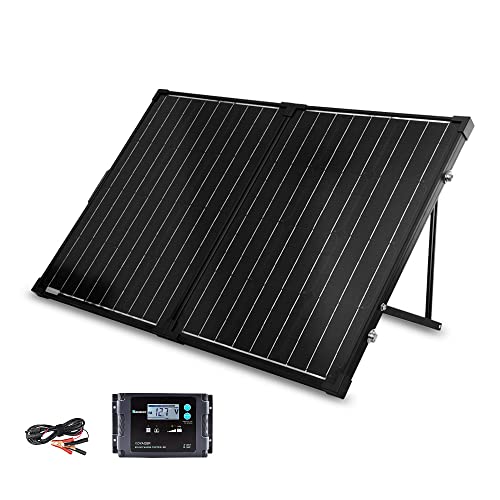
This 100W panel packs 25% efficiency with N-Type cells and includes an adjustable kickstand for optimal sun angle. It folds into a suitcase-sized case and weighs around 7.9 kg (17.42 lbs), making it a portable choice for RV trips and off-grid getaways. Best for: beginners or light-power users who want quick setup without heavy equipment. Limitation: lower wattage compared to larger panels, so daily output may be limited in high-demand scenarios.
BougeRV 200W Portable Solar Panel

Featuring a fiberglass-reinforced design for durability and foldable portability, this 200W panel aims to balance power with transport ease. It includes XT60 and DC7909 connectors for compatibility with common devices and is suitable for BougeRV-powered fridges or power stations. Best for: campers who need robust construction and solid power in a packable form. Limitation: connector compatibility should be checked with existing equipment to ensure full compatibility.
ZOUPW 450W Portable Solar Panel

This high-capacity panel uses next-gen N-Type 16BB technology to sustain about 25% efficiency and deliver substantial output for large power stations. Its 450W rating makes it suitable for EcoFlow Delta, Anker C1000, and similar high-capacity units. Best for: RVers with demanding energy needs and compatible high-voltage inputs. Limitation: heavier weight at about 29.5 lbs and not suitable for very small vehicles or tight mounting spaces.
Buying Guide
- : Higher wattage panels deliver more energy but are heavier; balance daily energy needs with how you’ll transport and deploy the panel.
- cell technology: N-Type cells improve efficiency and durability; panels with 16BB or similar designs typically perform better in variable light.
- wiring and compatibility: Look for built-in controllers for easy setup, or ensure the panel includes MC4, XT60, or 4-in-1 cables to match your power station or 12V system.
- durability and weather resistance: IP ratings (like IP65 or IP68) and rugged frames help withstand outdoor use; consider ETFE coatings for longevity in harsh environments.
- portability features: Foldable designs, suitcase-style cases, and lightweight builds simplify transport and setup at campsite or pull-in locations.
- setup considerations: Panels with adjustable kickstands or tilting capabilities maximize sun exposure; ensure you have clear near-sun angles for best results.
- best-use scenarios: Choose based on vehicle size, typical travel routes, and whether you prioritize ultra-light packs or higher power reserves.
FAQ
- What is a typical RV solar panel wattage I should consider? For moderate energy use, 100–200W per panel is common; larger rigs may benefit from 350–450W in total across multiple panels.
- Do I need a separate controller? Some kits include a PWM or MPPT controller; others are ready-to-use with integrated charge controllers. Check if your power station requires a specific controller type.
- Are foldable panels durable enough for road trips? Yes, many foldable panels feature rugged materials and weather resistance; verify IP rating and construction for road-use conditions.
- Can I run multiple devices at once? If the panel includes USB-C PD and USB-A outputs (plus MC4 or similar), you can charge several devices concurrently; compatibility depends on the total available current.
- Is higher efficiency always better? Higher efficiency panels generate more power in limited space, but total wattage and your charging setup determine actual daily output.
- How do I store panels in an RV? Use the folded position with protective cases or pockets; avoid bending panels beyond their designed fold lines to prevent damage.