Best Plug in Grid Tie Inverters for Home Solar Power
If you’re wiring a grid-tied solar system for a home or small business, a plug-in grid tie inverter is a practical choice for converting DC from solar panels into usable AC power. This guide highlights five reliable options, who they’re best for, and key considerations to help you compare quickly. Whether you’re balancing cost, simplicity, or efficiency, these models cover common residential setups and small commercial installations.
Quick buyer snapshot:
| Product | Best For | Why It Stands Out | Limitations |
|---|---|---|---|
| Y&H 600W Solar Grid Tie Micro Inverter | Small systems, rental homes | IP65 waterproof design, real-time AC data monitoring | Limited to modest panel counts and lower total output |
| Solar Grid Tie Micro Inverter WVC-1200W | Medium residential projects | High MPPT precision, LCD display, efficient transfer | Higher wattage may require careful layout |
| Y&H 1000W Grid Tie Inverter Power Limiter | Small to mid-size solar arrays | Battery-ready option, MPPT with limiter | Requires matching voltage range and proper wiring |
| Y&H 350W Grid Tie Micro Inverter MPPT | Compact rooftop setups | MPPT range compatible with common panels | Lower power ceiling |
| 600W Grid Tie Inverter LiHUiee | Plug-and-play for basic homes | 6-stage power search, direct AC output | May underperform in complex shading |
Y&H 600W Solar Grid Tie Micro Inverter

Best for small, single-branch residential solar setups or DIY installations. Key features include IP65 waterproof housing and a DC input designed for MC4 connectors, which reduces miswiring risk. It converts panel DC to usable AC and supports real-time monitoring via an AC digital meter including voltage, current, active power, energy, frequency, and power factor. Caution: total system output is limited to 600W, so scale appropriately.
Solar Grid Tie Micro Inverter WVC-1200W

Best for mid-sized homes or small schools where higher output is beneficial. This model emphasizes high MPPT precision to maximize panel harvest, with a respectable claimed efficiency boost and an LCD display for easy status checks. It also uses 32-bit DSP SPWM for smooth operation. Limitation: while robust, the 1200W rating requires adequate panel area and proper layout to avoid underutilization.
Y&H 1000W Grid Tie Inverter Power Limiter
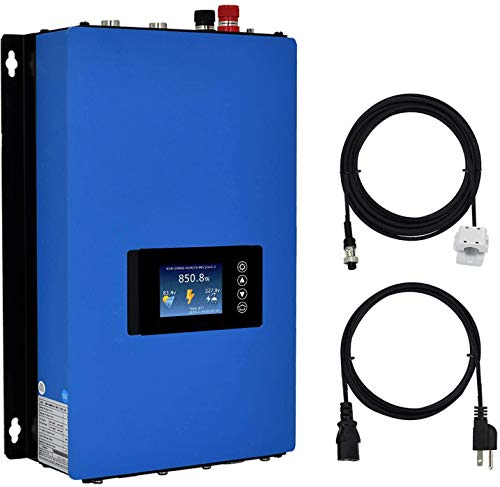
Best for compact arrays seeking an efficient MPPT-based control with battery compatibility. It supports a battery discharge mode and has a defined DC input range (22-60V) with a startup around 26V, making it suitable for systems that may pair with 36V or 48V battery banks. Caution: ensure open-circuit voltage stays within window (38–60V) for optimal performance and safety, and match battery bank voltage carefully.
Y&H 350W Grid Tie Micro Inverter MPPT

Best for small rooftop arrays with limited space. This micro inverter supports MPPT within a 24-42V range, aligning well with typical 30–42V panel outputs and recommending panel voltages around Vmp30-42V. Limitation: the 350W limit may require multiple units for larger systems, and ensure each is properly sited to avoid shading losses.
Solar Micro Grid Tie Inverter, 1200W

Best for larger residential installations needing more headroom. It features an aluminum alloy body for durability and an LCD display for real-time monitoring of voltage, power, frequency, and current. It claims high efficiency through precise MPPT and 99.9% power transmission capability. Caution: aluminum enclosure adds weight; consider mounting and ventilation in sunny climates.
1000W Grid Tie Inverter For 36V Panels

Best for 36V panel configurations and battery-inclusive setups. It emphasizes high-quality materials, environmental friendliness, and MPPT-driven efficiency above 99%. Limitation: ensure compatibility with your 36V solar array and battery system, and verify that wiring and breakers are sized correctly for safe operation.
Y&H 2000W Grid Tie Inverter SUN-2000GTIL2-H

Best for larger grid-tied systems requiring stacking capability and 240V adaptability. This unit supports a wider input range (45-90V) and is designed for American 240V output, with a battery option and MPPT efficiency up to 99%. Caution: not suited for 110/120V systems; ensure your electrical panel and service can safely accommodate higher voltages and multiple units if scaling is desired.
Buying Guide: What to Consider When Choosing a Grid Tie Inverter
- System voltage compatibility: Match the inverter’s DC input range to your solar array’s Voc and Vmp. Incorrect voltage alignment reduces efficiency or can prevent startup.
- Output power and scalability: For small rooftops, 600–1000W units may suffice; for larger homes or small businesses, plan for multiple units or higher-wattage models and consider stacking capabilities where supported.
- MPPT technology: A precise MPPT increases energy harvest, especially in variable conditions. Look for high-efficiency figures (often above 95% in real-world specs) and fast tracking.
- Protection and safety: Waterproof or IP-rated housings, proper isolation, and clear labeling help reduce risk in damp environments. Ensure wiring complies with local electrical codes.
- Monitoring and interface: LCD displays or digital meters simplify on-site checks. Real-time monitoring helps detect performance issues early.
- Battery compatibility: Some inverters offer battery discharge or charging features. Verify that the battery voltage and chemistry are compatible if you plan to pair energy storage.
- Installation context: Evaluate whether a plug-in micro inverter design fits your roof layout, shading patterns, and electrical panel access. In some cases, micro inverters provide better shading resilience than string inverters.
Frequently Asked Questions
- What is a grid tie inverter?
A grid tie inverter converts DC electricity from solar panels into AC power that can be fed into the home or grid. It synchronizes phase and frequency with the electrical system for safe transfer.
- Do I need battery storage with a grid tie inverter?
No, not required for grid-tied setups. Batteries are only needed if you want backup power or load shifting. Some models offer battery-compatible modes.
- Can I mix different brands of grid tie inverters?
Mixing is possible but not always ideal. Different MPPT ranges and efficiencies can complicate optimization. Consistency in system design is usually preferred.
- What should I consider for safety when installing?
Ensure proper electrical panel capacity, proper grounding, weather-rated housings for outdoor use, and compliance with local codes. Consider professional installation for high-voltage or complex configurations.
- How important is MPPT in a grid tie inverter?
MPPT is critical for maximizing energy harvest, especially when panel output varies with temperature, shading, or aging. Higher precision MPPT generally yields more stable power.
- Do these inverters require optimized panel layouts?
Yes, correct panel orientation and voltage within the MPPT range optimize performance. Excessively high Voc or mismatched Vmp can reduce efficiency.
Choosing the right plug-in grid tie inverter depends on your system size, panel configuration, and whether you plan to add storage later. Use the buying guide questions to map your needs against each model’s MPPT range, input voltage, and maximum output. This approach helps ensure safe installation and consistent energy generation across seasons.