Best Onboard Battery Chargers and Maintainers for 12V Systems
Answering the question: choose an onboard charger that fits your battery type, vehicle or boat setup, and intended maintenance routine. This guide highlights five top onboard chargers/maintainers that are well-suited for 12V lead-acid and lithium batteries, including AGM, flooded, deep-cycle, and marine applications. Each option suits different user profiles—compact installations, multi-bank setups, or heavy-duty charging for harsh environments. The following summary table helps compare key attributes at a glance to help buyers pick the right model quickly.
| Product | |||
|---|---|---|---|
| NOCO GENIUS2D | 1 | 2 A | Direct-mount, all-in-one maintainer for 12V lead-acid batteries |
| NOCO Genius GEN5X2 | 2 | 10 A | Marine environments requiring dual-bank charging |
| NOCO Genius GEN5X1 | 1 | 5 A | Compact single-bank maintenance for diverse 12V batteries |
| NOCO Genius GENPRO10X2 | 2 | 20 A | Higher-capacity, dual-bank charging for boats and deep-cycle systems |
| NOCO Genius GEN5X3 | 3 | 15 A | Three-bank onboard charging for multi-battery setups |
Note: All products listed are designed to handle both lead-acid and lithium batteries with overcharge protection and temperature compensation. Select the configuration that matches your battery count and the environments where the charger will operate most often.
Genius 2D: 2A Onboard Battery Charger & Maintainer
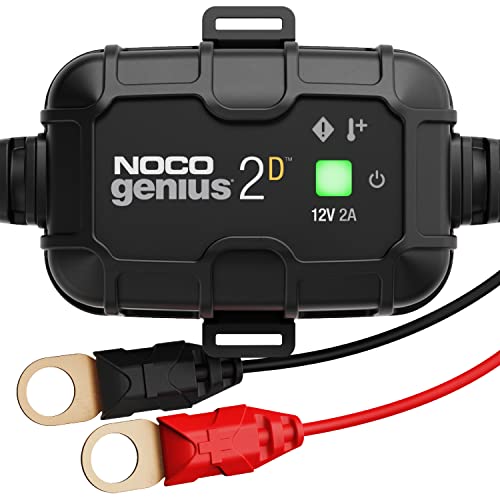
The Genius2D is a direct-mount onboard charger designed for 12-volt lead-acid batteries, including AGM, Gel, SLA, VRLA, flooded, and deep-cycle variants. It functions as a battery charger, maintainer, trickle charger, and desulfator with overcharge protection and temperature compensation. Best for users who want a compact, integrated solution that can be mounted near the battery for vehicles, boats, or off-road equipment requiring a simple, single-bank charger.
Best for: Small, space-constrained installations where a single-bank charger is sufficient. Cautious note: mounting requires a compatible surface and traditional fasteners; ensure compatibility with your surface material.
Genius GEN5X2: 2-Bank, 10A Onboard Charger
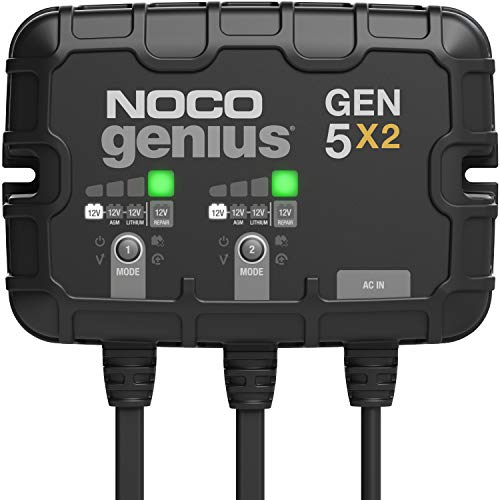
The GEN5X2 offers two independent charging banks with a combined 10 amps (5 A per bank). It’s engineered for marine environments and supports 12V AGM and 12V Lithium modes, plus a 12V Repair Mode. This model is ideal for boats, starters, and deep-cycle systems requiring separate charging channels and precise mode selection. Best for: Dual-battery setups on boats or vehicles where separate battery types need individual charging profiles.
Limitation: Slightly larger footprint than single-bank models; ensure installation space and mounting provisions meet your boat or vehicle’s requirements.
Genius GEN5X1: 1-Bank, 5A Onboard Charger
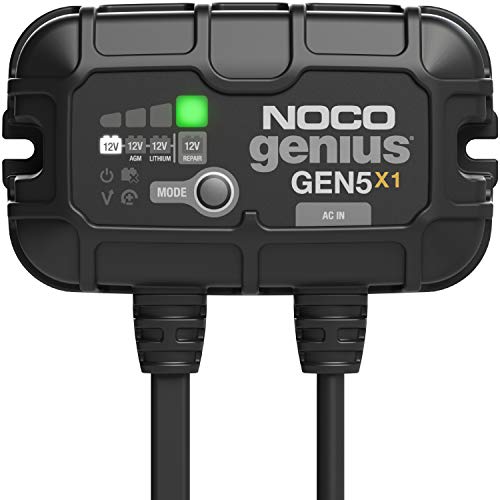
The GEN5X1 provides a compact, single-bank 5-amp onboard charger with modes for 12V lead-acid and lithium batteries, plus a 12V Repair Mode. It is suited for smaller power setups where space is at a premium and a single battery needs reliable maintenance and charging. Best for: Lightweight applications or auxiliary batteries in compact marine or RV setups.
Limitation: Only one bank means less flexibility for multi-battery systems or mixed battery chemistries in parallel installations.
Genius GENPRO10X2: 2-Bank, 20A Onboard Charger

The GENPRO10X2 delivers 20 amps total across two banks (10 A per bank) with selectable modes for 12V, 12V AGM, 12V Lithium, and 12V Repair Mode. It is designed for marine environments and supports independent charging of lead-acid and lithium batteries with precision. Best for: Higher-capacity boats or vehicles needing robust handling of two batteries with different chemistries. Caution: Confirm space for a larger two-bank unit and ensure proper wiring for both banks.
Genius GEN5X3: 3-Bank, 15A Onboard Charger
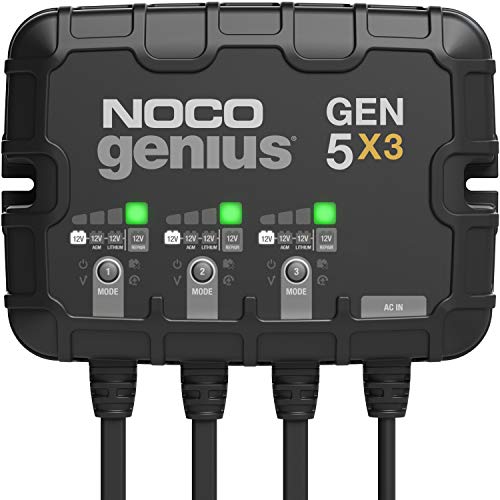
The GEN5X3 provides three independent banks totaling 15 amps (5 A per bank), with modes for 12V, 12V AGM, 12V Lithium, and a Repair Mode. It’s engineered for multi-battery setups in marine and deep-cycle systems, enabling precise maintenance across all connected batteries. Best for: Three-battery installations or complex boats requiring separate charge profiles. Limitation: Higher power needs and a larger footprint than single-bank options.
Buying Guide: Key Purchase Considerations
- Bank count and total amperage: Match the number of batteries and the required charging speed. More banks allow independent charging for different battery chemistries.
- Battery types supported: Ensure compatibility with lead-acid variants (AGM, Gel, flooded) and lithium (LiFePO4) if applicable.
- Charging modes: Look for selectable modes per bank (12V, AGM, Lithium) and a repair or desulfation feature for aging batteries.
- Temperature compensation: A built-in sensor helps prevent overcharging in heat and undercharging in cold environments.
- Mounting and installation: Direct-mount units require space near the battery and secure mounting provisions. Surface compatibility and mounting hardware matter for a durable setup.
- Environmental durability: Marine-rated or IP-rated units provide better protection against moisture and vibration in boats or vehicles.
- Maintenance features: Desulfation or desulfator capabilities can extend the life of old lead-acid batteries.
FAQ
- What is an onboard battery charger vs. a maintainer?
A: A maintainer keeps a fully charged battery at optimal voltage during storage, while a charger actively restores voltage after discharge. Some models combine both functions with smart desulfation and temperature compensation. - How many banks should I choose?
A: Choose based on your number of batteries and whether you need separate profiles for different chemistries. Two or three banks are common for boats with multiple batteries. - Do these units support lithium batteries?
A: Yes, many NOCO models include 12V Lithium modes and temperature compensation suitable for LiFePO4, in addition to lead-acid options. - Is mounting a charger under the hood or in a marine compartment safe?
A: Yes, when using a unit designed for automotive or marine use, with proper enclosure, ventilation, and secure mounting per manufacturer instructions. - Can I use these in extreme temperatures?
A: Most units include a temperature sensor and protective features, but always verify operating temperature ranges in the product specs. - Will these maintain a dead battery?
A: Some models offer a Recovery/Repair Mode to attempt reviving deeply discharged batteries, but success depends on battery condition.