Best Office Air Conditioning Systems for Small to Medium Spaces
Answering the demand for compact, energy-efficient cooling suitable for offices, homes, and shared workspaces. This guide highlights five compact cooling options that suit desks, break rooms, and small to mid-size offices. Each product is evaluated for ease of use, energy efficiency, and how well it handles dry or warm indoor air. The top picks are ideal for buyers who want portable cooling, quiet operation, or integrated heating alongside cooling. Below you’ll find a quick comparison and practical buying guidance tailored to office environments.
| Product | Best For | Key Advantage |
|---|---|---|
| EXNOS 3-in-1 Evaporative Air Cooler | Open-plan home offices | Wide-area airflow, 3 modes |
| Humuge Mini Air Conditioner | Desks & small spaces | 4-in-1 portability, quiet |
| Air Choice Swamp Cooler | Large desks & shared spaces | Large water tank, 120° oscillation |
| Arctic Air Pure Chill 2.0 | Personal cooling | Hydro-Chill, energy efficient |
| MRCOOL 12000 BTU Mini Split | Small offices with heating needs | Inverter, heating and cooling |
EXNOS 3-in-1 Evaporative Air Cooler
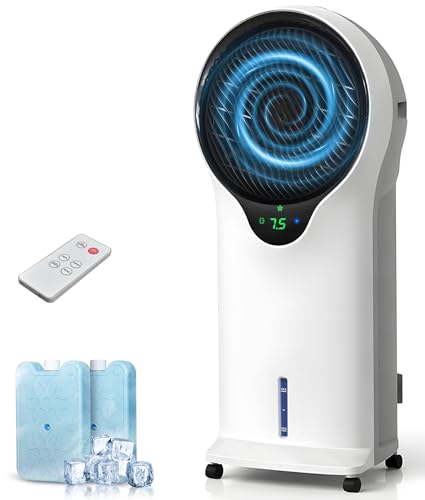
Best for: Open-office layouts or breakout areas where wide airflow is beneficial. This unit uses evaporative cooling and has 360° adjustable airflow for even coverage. It combines a fan, humidifier, and cooler in one, with three speeds and three modes to tailor comfort for busy workdays.
Why selected: High-efficiency evaporative technology and a low power draw (110W) help reduce energy use in office settings. The 360° airflow and multiple modes support both quick relief from heat and sustained comfort during long work sessions.
Limitation to consider: Best suited for dry or moderately dry environments; its cooling effect relies on evaporation, which can be less effective in very humid spaces.
Humuge Mini Air Conditioner

Best for: Personal cooling at a desk or on a small workstation. This 4-in-1 unit serves as a portable AC, humidifier, desk fan, and ambient LED night light, offering flexible use in a compact form.
Why selected: The compact footprint and USB-C power compatibility enable easy use in office cubicles or student desks. Quick ice/water setup accelerates cooling, which helps during short or intense heat spells.
Limitation to consider: Primarily a personal-space cooler; cooling area is limited compared with larger evaporative towers or mini-splits.
Air Choice Swamp Cooler

Best for: Medium to large office spaces, conference rooms, or shared areas that require longer cooling durations and broad air distribution. It includes a large water reservoir and multiple ice packs for enhanced cooling.
Why selected: 120° oscillation and a 5.5-gallon tank enable extended operation with less frequent refills. It offers a robust, humidifying 3-in-1 action suitable for dry indoor air.
Limitation to consider: It is not a traditional compressor-based AC and does not provide precise room temperature control. It’s best where open airflow and added humidity are acceptable.
Arctic Air Pure Chill 2.0

Best for: Personal or small-space cooling with a compact footprint. This unit emphasizes portability and low energy use while providing targeted cooling and humidification.
Why selected: Hydro-Chill technology and dual cooling jets offer efficient, localized cooling without high energy consumption. It is ideal for desks, small offices, and travel-friendly setups.
Limitation to consider: Not designed for cooling larger rooms; effects are more pronounced at the immediate vicinity of the unit.
MRCOOL 12000 BTU Mini Split

Best for: Small offices or workspaces that require year-round climate control with both cooling and heating capabilities. This wall-mounted unit is a compact, inverter-driven mini split.
Why selected: Inverter technology supports smooth temperature changes with energy efficiency and quiet operation. The system is suitable where heating is desired alongside cooling for shoulder seasons or year-round use.
Limitation to consider: Installation is more involved than portable units and may require professional setup for best performance in office spaces.
Buying Guide
How to choose the right office cooling solution involves space size, humidity, noise tolerance, and energy goals. Consider these practical questions.
- What space will the unit serve? For open-plan offices or large desks, prioritize higher airflow and larger tanks or coverage ranges. For personal desks, choose compact, quiet units.
- Is humidity control important? Evaporative coolers add moisture; humid environments may benefit from dehumidified options or traditional AC.
- Do you need heating alongside cooling? If year-round comfort is a goal, consider a mini-split or a unit with heating functions.
- What is the power source? USB-C or battery-powered options offer desk-friendly flexibility; plug-in models may require outlet access but often deliver stronger cooling.
- How important is noise level? Office work can be disrupted by loud devices; look for low-noise ratings or desk-appropriate quiet modes.
- Maintenance and refills: Tanks that are easy to refill and clean reduce downtime and operational costs in busy offices.
Practical considerations by scenario
- Open-plan offices: Favor evaporative coolers with wide airflow and large tanks for sustained comfort.
- Shared spaces: Look for configurable fan speeds and modes to accommodate varying comfort needs.
- Desks and cubicles: Personal or mini units with flexible mounting or portability work best.
FAQ
- Do evaporative coolers work well in humid environments? They are most effective in dry or moderately dry spaces. In high humidity, cooling may be less noticeable.
- Are mini split systems suitable for office use? Yes, especially where year-round climate control is needed and installation is feasible.
- Can these units replace central air in an office? They can supplement cooling in smaller spaces but may not replace central AC for whole-floor cooling.
- Is energy efficiency a priority? Look for models with low wattage, inverter technology, and energy-saving modes to minimize costs.
- What maintenance is required? Regular tank cleaning, water replacements, and filter or pad checks help sustain performance.