Best Marine Automatic Charging Relay Systems for Dual Battery Boats
The best marine automatic charging relay (ACR) keeps your boat’s primary and auxiliary batteries charging efficiently, so you’re ready to start engines and power electronics without manual switching. This guide compares five top ACRs and dual-battery isolator kits, highlighting who each product is best for, their key strengths, and any notable limitations. It helps boaters choose the right auto-charge relay for small saltwater craft, fishing boats, cruisers, and RV/boat combinations that rely on reliable battery management.
Buyer’s quick reference table
| Product | Best For | Key Benefit | Notable Limitation |
|---|---|---|---|
| Blue Sea 7611 Auto Charge Relay | Medium boats needing high current | 120A continuous rating for robust operation | Limited to 12/24V systems |
| VEVOR Split Charge Relay Kit | DIY installers; multiple battery setup | Includes complete accessories; easy installation | Plastic body may vary in ruggedness vs metal |
| Blue Sea 7610 SI-ACR | Engineered isolations for larger systems | Temporary isolation protects electronics during cranking | Overhead wiring considerations on small boats |
| Blue Sea 7601 m-Series | Compact, space-constrained installs | Lightweight, 65A rating for smaller boats | Lower current rating than 120A models |
| Nilight 12V 140A dual battery isolator | Rugged, off-road marine and RV use | IP66 waterproof rating; strong dual-battery logic | May require additional mounting hardware in tight spaces |
The selections below focus on models with automatic charging logic, clear voltage thresholds, and practical installation features for boaters who want reliable start power and accessory running capability with minimal manual intervention.
Blue Sea Systems 7611 Auto Charge Relay

This 120 Amp continuous-rated ACR is designed for 12/24V DC auto-ranging input, making it suitable for mid-sized boats with two battery banks. Best for boaters who run essential electronics and require a strong relay to manage charging between house and starting batteries. The product’s 12/24V compatibility supports common marine electrical setups. A limitation is its fixed input range, which may require compatibility checks with non-standard systems.
VEVOR Split Charge Relay Kit

Best for DIY installers who need a complete, ready-to-use dual battery isolator with two batteries charging in tandem. The kit includes necessary accessories and detailed instructions, designed to cut in at 13.3 volts and cut out at 12.8 volts to protect the starting battery. It supports two batteries simultaneously and isolates them when the engine is off. A potential drawback is the plastic housing, which may be less rugged in harsh offshore environments than metal housings.
Blue Sea Systems 7610 SI-ACR Automatic Charging Relay
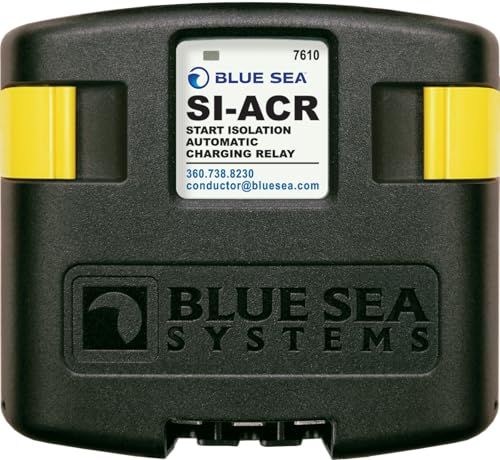
Best for boats needing protective isolation during engine cranking. This model provides temporary isolation of house loads from the engine circuit, helping prevent voltage drops during starting. It accepts 12/24V inputs and uses hermetically sealed contacts for vapor-proof operation. A caveat is the need for careful wiring to maintain reliability in rough sea conditions.
Blue Sea Systems 7601 m-Series Automatic Charging Relay

Best for compact installations where space is at a premium. The 65A output suits smaller boats or RV setups with lighter accessory loads. The product is lightweight and compact, but its current rating is lower than high-capacity models, so choose this when the demand is modest and space is limited.
Nilight 12V 140A Dual Battery Isolator

Best for rugged marine and RV use with dual battery capability. It uses a voltage-sensitive relay to start charging the secondary battery when the engine is running, ensuring both batteries stay charged. It features an IP66 rating, which is beneficial for off-road or wet marina environments. A limitation is that some users may need to verify compatibility with their specific alternator and vehicle electrical system.
Buying Guide: Key Considerations For Marine Automatic Charging Relays
What voltage and amperage do you need? Choose a unit sized for your boat’s total auxiliary load and engine starting requirements. Higher amperage models handle larger electrical draws but may require more space and heavier wiring.
How will the relay be installed? Look for kits with complete mounting hardware and clear wiring diagrams. Some models offer manual control or remote switching options, which can be useful for service accessibility on deck or in the cabin.
What about protection and durability? Sealed or vapor-proof contacts help prevent corrosion in saltwater environments. Consider IP ratings and housing materials (plastic vs. metal) based on exposure, vibration, and mounting location.
Is isolation important for you? A good ACR should prevent discharge of the starting battery during engine-off conditions while allowing a robust charge to the house or auxiliary bank when running.
Future needs and expandability matter. If you plan to add another battery or heavier electronics, pick an ACR with a higher amperage rating or modular options that can grow with your system.
Frequently Asked Questions
- What does an automatic charging relay do? It automatically connects and disconnects two battery banks to optimize charging and protect starting and auxiliary batteries.
- What voltage range is typical for marine ACRs? Most marine ACRs support 12V or 24V systems, with auto-ranging inputs in several models.
- Do I need a separate isolator kit? If you want to charge two batteries independently from one alternator, a dual-battery isolator or ACR is recommended.
- Can I install these myself? Many kits are designed for DIY installation with provided accessories and instructions; however, assess your electrical skills and safety.
- Which is better for rugged use: plastic or metal housings? Metal housings are often more rugged; plastic housings can be adequate in protected or indoor areas but may show wear in harsh environments.
- Do these devices affect engine cranking? Some models include protections to prevent engine cranking interruptions by isolating loads during starting.