Best Nema 14-50 to J1772 Cable EV Chargers for Home Charging
Direct, reliable Level 2 charging is essential for daily EV use. This guide highlights five top NEMA 14-50 plug EV chargers with J1772 connectors, designed for North American J1772 vehicles and compatible adapters where noted. Each option targets a different buyer: homeowners seeking straightforward plug-and-play charging, road-trippers needing longer reach, or tech-minded users who want app control and adjustable amperage. Below is a quick summary and a table of the featured models to compare key points at a glance.
| Product | Best For | Max Amps | Cable Length | |
|---|---|---|---|---|
| AIMILER Level 2 EV Charger | Homeowners needing flexible amperage | 32 | 25 ft | App control; J1772; 6X faster than Level 1 |
| ELEGRP Level 2 EV Charger | Great balance of price and features | 40 | 25 ft | ETL certified; multi-current levels |
| TLE LEVEL Level 2 EV Charger | DIY-friendly, compact setup | 40 | 25 ft | LED display; off-peak scheduling |
| Lectron Level 2 EV Charger | Reliability with universal safety features | 40 | 16 ft | ETL certified; IP65 listed |
| DREAMDASH Upgraded Level 2 EV Charger | High-speed charging with smart controls | 40 | 25 ft | IP66; LCD/APP control; wide compatibility |
AIMILER Level 2 EV Charger

This charger uses a NEMA 14-50P plug and provides an adjustable current up to 32A on 240V. It includes a J1772 connector suitable for most North American EVs and PHEVs, with a note that Tesla or NAC-connector vehicles require an adapter. It emphasizes safety with ETL certification and compliance to SAE J1772 and UL standards. Best for buyers who want a portable, app-controllable charger that can operate on a 20–40A circuit.
- Best for: EV owners who want flexible amperage (16–32A) and portable 240V charging.
- Why selected: Combines a familiar plug, J1772 compatibility, and adjustable current for different circuit capacities.
- Caution: Not compatible with Tesla’s own connector without an adapter; slower charging on some 110V adapters.
ELEGRP Level 2 EV Charger

The ELEGRP charger delivers up to 9.6 kW at 240V with five current settings (16/20/24/32/40A). It uses NEMA 14-50 for easy plug-and-play, and includes a 25-foot extension cable. ETL certified and featuring ELEGRP’s PBE protection for overheat and multi-layer safety systems. Best for households that want to maximize charging speed without upgrades to electrical panels.
- Best for: Homes needing faster charging while preserving circuit safety.
- Why selected: 40A capability, built-in safety features, and long reach for garages or driveways.
- Caution: May require a 40A circuit to reach 9.6 kW; ensure compatible electrical panel rating.
TLE LEVEL Level 2 EV Charger

This model provides 9.6 kW charging at 40A with a 25-foot cable and a NEMA 14-50 plug. It emphasizes DIY-friendly setup, enabling users to plug into common 240V outlets without hardwiring. The LED display and scheduling feature allow off-peak charging. Best for homeowners who want straightforward, self-service installation and a clear user interface.
- Best for: DIYers who prefer simple plug-in installation and scheduling.
- Why selected: Clear LED interface, flexible current settings, and 60-second garage setup claim.
- Caution: Not all EVs may reach full 40A; verify vehicle compatibility and circuit capacity.
Lectron Level 2 EV Charger

Lectron’s charger is ETL certified and uses a 40A J1772-compatible system with a 16-foot extension cord. It emphasizes safety with FCC and ETL certifications and IP65 protection for dust and water resistance. A good choice for users who value safety certifications and compact cable length for smaller garages or parking spots.
- Best for: Users prioritizing safety certifications and durable construction.
- Why selected: Reliable protection features and a compact 16 ft reach for tight spaces.
- Caution: Shorter cable length may require vehicle positioning adjustments in some setups.
DREAMDASH Upgraded Level 2 EV Charger
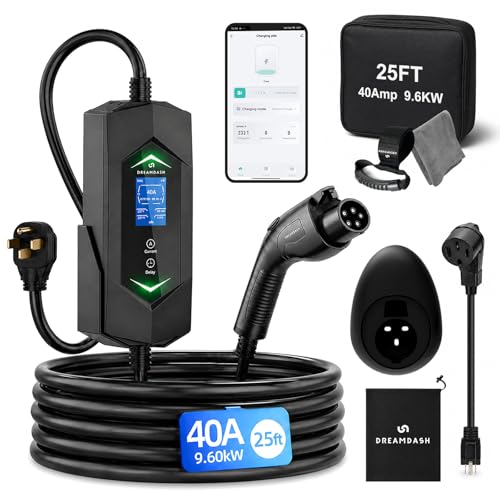
The DREAMDASH charger features a 40A output, 9.6 kW charging at 240V, and a NEMA 14-50 plug. It supports app and plug-and-play control, adjustable current via LCD or APP, and an IP66 rating for weather resistance. It clearly targets users wanting fast charging, smart features, and robust build quality. Best for users who need strong performance in varying weather conditions.
- Best for: Mixed environments needing weather resistance and smart control.
- Why selected: 9.6 kW capability with app control and wide safety certifications.
- Caution: Not compatible with Tesla models that require different adapters without J1772 compatibility tools.
Buying Guide: Key Questions For Your NEMA 14-50 To J1772 Charger Choice
- What charging speed do you truly need at home? If you drive daily, a 32–40A unit can significantly reduce charge times compared with Level 1 or slower Level 2 options.
- Does your electrical panel support a 40A circuit? Verify the available capacity and whether upgrades are necessary before selecting a charger.
- Is a long extension cable important for your setup? Consider 25 ft vs shorter lengths for garage layouts and driveway parking.
- Do you need app control or scheduling? If yes, prioritize models with mobile apps and off-peak charging features to maximize savings.
- Which vehicles require adapters? Most J1772 EVs are supported, but Tesla models or NAC connector cars may need adapters or different connectors.
- Are weatherproofing or outdoor use a factor? IP66 or IP65 ratings provide better protection in harsher environments.
Frequently Asked Questions
- Can I plug a J1772 charger into a NEMA 14-50 outlet? Yes, most Level 2 EV chargers use a NEMA 14-50 plug to connect to 240V outlets found in garages and RV parks.
- Will these chargers work with Tesla vehicles? Tesla cars typically require a J1772 to Tesla adapter for charging with J1772 connectors.
- What amperage should I choose for my charger? Choose the highest amperage your electrical circuit and vehicle will support to maximize charging speed, commonly 32A or 40A.
- Are these chargers safe for outdoor use? Some models include IP ratings or weather-resistant housings; check the product page for exact protection ratings.
- Do these chargers require professional installation? Most are plug-and-play, but always follow local electrical codes and manufacturer guidelines; some setups may benefit from professional inspection.
- Can I program charging to off-peak hours? Several models offer scheduling features via LCD or mobile apps to reduce costs and stress on the grid.