Best Stand-Alone Access Control Keypad Systems for Doors
Discover the top stand-alone access control keypads designed to secure entrances with keypad, RFID, or card options. This guide highlights five reliable options with weatherproof builds, Wiegand interfaces, and user capacity up to 2000. Each product section includes key features, installation notes, and compatibility details to help you choose the right system for homes, offices, or small businesses.
Product Comparison at a Glance
| Product | Brand | Key Features | User Capacity |
|---|---|---|---|
| Retekess T-AC03 Security Access Control Keypad | Retekess | Wiegand 26-bit, standalone reader, weatherproof, backlight, 0-99s relay | 2000 |
| Wireless WiFi Access Control Keypad | AMOCAM | TUYA app, multiple unlock methods, weatherproof, backlight | 2000 |
| Door Access Control System Stand-Alone | AMOCAM | 5 keyfobs, 2000 users, weatherproof, simple setup | 2000 |
| Waterproof Stand Alone Access Control Keypad | BSTUOKEY | Wiegand 26, zinc alloy, anti-vandal, 0-99s relay | 2000 |
| HFeng Standalone IP68 Keypad | HFeng | IP68 rainproof, 2000 users, card/password options | 2000 |
Notes: All models support standalone operation without a dedicated computer, and most offer LED indicators, backlighting for night use, and 12V or similar power requirements. Consider mounting location (indoor vs outdoor), weatherproof needs, and whether you require keyfobs or app-based management when selecting a unit.
Retekess T-AC03 Security Access Control Keypad
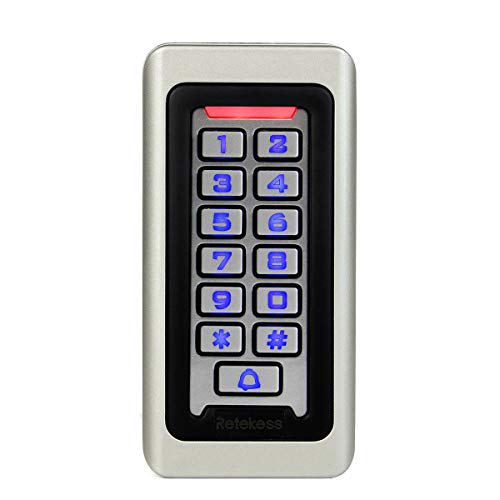
The Retekess T-AC03 is a rugged stand-alone keypad designed for both indoor and outdoor usage. Its zinc alloy construction and epoxy-encapsulated circuit board ensure weather resistance, making it suitable for exterior doors. Front-panel backlighting helps operation in low light, with indicator lights to differentiate modes. It supports a Wiegand 26-bit interface and offers a configurable door relay time from 0 to 99 seconds, enabling straightforward door control without external hardware.
AMOCAM Wireless WiFi Access Control Keypad

AMOCAM’s wireless keypad integrates with a TUYA-based app for remote management, password and ID card handling, and access logs. It ships with five ID key fobs and supports up to 2000 users. Its zinc alloy body with epoxy encapsulation provides weather resistance for outdoor mounting. The device features continuous backlight for nighttime visibility and is designed to work with various electric locks, gates, and doors via a standard door sensor and power interface.
AMOCAM Door Access Control System Stand-Alone

This standalone system emphasizes simple setup with full keypad programming and a robust zinc alloy case. It supports up to 2000 users and includes five proximity key fobs. The rugged housing and epoxy encapsulation are designed for both indoor and outdoor use, providing reliable operation in challenging environments. Users can manage access via cards, passwords, or a combination, depending on configuration and lock compatibility.
BSTUOKEY Waterproof Stand Alone Access Control Keypad

BSTUOKEY’s waterproof keypad features a zinc alloy shell with anti-vandal and anti-explosion properties. It supports up to 2000 users and uses a Wiegand interface when integrated with other security components. The unit includes a 0-99 second relay delay to control door opening and can operate with a powered device without requiring intermediary computing hardware. The backlit keypad provides visibility in dim conditions.
HFeng Standalone IP68 Waterproof Keypad

HFeng offers an IP68-rated keypad suitable for harsh outdoor environments. It supports up to 2000 users and provides card, password, or card-plus-password access methods. The unit is designed for simple standalone operation and includes a durable metal case with a blue backlight for easy use at night. Installation is straightforward, with no computer required for basic configuration and management.
Buying Guide
Key purchase considerations for stand-alone access control keypads include:
- Weatherproof rating: If the unit will be outdoors, prioritize IP68 or equivalent sealing for rain and dust resistance.
- Power and wiring: Confirm power requirements (DC12V is common) and whether the device supports battery backup in case of outages.
- Access methods: Decide between keypad-only, card/proximity, or mixed modes, and ensure compatibility with your existing locks or door controllers.
- User capacity: Choose a model that accommodates your current and anticipated future users (2000 is a common max in this category).
- Management features: Some models offer remote management via mobile apps (e.g., TUYA), while others are fully standalone with keypad programming only.
- Security features: Look for anti-tamper, anti-vandal design, and clear LED indicators; some units include tamper alarms or alarm outputs.
- Installation environment: Indoor vs outdoor mounting, surface mounting versus flush mounting, and compatibility with gate or door types.
When evaluating options, compare total cost of ownership, including potential accessories (fobs, cards, or mounting equipment) and any required door hardware (electric strikes, door sensors, or relays). Consider your preferred management approach—local keypad programming or app-based administration—to ensure the system fits into your security workflow.