Best MpO 24 Fiber Cable Solutions for Dense Data Center Deployments
Answering the need for high-density, low-loss fiber connectivity, this guide highlights 24-fiber MPO/MTP cables that suit data centers, enterprise networks, and high-performance computing environments. The top five products below are chosen for versatility, compatibility with popular transceivers, and clear performance characteristics. Best for data center cabling planners, network engineers, and technicians seeking scalable, multi-fiber solutions.
| Product | Core Benefit | Typical Use |
|---|---|---|
| VANDESAIL MPO to MPO Cable | Low insertion loss, OM3, high density | QSFP+/QSFP28 short-reach links |
| OPFI MPO Fiber Cable | OM4 performance, plenum rated | 40G/100G transceivers in data centers |
| AMPCOM MPO to MPO Trunk Cable | OS1/OS2 singlemode option, LSZH | Longer runs with safety compliance |
| Tripp Lite MTP / MPO Patch Cable | High-density 24-fiber Aqua cable | High-density fiber chassis links |
| Invaxing MTP/MPO to MPO Cable | Ultra-high density OM4, low loss | 400G/800G parallel optics |
VANDESAIL MPO to MPO Fiber Cable, 0.9M

Best for high-speed, short-reach data center links requiring dense port layout. This 12-core OM3 MPO-to-MPO cable supports QSFP+ and QSFP28 transceivers with low insertion loss (≤0.35dB) and a 850/1300 nm wavelength. The LSZH aqua jacket offers safer installation in crowded racks. Type B polarity suits most standard MPO setups. Available lengths extend from 1m to 15m for flexible planning.
Who this is for: network engineers building dense server-to-switch interconnects in data centers or cloud facilities. Why selected: combines high-density 12-core MPO with proven OM3 performance and QSFP compatibility in a compact, safe jacket.
Caution: While designed for short-reach deployments, consider total run length and bend radius in tight cable trays to maintain low loss across all fibers.
OPFI MPO Fiber Cable, 12 Fibers, OM4, Magenta

Best for longer reach and higher performance in modern data centers. This 12-fiber MPO-to-MPO cable uses OM4 fiber for greater distance capabilities and better bend tolerance. It is compatible with 40G QSFP+/100G QSFP28 transceivers and features a low insertion loss design (0.35dB) and plenum-rated OFNP fire safety credentials. The Type B polarity aligns with standard MPO setups in most installations.
Who this is for: facilities upgrading to OM4-based parallel links or needing improved reach without replacing transceivers. Why selected: OM4’s longer reach and robust bend tolerance provide advantages over older OM3 paths in dense racks.
Caution: Ensure compatibility with older MPO terminations in mixed environments to avoid connector mismatch in non-standard OEM configurations.
AMPCOM MPO to MPO Trunk Cable 24 Fiber, OS1/OS2

Best for longer, backbone-style connections that require singlemode performance. This 24-fiber MPO-to-MPO trunk uses a Type B polarity and an LSZH/Riser jacket with UPC/FOCIS-5 compliance. It’s designed for OS1/OS2 single-mode deployments, making it suitable for long-distance links between core network devices where low attenuation is crucial.
Who this is for: data center corridors or campus networks migrating to single-mode MPO trunks. Why selected: provides solid single-mode performance with fire-safe jacket and recognized standards compliance.
Caution: This is a single-mode solution; ensure your transceivers and fiber type match for optimal results.
Tripp Lite MTP/MPO Patch Cable, Aqua 2M
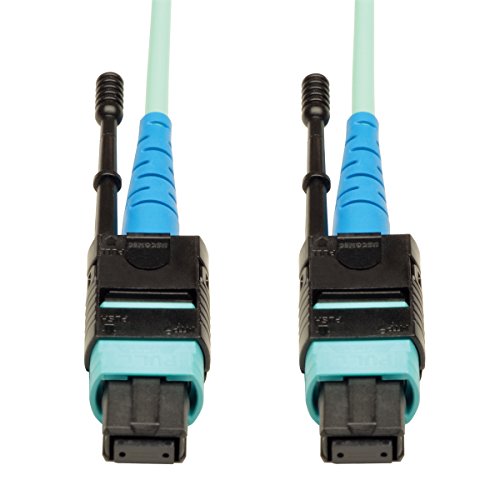
Best for quick, high-density fiber interconnects in a small footprint. This aqua MTP/MPO patch cable supports 24 fibers and is designed for rapid rack-to-rack transitions without bulky fan-out sections. It emphasizes density and ease of use in 100GBASE-SR10, CXP, and related parallel optics environments.
Who this is for: network technicians needing a compact, high-density patch solution in blade servers, switches, or aggregation points. Why selected: MTP/MPO push-pull connectors enable fast connections in tight spaces.
Caution: Plenum rating varies by model; verify installation space and local codes when used in air-handling spaces.
Invaxing MTP/MPO to MPO Cable, 24-Core OM4

Best for high-density, parallel optics deployments such as 400G SR8 and 800G SR4.2. This 24-fiber OM4 MPO-to-MPO cable emphasizes ultra-high density with low typical insertion loss (≤0.60dB) and robust bend performance, built on a laser-optimized multimode core for VCSEL transceivers.
Who this is for: teams designing large-scale parallel fiber networks or upgrading to higher-bandwidth optic paths. Why selected: higher fiber count per connector reduces the number of active cables and simplifies routing in dense racks.
Caution: For installations using longer runs, confirm the link budget and device compatibility to avoid loss accumulation across multiple hops.
Buying Guide
What to consider when choosing a 24-fiber MPO/MTP cable
Fiber type and performance: OM3, OM4, and single-mode options affect distance and bandwidth. Choose OM4 for longer reach and higher bandwidth; OM3 for cost-effective short-reach links in dense racks.
Jacket material and safety: LSZH jackets minimize smoke and toxicity in accidental fires, while plenum-rated jackets are required for air-handling spaces. Select based on installation path and code requirements.
Polarity and connector type: Type B polarity is common for MPO-to-MPO connections. Confirm polarity compatibility with your transceivers and patch panels to avoid miswiring.
Insertion loss and return loss: Lower insertion loss and higher return loss reflect better signal integrity. Use products with stated ≤0.35dB to ≤0.60dB typical insertion loss for high-density, short- to mid-range links.
Distance and bend tolerance: OM4 typically supports longer distances and tighter bends. Evaluate bend radii and tray layouts to prevent micro-bends and signal degradation.
Compliance and safety: Look for OFNP or LSZH ratings and adherence to IEC and TIA standards. This influences installation safety and regulatory compliance.
Future scalability: If planning to expand to 400G/800G, consider 24-fiber trunks and breakout options to simplify upgrades and reduce cable clutter.
Quick comparison checklist
- OM3 vs OM4: distance and bend tolerance differences
- Jacket: LSZH vs plenum-rated
- Polarity: Type B common; verify with equipment
- Insertion loss: target ≤0.35–0.60 dB
- Application: data center core, access/aggregation, or long-haul
FAQ
- What is MPO 24 fiber cable used for?
It enables high-density parallel fiber connections for multi-panel uplinks and parallel optics transceivers in data centers and enterprise networks.
- Which OM fiber is best for 400G or 800G?
OM4 supports longer distances and higher bandwidth, making it preferable for higher-speed parallel links.
- What does polarity Type B mean?
Type B polarity means a standard MPO-to-MPO wiring arrangement that matches most transceiver setups; verify with equipment documentation.
- Is LSZH jacket safer than plenum-rated?
LSZH minimizes toxic fumes in a fire, while plenum-rated jackets meet fire codes for air ducts; choose based on installation location.
- When should I use a breakout MPO-to-LC cable?
Use breakout cables to connect a single MPO interface to multiple LC duplex ports, often in rack density or edge fabric interconnects.