Best Mini Grid Tie Inverters for Small Solar Setups
Discover compact grid-tie inverters that maximize solar output for small systems. This guide highlights five suitable options, detailing who each is best for, key specs, and practical considerations. Perfect for DIY solar enthusiasts, cabin setups, or backup systems where space and budget matter.
The following table compares the selected products to help you choose quickly:
| Product | Best For | Key Range | Best Use Case | Limitation |
|---|---|---|---|---|
| Y&H 350W Grid Tie Micro Inverter MPPT Solar Input | Small 24–42V panels | 24–42V | Compact 350W array | Max panel power 350W |
| Y&H 180W MPPT Grid Tie Micro Inverter | 12V systems with MPPT efficiency | 16–21V | Lower-voltage solar panels | Lower power ceiling |
| Y&H 600W 30V/36V Grid Tie Inverter | Moderate 36V panels, stackable setups | 30–36V | Stackable or larger 36V arrays | DC input guidance critical |
| HIPUDNLM 1000W Grid Tie Inverter | Higher power with cooling | 10.8–30V DC input | Mid-scale 18–24V panels | Cooling needed at high load |
| POWLSOJX 180W/700W Grid Tie Inverter Family | Versatile MPPT with battery options | 18–50V | Hybrid-like setups or battery-ready systems | Check compatibility with batteries |
Y&H 350W Grid Tie Micro Inverter MPPT Solar Input

Best for: Small prefabricated solar kits or DIY projects using mid-range 24–42V panels. This model uses MPPT to optimize energy capture from panels with Vmp in the 30–42V range, while staying under 350W. Choose this if your system is compact and you want straightforward grid-tie operation.
Best for: Users prioritizing a simple plug-and-play, with clear MPPT guidance for panel voltage. Limitation: Maximum output remains 350W, so larger arrays should use higher-capacity inverters.
Y&H 180W MPPT Grid Tie Micro Inverter PV Input DC16-26V

Best for: Small 12V solar panels or low-voltage arrays needing efficient MPPT. This unit targets PV inputs around 16–21V and outputs standard grid voltage. It is ideal for compact setups or educational projects.
Best for: Low-voltage systems seeking reliable MPPT performance. Limitation: Lower power ceiling at 180W, not suited for larger roof arrays.
Y&H 600W 30V/36V Grid Tie Inverter

Best for: 36V solar panel systems that need a robust but compact grid-tie solution. The product describes a 30–36V working window with DC input 22–60V, making it important to keep panel matching in the MPPT range.
Best for: Those planning stackable or multi-panel configurations. Limitation: Inverter’s starting voltage is 30V, so DC inputs below that aren’t viable.
1000W Grid Tie Inverter, 10.8-30V DC Input

Best for: Mid-size systems using 18–24V panels, where higher efficiency and cooling support are valuable. This model emphasizes robust cooling and durable construction for longer operation in varying environments.
Best for: Projects requiring stronger performance without stepping up to very high-voltage inputs. Limitation: Lower voltage range means panel choices must be matched accordingly.
POWLSOJX Micro Grid-Tie Inverter with Battery Storage
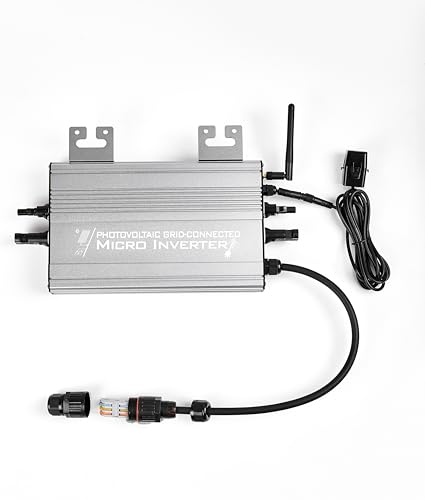
Best for: Systems needing multiple connection modes and battery integration. This unit supports six modes to connect batteries and PV panels, offering flexibility for hybrid-like operation and energy storage.
Best for: Users seeking robust MPPT performance to capture maximum solar output. Limitation: Battery storage features require careful configuration and may require additional components.
POWLSOJX Solar Grid Tie Micro Inverter MPPT Smart Micro PV System

Best for: Versatile micro inverters with a wide MPPT range (18–50V), suitable for mixed-panel setups or future expansions. The unit emphasizes a high-efficiency MPPT algorithm for improved energy harvest.
Best for: Systems needing reliable pure sine wave output and stable performance. Limitation: Ensure panel voltage stays within 18–50V to maintain MPPT accuracy.
YINZINR 1000W Grid Tie Inverter for 36V Solar Panel

Best for: 36V panel systems that require high power with strong efficiency. The unit emphasizes a high-quality aluminum alloy chassis and MPPT technology to stabilize the maximum power point.
Best for: Users prioritizing durable construction and consistent energy conversion. Limitation: Higher voltage and power demand mean panel and wiring must be appropriately sized.
Buying Guide
What should you consider when choosing a mini grid-tie inverter?
- Panel voltage and MPPT range: Match your solar panel’s Vmp to the inverter’s MPPT window for optimal efficiency.
- Power rating vs. system size: Select an inverter with a power rating that comfortably exceeds your expected peak output to avoid clipping.
- Input voltage range and battery compatibility: If you plan to use batteries or future expansion, choose models that offer flexible connection modes.
- Cooling and enclosure: Higher-power units benefit from good cooling; consider enclosures rated for outdoor use if your installation is exposed.
- Installation environment: Indoor vs. outdoor installation, weather resistance, and mounting options influence longevity and safety.
- Future expandability: If you anticipate adding more panels or batteries, opt for scalable solutions or models with flexible connection modes.
Frequently Asked Questions
- What is a grid-tie inverter used for?
It converts solar DC into AC and synchronizes with the grid, allowing surplus energy to be fed back to the utility or used within a connected system.
- Do I need batteries with a grid-tie inverter?
Most grid-tie inverters do not require batteries. Some models offer battery storage options for hybrid setups.
- What happens if panel voltage is outside the MPPT range?
Efficiency drops, and in some cases the inverter will not operate correctly or could be damaged.
- Can I use these inverters for off-grid applications?
Typically not ideal for off-grid without a grid reference, as they are designed to synchronize with the grid.
- How important is cooling for grid-tie inverters?
Cooling helps maintain performance and longevity, especially in high-load or hot environments.