Best Mid West RV Lithium Batteries for Reliable Off-Grid Power
Answering the demand for durable, space-efficient power in American RV setups, these midwest-friendly lithium options deliver long cycle life, safety protections, and scalable configurations. Ideal for RV owners who travel through flat plains, forested routes, and wider horizons, each selected product targets different use cases—from compact, lightweight packs for smaller rigs to high-capacity banks for full-time off-grid living. Below is a quick look at five strong contenders and who they’re best for.
| Product | Best For | Key Benefit |
|---|---|---|
| GRNOE 2 Pack 12V 100Ah LiFePO4 | Small to mid-sized RVs, boats | Expandable 4S4P up to 20.48kWh |
| SUPER EMPOWER 12V 100Ah 2 Pack | Auxiliary house power, trolling motors | Long cycle life, robust BMS |
| Dyness 12V 100Ah LiFePO4 (2 Pack) | Compact, space-conscious RVs | Lightweight, scalable with series/parallel |
| GOKWH 12V 320Ah LiFePO4 | Large RVs, off-grid systems | High capacity, 200A BMS, Bluetooth |
| Elefast 12V 330Ah LiFePO4 | High-capacity RVs and solar setups | Very large energy bank, Bluetooth & BMS |
GRNOE Two-Pack 12V 100Ah LiFePO4 for RVs
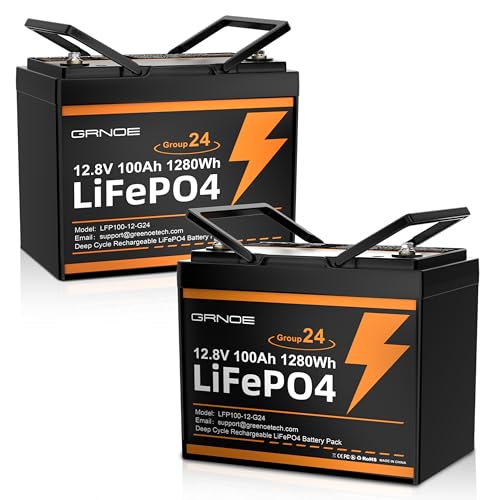
Features: Two Grade A+ LiFePO4 cells provide 15,000 cycles @60% DOD, with a built-in 100A BMS. Expansion to 51.2V 400Ah (20.48kWh) is possible by wiring in series and parallel, supporting growing energy needs in RVs or off-grid setups. It’s designed to withstand dust, moisture, and salt spray for harsh environments.
Best for: RV owners who want a scalable, maintenance-free solution with strong durability in wet or dusty Midwest conditions. The 4S4P expansion makes this a future-ready option as power demands rise. Caution: data indicates long-term cycles, but actual performance depends on charging discipline and ambient temperatures.
SUPER EMPOWER 12V 100Ah (2 Pack) LiFePO4 Battery
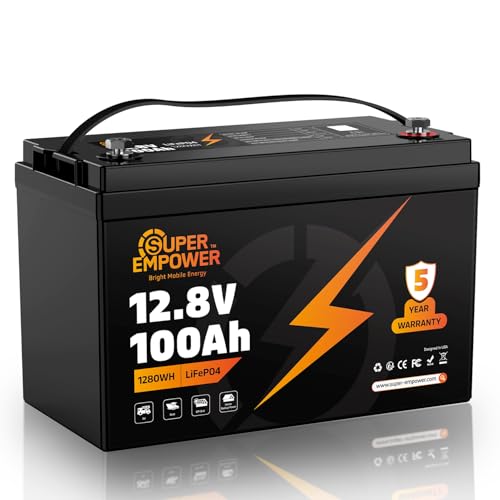
Features: Deep-cycle LiFePO4 with integrated 100A BMS protecting against overcharge, over-discharge, and short circuits. Long cycle life (up to 15000 cycles at 60% DOD in some variants) and a drop-in feel for RV and marine use. Not designed for engine starting; intended for energy storage and house power needs.
Best for: RV auxiliary power and off-grid setups where a balance of weight, space, and reliable cycling is required. Choose this if you want a straightforward, dual-battery pack that slots into standard battery compartments. Caution: suitability for high- draw starting needs is limited; better as energy storage than cranking power.
SUPER EMPOWER 12V 100Ah (2 Pack) Group 24 Drop-In

Features: Group 24 size, 100Ah capacity with BMS protection. Designed as a drop-in replacement for lead-acid setups in RVs, boats, or solar systems. Listed cycle life claims support thousands of cycles at partial DoD, with a lighter weight compared to lead-acid.
Best for: RVers upgrading older systems who want minimal changes to fit battery trays and boxes. Limitation: the 24-size dimension may require compatible housing; verify tray compatibility before swap.
Dyness 12V 100Ah LiFePO4 (2 Pack)

Features: A+ grade cells, up to 20.48kWh with 4S4P expansion. Low-temperature charging protection and a 100A BMS monitor charge, discharge, and temperature. Lightweight compared with lead-acid, designed for RVs and off-grid energy storage.
Best for: RVs where space savings and weight reduction are important, and where future expansion to larger banks is planned. Caution: ensure charger compatibility with lithium mode and temperature protections for cold Midwest mornings.
GOKWH 12V 320Ah LiFePO4 Battery

Features: 320Ah capacity with a built-in 200A BMS. Low-temperature protection helps prevent charging or operation in near-freezing conditions. Flexible charging options include LiFePO4 chargers, solar controllers, and DC generators. Bluetooth connectivity offers monitoring convenience.
Best for: Larger RVs or off-grid setups that require a substantial energy reserve and remote monitoring. Limitation: higher capacity models may demand more space and robust battery housing; ensure tray fitment and weight distribution.
Elefast 12V 330Ah LiFePO4 Battery

Features: Extra-large 330Ah capacity with built-in 200A BMS and Bluetooth app. Designed for RVs, solar, off-grid systems, and home backup, delivering a very large energy bank in a single unit. The BMS guards against overcharge, over-discharge, and temperature extremes.
Best for: RVs requiring a high-capacity, integrated monitoring solution for continuous power during extended trips. Caution: very large capacity translates to higher upfront weight and volume; verify installation space and weight limits.
Buying Guide: Key Considerations For Mid West RV Lithium Batteries
- Capacity vs. space: Determine daily energy needs. A 100Ah to 320Ah bank will handle different RV sizes and usage. For tight spaces, lighter 100Ah packs or compact 2-Packs may fit best.
- Expansion potential: If you plan to grow, choose batteries that support in-series and in-parallel expansion (e.g., 4S4P configurations) to scale up without replacing existing packs.
- BMS protections: Look for overcharge, over-discharge, short-circuit, temperature, and low-temperature protections. A robust BMS improves safety and longevity in varying Midwest climates.
- Temperature considerations: Cold-weather charging and operation can affect performance. Batteries with low-temperature protection help prevent charging in freezing conditions.
- Compatibility: Ensure compatibility with your charger (CC/CV for LiFePO4), solar controllers (MPPT/PWM in lithium mode), and existing battery boxes or trays.
- Weight and footprint: LiFePO4 cells are lighter than lead-acid, but higher-capacity models are heavier. Verify tray dimensions, mounting options, and weight limits for your RV.
- Monitoring features: Bluetooth or app-based monitoring helps track voltage, SOC, and health remotely—useful for midwest trips where access to service centers may be sparse.
- Durability and environment: Dust, moisture, and salt spray resistance are beneficial for RVs used near lakes, dunes, or muddy parks. Ensure the battery casing suits your typical terrain.
Frequently Asked Questions
- What is the typical lifespan of a LiFePO4 battery in an RV?
Answer: LiFePO4 batteries commonly offer thousands of cycles (often 5,000–15,000 cycles depending on depth of discharge and temperature). - Do I need a special charger for LiFePO4 in an RV?
Answer: Yes, use a LiFePO4-compatible charger with appropriate voltage (typically CC/CV at around 14.4–14.6V) for best results. - Can I mix different brands of LiFePO4 batteries in the same system?
Answer: Mixing brands is not recommended because different chemistry tolerances and BMS behavior can lead to uneven aging and safety concerns. - Is low-temperature protection essential for Midwest RV use?
Answer: Yes, low-temperature protection helps prevent charging in freezing conditions, protecting battery life. - What should I consider for space and weight when upgrading?
Answer: Compare tray dimensions and total weight of the bank; ensure chassis and compartments can safely carry the load while fitting your layout.