Best Reptile Thermostat and Humidity Control for Terrariums in 2026
Answering the top buyer questions: these reptile thermostats and humidity controllers help you maintain stable temps and humidity for reliable health in terrariums. Best fits: DIY hobbyists needing dual-zone control, beginners wanting simple one-button modes, and advanced keepers requiring Wi‑Fi access and precise scheduling. Below are five well-rounded options chosen for reliability, feature variety, and suitability for common reptile habitats. A quick buying table follows for side-by-side comparison.
| Product | Best For | Key Feature |
|---|---|---|
| Pymeter Dual Probe Thermostat | Dual zones, heat + cooling | Two independently controlled outlets with dual waterproof sensors |
| REPTI ZOO THC16 | Beginner and intermediate dependability | One-button tropical/desert modes, day/night schedules |
| BN-LINK Digital Thermostat | Simple setup, heating-only systems | Easy 3-button programming, clear indicators |
| briidea Smart WiFi Controller | App-based control, humidity included | 3-in-1 function: temperature, humidity, timer; dual-band Wi‑Fi |
| DIGITEN DHTC-1011 | Combined temp and humidity control | 2-in-1 sensor, dual relay outputs |
Pymeter Digital Temperature Controller Dual Probe

The Pymeter unit provides two independently controlled outlets, each capable of heating or cooling. It ships with two waterproof sensors, enabling dual-zone control—useful for separate heat mats or lamps across two tanks. Best for keepers who want precise, zone-specific regulation in two areas. A limitation is that the unit supports up to 1200W total across both outlets, so plan loads to avoid overtaxing the switchgear.
- Two separate outlets for independent control
- Two waterproof temperature sensors
- On/off setpoints for heating and cooling
REPTI ZOO THC16 Reptile Thermostat
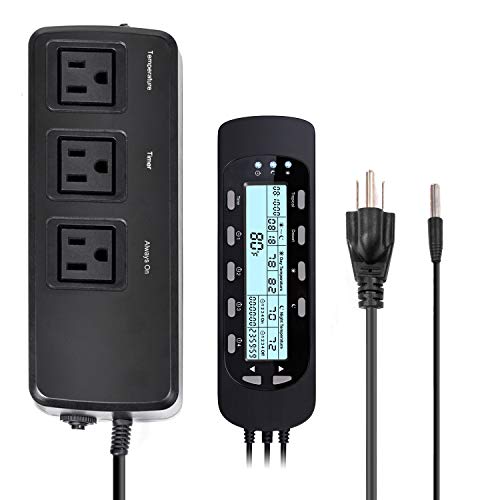
Designed for beginners and advancing hobbyists, the THC16 offers tropical and desert modes with day/night control and four timer periods. It’s easy to set up, supports a detachable waterproof probe for maintenance, and includes alarm indicators for extreme temperatures. Best for simple, reliable control when you want quick mode changes and strong memory retention in case of power loss. Be aware that more advanced programming exists in newer models, which may be overkill for casual setups.
- One-button tropical or desert mode
- Day/night temperature with four timer periods
- Detachable waterproof sensor probe
BN-LINK Reptile Thermostat Digital Controller

The BN-LINK controller is designed for heating devices like reptile mats and heat lamps. It emphasizes easy setup through three buttons and a clear LED indicator for status in low-light conditions. Best for hobbyists who want straightforward operation and a rugged build. Its limitation is intended use for heating devices only, meaning you should not rely on it for humidity or cooling control unless paired with separate equipment.
- Three-button setup with Fahrenheit/Celsius switch
- Bright display and indicator lights
- Rugged, durable plug-in design with a sensor probe
briidea Smart WiFi Temperature And Humidity Controller

This 3-in-1 device combines temperature and humidity control with a timer feature. It supports dual-band 2.4GHz/5GHz Wi‑Fi for remote monitoring and adjustment via an app, making it ideal for keepers who travel or want to monitor environments remotely. Best for homes or greenhouses where humidity tracking is as important as temperature. A potential drawback is reliance on Wi‑Fi; in unstable networks, remote control may lag or disconnect.
- App-based control with dual-band Wi‑Fi
- 3-in-1 design: temperature, humidity, timer
- Independent outlet settings via app or panel
DIGITEN DHTC-1011 Temperature And Humidity Controller
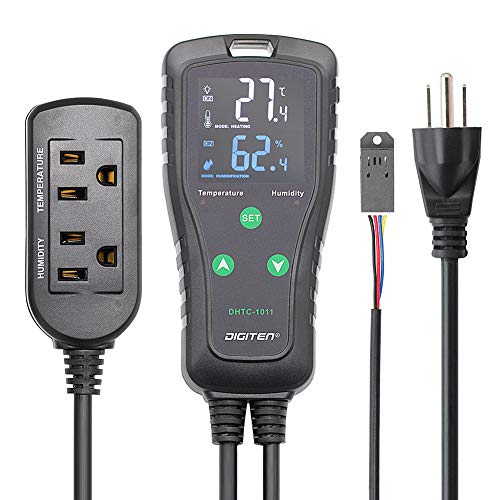
The DIGITEN DHTC-1011 provides a two-in-one sensor for temperature and humidity with dual relay outputs. It automatically starts cooling/heating and humidifying/dehumidifying based on configured parameters, helping maintain stable conditions for reptiles and greenhouses. Choose this if you need simultaneous temperature and humidity regulation with clear, logic-driven control. A caution is to verify power-handling limits to avoid overloading the relays when using high-wattage devices.
- -40℉~248℉ temperature range; 1%–100% RH humidity range
- Large LCD and straightforward 3-button setup
- Dual relay outputs for separate temperature and humidity control
Buying Guide
Key considerations when selecting a reptile thermostat and humidity controller:
- Scope of control: Do you need single-zone, dual-zone, or whole-tank regulation? Dual outlets and two sensors help with multiple zones.
- Humidity needs: Some setups require humidity tracking in addition to temperature. Look for models with hygrometers or external sensor compatibility.
- Power handling: Ensure the device can safely manage the wattage of your heat mats, lamps, or fans. Check total wattage limits and per-outlet capacity.
- Connectivity: If you travel or want remote monitoring, consider Wi‑Fi-enabled units with apps. Be aware of potential network reliability issues.
- Ease of use: Beginners benefit from one-button modes and clear indicators; advanced users may prefer programmable timers and memory features.
- Sensor placement: Waterproof or splash-resistant sensors help in terrarium environments; ensure probes are easy to replace or clean.
- Installation: Look for plug-and-play designs with clear wiring diagrams and included mounting options.
Frequently Asked Questions
- What is a reptile thermostat used for?
It regulates heating devices to maintain stable temperatures in terrariums, helping reptiles avoid temperature swings that can cause stress or illness.
- Why would I need humidity control for a reptile tank?
Humidity affects shedding, respiration, and overall health. Humidity control helps mimic natural environments for tropical or desert species.
- Is Wi‑Fi control necessary for reptile care?
Not strictly necessary, but it’s convenient for remote monitoring and scheduling if you travel or have multiple enclosures.
- Can I use a thermostat for both heat mats and lights?
Yes, but ensure the device’s specifications and outlets are suitable for both heating elements and electrical loads, and follow safety guidelines.
- What should I check before buying?
Check the temperature and humidity ranges, sensor reliability, dual-relay capacity, and whether the unit supports multiple zones or timers.
- Are these devices safe for long-term reptile care?
When used within device limits and with proper sensor placement and maintenance, they support stable environments necessary for reptile welfare.