Best Marine DC to DC Chargers for Boats and RVs
Answering the need for reliable battery charging while on the move, these marine DC-to-DC chargers are built to protect start batteries, optimize house battery life, and work with LiFePO4, AGM, Gel, and flooded types. The top picks here are best for boaters, RV travelers, and commercial marine operators who require safe, automatic charging with alternator compatibility. The list focuses on units with smart charging, isolation, and Bluetooth or app monitoring for easy optimization.
| Product | Key Strength | Best For |
|---|---|---|
| Renogy 40A DC-DC Charger | Smart, safe startup, easy setup | RVs and boats needing solid mid-range charging |
| Renogy 60A LiFePO4 DC-DC Charger | High current, LiFePO4 activation | Large battery banks on boats and RVs |
| Victron Orion-Tr Smart 30A | Bluetooth monitoring, isolation | Dual-battery systems with smartphone control |
| Victron Orion-Tr Smart 18A | Compact, efficient for smaller systems | Smaller dual-battery setups |
| Victron Orion-XS Smart 50A | High power, IP65, configurable | Power-hungry systems in harsh environments |
Renogy DC to DC Charger 12V 40A

Best for mid-sized battery banks on boats and RVs, this Renogy 40A charger features built-in alternator detection and intelligent charging strategies. It charges only when the engine runs, protecting the starter and the house battery. A compact, wall-mount design simplifies installation, and the internal layout minimizes the risk of short circuits in marine environments.
Who it’s best for: boat owners and RV users with LiFePO4, AGM, Gel, or flooded batteries who want automatic, engine-aware charging without constant supervision. The 2nd-generation design emphasizes safety by creating a safe distance between input and output terminals.
Limitation to note: While it supports a range of battery types, users should confirm compatibility with their exact battery model and alternator type before installation.
Renogy DC to DC Charger 12V 60A Lifepo4
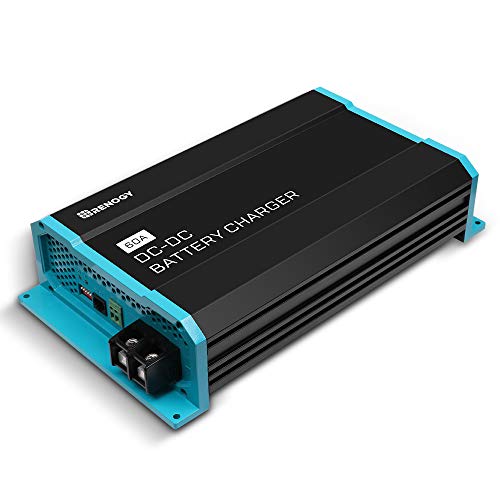
Best for larger house battery banks on yachts and heavy-use campers, this 60A Lifepo4 charger handles high-current demands with intelligent LiFePO4 activation. It supports multi-stage charging (bulk, boost, float) and includes protections such as over-voltage, over-temperature, and reverse polarity to keep both alternator and batteries safe.
Who it’s best for: users with large LiFePO4 or mixed chemistries who need a robust charger that can reliably fill a sizeable house battery bank while the engine runs. It’s a strong option when fast replenishment is a priority.
Limitation to note: Higher current means more heat; ensure proper mounting and ventilation in confined compartments to avoid thermal issues.
Victron Orion-Tr Smart DC to DC Charger 12/12V 30A

Best for dual-battery systems requiring reliable, smart charging with Bluetooth monitoring, this Orion-Tr 30A unit isolates input and output to prevent electrical interference. It supports a broad range of battery types and provides three-stage charging for safe, automatic replenishment while the engine runs.
Who it’s best for: boaters and RV owners who want seamless, smartphone-enabled control and clear data on charging status. It’s a balanced choice for moderate power needs and smart integration into existing electrical systems.
Caution: Bluetooth monitoring requires the VictronConnect app and compatible devices; plan for connectivity in areas with limited signal.
Victron Orion-Tr Smart DC to DC Charger 12/12V 18A
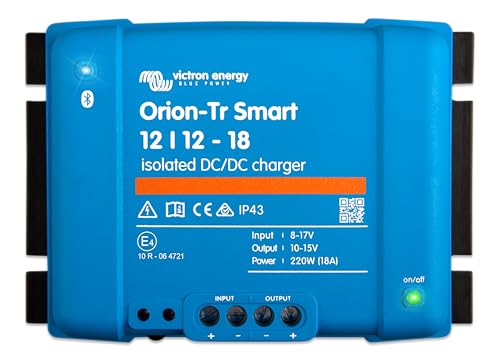
Best for smaller dual-battery setups, this 18A Orion-Tr unit delivers efficient, three-stage charging with isolation to prevent cross-talk between starter and house batteries. It’s compact and suitable for tight spaces on smaller boats or vehicles where space is at a premium.
Who it’s best for: owners with limited space and modest house battery draw who still want reliable engine-running charging with Bluetooth access for monitoring. It’s a compact solution that remains feature-rich.
Limitation: Lower current means slower replenishment for larger house banks; plan accordingly for daily energy use.
VEVOR 60A DC to DC Charger

Best for versatility across battery chemistries, this 60A on-board charger handles lead-acid and lithium varieties, including LiFePO4, AGM, Gel, and Flooded options. It uses smart multi-stage charging with isolation between input and output to minimize electrical interference in marine or RV applications.
Who it’s best for: users needing a broad compatibility range and a robust 60A charge rate in a single unit. It’s suitable for mid-to-large battery banks that require steady replenishment on the go.
Caution: Ensure the installation location supports adequate heat dissipation due to sustained high current during charging cycles.
Victron Orion-XS Smart DC to DC Charger 50A

Best for high-demand systems, this Orion-XS unit delivers up to 700W with 98.5% efficiency. It supports 12V and 24V systems, works across lithium, LiFePO4, lead-acid, AGM, and gel batteries, and includes configurable input and output currents. IP65-rated for dust and water resistance suits demanding marine environments.
Who it’s best for: operators with large house battery needs, mixed-voltage configurations, or harsh installations where robust protection and configurability are critical. It offers top-tier efficiency and resilience in a compact form.
Limitation: Higher feature set and power require careful setup; ensure correct configuration to prevent alternator overload and to maximize battery longevity.
Buying Guide
What should you consider when choosing a marine DC-to-DC charger?
- Battery type compatibility: Ensure the charger supports LiFePO4, AGM, Gel, and Flooded batteries as needed.
- Current rating: Match amperage to your house battery bank size. Higher capacities (40A–60A–50A) suit larger banks and faster replenishment.
- Alternator detection and engine-run sensing: Prefer models that only charge when the engine runs to protect the starting battery.
- Safety features: Look for over-voltage, over-temperature, reverse polarity, and input/output isolation to prevent cross-interference and damage.
- Protection and isolation: Isolated inputs/outputs help prevent electrical noise and potential faults from affecting other systems.
- Monitoring and control: Bluetooth or app connectivity (e.g., VictronConnect) provides visibility into charging status and adjustments on the go.
- Physical considerations: Space, mounting options (wall-mount, under-seat, etc.), and heat management are essential for marine installations.
- Environmental durability: IP ratings (like IP65) protect against dust and water exposure typical in boats and coastal environments.
Frequently Asked Questions
- What is a DC-to-DC charger used for on boats?
A DC-to-DC charger charges the house battery bank from the vehicle or boat’s alternator while the engine runs, protecting the start battery and maintaining ready-to-use power.
- Do I need Bluetooth monitoring on a marine charger?
Bluetooth monitoring helps with real-time status and configuration, especially for owners who want to fine-tune charging without opening the boat’s electrical cabinet.
- Can I mix battery chemistries with a DC-to-DC charger?
Many modern chargers support multiple chemistries, but confirm compatibility for each battery type in your system to prevent improper charging.
- What happens if the engine isn’t running?
Most DC-to-DC chargers designed for marine use will not charge when the engine is off, protecting the starting battery. Some models offer remote sensing or alternative modes but verify operation in your setup.
- Is isolation between input and output important?
Yes. Isolation reduces electrical interference and protects sensitive electronics in both the starting and house batteries.