Best Low Voltage Garden Light Transformer Options for Outdoor Lighting
Find the right low voltage garden light transformer to power outdoor lighting safely and efficiently. This guide highlights five highly compatible units, ideal for different yard sizes, lighting plans, and installation preferences. Best for: homeowners upgrading landscapes, property managers needing reliable dusk-to-dawn control, and DIYers seeking straightforward setup.
Summary table of chosen products:
| Product | Brand | Key Strengths | Best For |
|---|---|---|---|
| DEWENWILS 120W Low Voltage Landscape Transformer | DEWENWILS | Dusk-to-dawn sensor, 1-9 hour countdown, easy wall mounting | Smaller landscape setups, simple timers |
| SUNVIE 300W Two-Zone Transformer | SUNVIE | Two independently controlled zones, multiple modes, external sensor | Medium yards with separate lighting zones |
| SUNVIE 100W Low Voltage Transformer | SUNVIE | Photocell, countdown memory, durable outdoor use | Pathways and spotlights with modest power needs |
| DEWENWILS 60W Low Voltage Transformer | DEWENWILS | Compact, dusk-to-dawn with countdown, weatherproof | Small lighting schemes and budget setups |
| DEWENWILS 300W Low Voltage Transformer | DEWENWILS | High wattage, dusk-to-dawn with countdown, outdoor ready | Larger landscapes with brighter lighting needs |
DEWENWILS 120W Low Voltage Landscape Transformer

Best for small to medium landscape lighting setups, this transformer converts 120V AC to 12V AC with 120W output. It includes a dusk-to-dawn sensor and a 1-9 hour countdown. Easy to install with mounting holes and a 3.3-foot power cord. It is suitable for LED lighting, spotlights, and pathway lights. Caution: Do not use with a dimmer switch. Best for buyers who want a compact, straightforward timer-controlled unit for entrance lighting or garden accents.
SUNVIE 300W Two-Zone Transformer
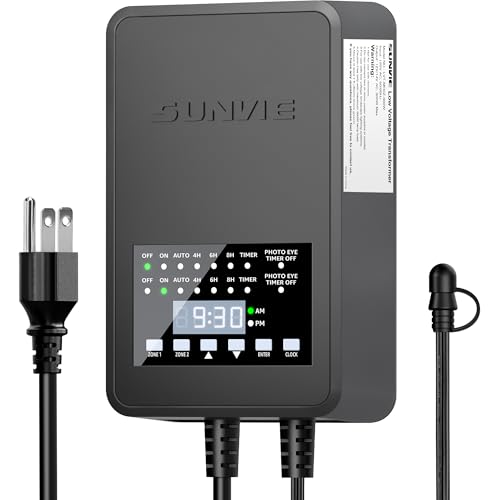
Best for medium yards needing two independent lighting zones. This transformer powers separate zones up to 300W total, with five modes including manual, dusk-to-dawn, and countdown. It uses an external photocell sensor with a long sensor cord for flexible indoor/outdoor placement. Choose this if you want zone-specific control to balance accents like uplights and path lights. Limitation: ensure the combined load stays within 80% of the rated power for optimal performance.
SUNVIE 100W Low Voltage Transformer

Best for focused lighting around mid-sized landscapes, this 100W transformer converts 120V AC to 12V DC, supporting LED lights and pathway fixtures. It includes dusk-to-dawn operation and a replaceable, UL-listed sensor cord. The memory function preserves the last mode after power outages, which helps maintain consistent lighting schedules. Use this when you want a reliable, compact unit with convenient outdoor sensor placement. Limitation: not recommended for halogen lighting.
DEWENWILS 60W Low Voltage Transformer

Best for compact, budget-oriented projects, this 60W transformer provides dusk-to-dawn functionality and a countdown feature, with a weatherproof body and simple plug-and-play installation. Ideal for entry pathways or small patio lighting. Caution: check that the total connected load does not exceed 60W to ensure reliable operation.
DEWENWILS 300W Low Voltage Transformer
Best for larger landscape installations, this 300W transformer powers brighter lighting across multiple zones with dusk-to-dawn control and a 1-9 hour countdown. It includes mounting holes and a sturdy outdoor-ready design. Use this when you need to support multiple high-wattage fixtures or longer run lengths. Limitation: higher wattage requires careful layout to avoid overloading circuits.
Buying Guide
What should you consider when choosing a low voltage garden light transformer?
- Power rating: Match the total wattage of your lighting plan to the transformer’s output. Go slightly higher to allow for future expansion.
- Control features: Dusk-to-dawn sensors and countdown timers help save energy and reduce maintenance.
- Number of zones: If your design uses distinct lighting areas, a multi-zone transformer offers independent control.
- Outdoor suitability: Look for weatherproof or ETL-listed units designed for exterior use.
- Installation: Check cord lengths, mounting options, and whether the sensor cord is external or internal to fit your space.
- Compatibility: Ensure the transformer supports your lights (LED vs. halogen) and accepts the correct voltage (12V or 12/14V).
What setup works best for small gardens?
A compact transformer (around 60W to 100W) with dusk-to-dawn control is often sufficient for entryways, small pathways, and focal accents. It’s easy to install and tends to be more budget-friendly while still providing reliable operation.
What if I have a larger yard with multiple lighting zones?
Choose a transformer with at least two independent zones or a higher-wattage model (200W to 300W). This allows separate scheduling for pathways, accents, and deck lighting without overloading a single circuit.
Are external photocell sensors necessary?
External sensors offer flexible placement and simplify maintenance. They are useful when lights are installed in shaded or distant locations where a built-in sensor might be less effective.
Can I use these with LED and halogen lights?
Most low voltage transformers are compatible with LED landscape lighting. Some are not suitable for halogen lighting, so verify voltage compatibility before pairing with halogen fixtures.
How important is certification?
ETL-listed or UL-listed transformers provide verified electrical safety for outdoor use, reducing risks associated with moisture and weather exposure.
FAQ
- What is a low voltage transformer used for in landscaping?
It converts standard household voltage to a safe 12V or 12/14V output suitable for landscape lights, reducing shock risk and enabling easier wiring outdoors.
- Do I need a timer for my garden lights?
Timers automate on/off cycles, saving energy and ensuring lights aren’t left on overnight unless desired.
- What should I consider when sizing a transformer?
Sum the wattage of all planned lights and choose a transformer with a higher rating to tolerate future additions.
- Can I install a transformer myself?
Yes, many units are designed for DIY installation with simple wall mounting and standard outdoor outlets. Follow manufacturer instructions and local electrical codes.
- Is multi-zone control important for landscapes?
Yes, it lets you customize lighting in different areas, improving ambiance and energy efficiency.
- What maintenance is required for outdoor transformers?
Occasional inspection for weatherproof seals, sensor cord integrity, and cleaning of dust or debris around sensors keeps performance stable.