Best Longest Running Portable Generator for Home Backups and RVs
Answering the demand for endurance, this guide highlights portable generators with the longest runtimes and reliable performance for home backup and on-the-road power. Each option targets different buyers—from RV campers needing quiet, fuel-efficient power to homeowners seeking extended run times during outages. The following selections emphasize long running times, fuel flexibility, and practical features to keep essential devices powered.
| Product | Why Chosen | Approximate Runtime (reference) |
|---|---|---|
| Oxseryn Power Equipment 4400W Inverter | Excellent 14-hour runtime at 25% load; multiple outputs including RV port, ideal for RVs and emergency home backup | Up to 14 hours |
| Westinghouse 12500W Dual Fuel | High power with dual fuel and long run times; transfer switch ready for whole-home backups | Up to 12 hours (gas) |
| Westinghouse 14500W Tri-Fuel | Most capacity among listed, longest run on gasoline; versatile fuel options for extended outages | Up to 19 hours (gas) |
| PowerSmart 3800W Dual Fuel | Very long propane runtimes (up to 25 hours) and efficient gas run times; good for long camping trips and outages | Up to 25 hours (propane) |
| MaXpeedingrods 3500W Portable Inverter | Balanced run times with Eco mode; compact, light, and suitable for travel and home backup | Up to 8.3 hours (Eco mode at 25% load) |
Oxseryn Power Equipment 4400W Inverter Generator

Key features include 4400 peak watts and 3400 running watts, two 120V outlets, a 12V DC port, and an RV outlet. ECO mode extends runtime to about 14 hours at low load. This model balances portability with enough power for RV use and small home backup. Best for RV owners who need quiet operation and straightforward fuel management.
Who it’s best for: RV enthusiasts and compact home backup buyers who prioritize multi-output versatility and longer runtimes at light loads. Why selected: best combination of endurance and portable open-frame design in this price range. Caution: data shows runtime at 25% load; higher loads reduce total runtime.
Westinghouse 12500 Watt Dual Fuel Home Backup

This dual-fuel powerhouse offers 9500 running watts on gasoline and 8500 running watts on propane, with up to 12 hours of run time on a 6.6-gallon tank. It includes a remote start, transfer switch readiness, and multiple outlets, including an RV-ready configuration. Best for: homeowners seeking substantial, flexible power with remote starting and transfer-switch compatibility. Better for: larger homes or heavy-duty backup needs where fuel choice matters. Caution: heavier unit and higher price point mean more space and setup considerations.
Westinghouse 14500 Peak Watt Tri-Fuel

With 14,500 peak watts and 11,500 running watts on gasoline, and substantial capacities on propane and natural gas, this model offers up to 19 hours of runtime on a sizable 9.5-gallon tank. It’s transfer-switch ready and designed for larger homes or dependable portable power. Best for: users needing maximum power and duration in a portable package. Choose this if: you anticipate prolonged outages and want multi-fuel flexibility. Limitation: higher fuel consumption at peak loads may require frequent refueling during extended outages.
PowerSmart 3800 Watt Dual Fuel Inverter
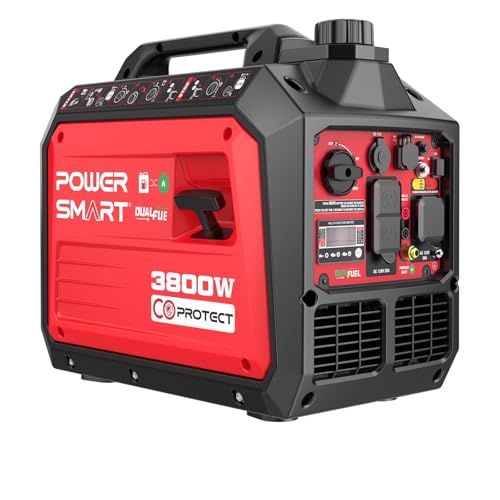
PowerSmart offers dual-fuel versatility with 3800 starting watts and 3300 running watts on gasoline, plus a 25-hour runtime on propane. Its inverter technology ensures clean power suitable for sensitive electronics, and a quiet operation profile makes it friendlier for residential use. Best for: campers and homeowners who value long propane runtime and clean power. Better for: remote camping and small-home back-ups where fuel availability varies. Caution: propane performance may vary with tank size and ambient conditions.
Inverter Generator 4200W AIVOLT

AIVOLT’s 4200W inverter delivers 3300 running watts with a 2.6-gallon tank for up to 16 hours at 25% load. It includes CO safety features and a low oil shutdown, making it a solid mid-range option for home and RV use. Best for: users needing a compact, long-running option with safety protections. Choose this if: you want a balance of runtime, portability, and clean power. Limitation: slightly lower peak output than larger units.
Buying Guide: Key Considerations For A Long-Running Portable Generator
- Fuel type and availability: Dual-fuel designs offer flexibility when gas prices rise or supply is inconsistent. Consider which fuel is most accessible in your area and during outages.
- Runtime at typical loads: Look for independently stated runtimes at 25% or 50% load to estimate real-world performance. A larger tank generally means longer continuous operation between refueling stops.
- Power needs: Match running watts to your essential loads. For RVs, consider outlets and RV-ready ports. For home backups, ensure the unit can handle your critical circuits via a transfer switch.
- Noise and portability: Inverter generators typically run quieter and deliver cleaner power. Weigh weight, handle design, and wheel kits for easy movement, especially if you’ll transport the unit regularly.
- Safety features: Look for CO sensors, low-oil shutoff, and automatic shutdown on dangerous conditions. These features protect occupants and equipment during extended use.
- Durability and maintenance: Engines with cast-iron sleeves and robust components tend to endure longer runtimes under demanding conditions. Check oil monitoring features and service intervals.
Frequently Asked Questions
- What is the longest running portable generator on the market?
– Models with dual-fuel capabilities and large fuel tanks, such as tri-fuel or dual-fuel units, typically offer the longest runtimes under varying loads. - Do I need a transfer switch for home backup power?
– For most whole-home backup setups, a transfer switch is recommended to safely isolate the generator from the utility grid. - Is a higher wattage generator always better for outages?
– Higher wattage helps power more devices, but you should prioritize essential loads and fuel availability to avoid overkill and wasted fuel. - What is running watts vs peak watts?
– Running watts indicate continuous power output, while peak watts are short-term surge capacities needed for starting motors or appliances. - Are dual-fuel generators safe for indoor use?
– No. They emit carbon monoxide. They should be used outdoors with proper ventilation, and CO sensors are essential when operating near living spaces. - How do I estimate runtimes accurately?
– Consider the load you plan to run, the fuel type’s efficiency, and the generator’s stated runtime at typical loads. Real-world runtimes vary with usage and environmental conditions.