Best Low Level CO Detectors for Home and Travel
The right low-level carbon monoxide detectors provide early warnings for sensitive occupants and travelers alike. This guide highlights five reliable options that alert early at 30–70 ppm, with clear alarms and practical features. These detectors are best for homes with young children, older adults, pregnant individuals, and pets, as well as for travelers who want portable protection. Each entry includes who it’s best for, notable strengths, and a practical caveat to consider.
| Product | Best For |
|---|---|
| Kidde Carbon Monoxide Detector, AA Battery Powered, COBDL | Homes needing portable, battery-powered protection during outages |
| Kidde Smart Carbon Monoxide Detector & Indoor Air Quality Monitor, COPDLQW | Smart home users seeking real-time alerts and IAQ insights |
| Kidde Carbon Monoxide Detector, Plug-in with AA Battery Backup, COPD | Rooms with outlets; travel-ready sojourns and rentals |
| Kidde Ultra-Sensitive Carbon Monoxide Detector for Pets | Households with medical needs or pets requiring early CO sensing |
| TOPTES CT-580 Portable Carbon Monoxide Detector | On-the-go, versatile environments (camping, travel, work sites) |
Kidde Carbon Monoxide Detector, COBDL

Features include detecting low-level CO and an 85 dB alarm with a digital backlit display and LED status indicators. It operates on AA batteries, enabling use during outages and without wiring. The device emphasizes advanced low-level CO technology that alerts at 30–70 ppm with distinct light and sound patterns, followed by a separate pattern at 70 ppm for more dangerous levels. Best for: apartment dwellers or travelers needing portable, standalone protection. Limitation: battery dependence may require periodic replacement during extended outages.
Kidde Smart CO Detector & Indoor Air Quality Monitor, COPDLQW

Real-time notifications via the Kidde app with no subscription required, plus ongoing IAQ insights, humidity and TVOC tracking. It uses 2.4 GHz Wi‑Fi and provides an 85 dB alarm for CO detection. It also offers low-level CO alerts (30–70 ppm) and a separate 70 ppm pattern. Best for: smart homes and users who want continuous air quality data. Caution: optional Home Health subscription adds features, which may be a consideration for budget-minded buyers.
Kidde Carbon Monoxide Detector, Plug-in with AA Battery Backup COPD

Plug-in CO detector with 120V AC power and 2 AA backup batteries for outages, plus a digital LED display showing CO levels or “GAS” if explosive gas is present. Best for: rooms with standard outlets and travelers who may move from hotel to rental properties. Limitation: reliant on plugging in, which may be inconvenient in some layouts or travel setups.
Kidde Carbon Monoxide + Explosive Gas Alarm
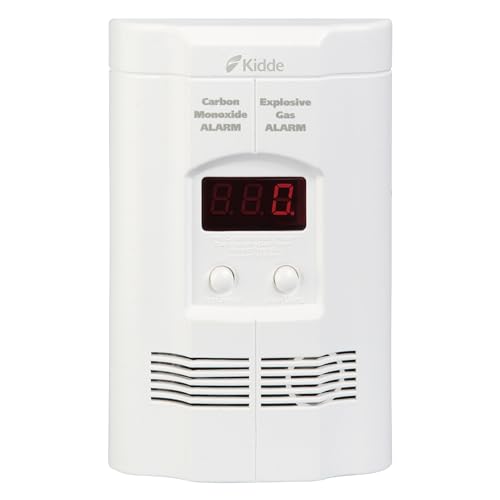
Plug-in CO detection with 9V battery backup and a digital display that shows CO levels or “GAS” for explosive gas. It provides a compact solution for homes needing both CO and gas monitoring. Best for: users who want a single device covering multiple gas risks in a single outlet. Caution: primary reliance on plug power; battery backup is available but may require maintenance.
Buying Guide
- Power source: Choose between battery-powered, plug-in with battery backup, or smart Wi‑Fi-enabled devices based on where you want protection and whether outages are common in your space.
- Low-level CO detection: Prioritize models that alert at 30–70 ppm with distinctive light and sound patterns to ensure early warning for vulnerable occupants.
- Display and alerts: A backlit digital display helps monitor CO levels, while loud alarms (85 dB) provide immediate evacuation cues. LED status lights add a quick hazard indicator.
- Smart features: Real-time notifications, IAQ metrics, and app integration offer ongoing insights. Consider whether optional paid subscriptions fit your budget.
- Portability vs. permanence: Battery-powered compact units work well for travel or rental properties, while plug-in units are convenient in fixed rooms; portable detectors support varied environments.
- Maintenance: Factor in battery replacement frequency and the ease of replacing batteries, as well as the need for periodic self-checks or hush/test functions.
FAQ
- What does low-level CO detection mean?
Low-level CO detection refers to sensing carbon monoxide at or near 30–70 parts per million, enabling earlier hazard warnings before higher concentrations accumulate.
- Which detector is best for homes with power outages?
Detectors with AA battery backups or portable battery-powered units are best for outages, such as the COBDL and the Ultra-Sensitive pet-focused model.
- Do smart CO detectors require a subscription?
Many smart CO detectors offer optional plans for advanced IAQ features. Basic alerts and app notifications typically do not require a subscription.
- Should I choose a plug-in detector or a battery-powered one?
Plug-in detectors are convenient for fixed locations with reliable outlets, while battery-powered detectors are ideal for travel and rooms without easy access to outlets.
- Can I use multiple detectors in the same home?
Yes. Place detectors in key areas—near sleeping spaces, kitchens, and utility rooms—to ensure comprehensive coverage and faster alerts across the home.