Best Lithium Travel Trailer Battery Solutions for RVing and Off-Grid Power
The best lithium travel trailer battery delivers reliable off-grid power, long life, and easy maintenance for RV travelers and boaters. This guide focuses on 12V LiFePO4 options with high cycle life, smart BMS protection, and easy drop-in compatibility for common Group sizes. The top picks below suit different buyers: weekend campers prioritizing lightweight, drop-in replacements; full-time RV users needing scalable systems; and off-grid enthusiasts seeking expandability. A quick buying table follows the product sections to help you compare at a glance.
| Product | Best For | Key Benefit |
|---|---|---|
| VEMDIA 12V 100Ah LiFePO4 | Lightweight RV upgrades | Drop-in Group 31 with 10-year life |
| SUPER EMPOWER 12V 100Ah Group 24 | Compact, versatile storage | Balanced cycle life and fit for Group 24 |
| SUPER EMPOWER 12V 100Ah Group 31 | RV and marine use | Robust 100A BMS, long cycles |
| GRNOE 2-Pack 12V 100Ah | Expandable systems | 4S4P expansion to 51.2V |
| Litime 12V 300Ah | High-capacity off-grid | 200A BMS, scalable up to 4P4S |
VEMDIA 12V 100Ah LiFePO4 Battery

Best for RV upgrades that require a lightweight, drop-in Group 31 solution. This 12V 100Ah battery uses a Smart 100A BMS with comprehensive protection and automatic low-temperature cut-off to prevent charging below 32°F. Its LiFePO4 chemistry reduces risk of thermal runaway and delivers a long service life. The compact size (12.9″ x 6.7″ x 8.5″) weighs 24 lbs, making installation and transport easier. Suitable for RV house banks, marine use, or off-grid solar storage.
Best for: RV owners seeking a maintenance-free, high-safety battery with a true 10-year lifespan. Limitation: while lightweight, larger builds may require multiple units for higher capacity needs.
SUPER EMPOWER 12V 100Ah Group 24 LiFePO4 Battery

Best for compact, versatile storage when Group 24 boxes are standard. This 12V 100Ah LiFePO4 unit includes a built-in BMS and is designed for deep-cycle energy storage in RVs, boats, and solar setups. With an estimated 5,000–15,000 cycles depending on depth of discharge, it provides long-term reliability and safe operation. It is intended for energy storage rather than engine starting.
Best for: users needing a dependable drop-in replacement with a balance of size and capacity. Limitation: not suitable for engine starting or cranking applications.
SUPER EMPOWER 12V 100Ah Group 31 LiFePO4 Battery
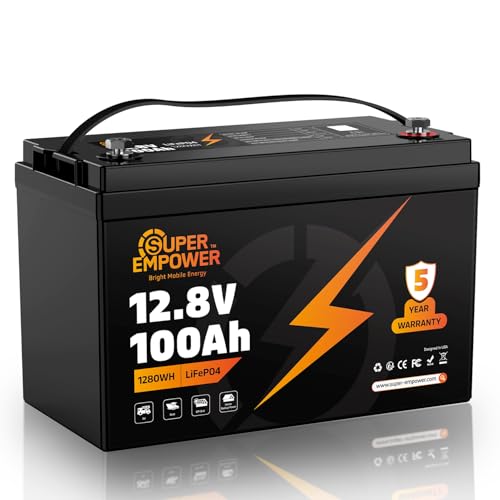
Best for RVs and boats that need a robust Group 31 form factor with strong protection and long life. It offers a 100A BMS and 10-year lifespan with cycles suitable for daily solar storage or weekend use. Designed for energy storage, not engine starting, and supports stable performance across seasons. A clear option for upgrading standard lead-acid systems with a modern LiFePO4 solution.
Best for: buyers who want a capable Group 31 replacement with solid cycle life. Limitation: ensure compatible battery box and terminals for Group 31 fit.
GRNOE 2-Pack 12V 100Ah LiFePO4 Batteries
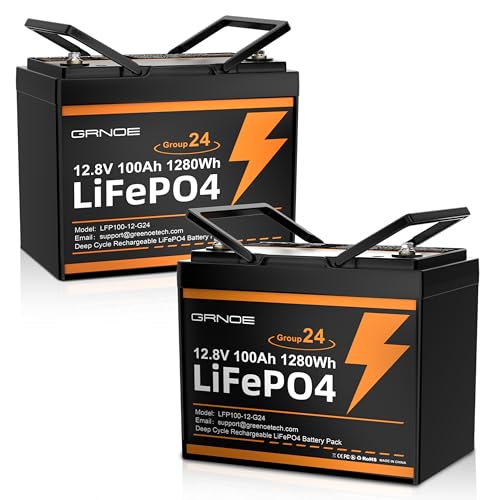
Best for expandable off-grid systems and larger RV or marine setups. This 2-pack starts with two 100Ah units and supports expansion up to 4S and 4P to reach 51.2V and 400Ah (20.48kWh). Each unit includes a 100A BMS with protections for overcharge, over-discharge, overcurrent, and short circuit, plus moisture and dust resistance for tougher environments.
Best for: customers planning phased capacity growth. Limitation: expansion requires compatible controller/charger and balance management across modules.
Litime 12V 300Ah LiFePO4 Battery
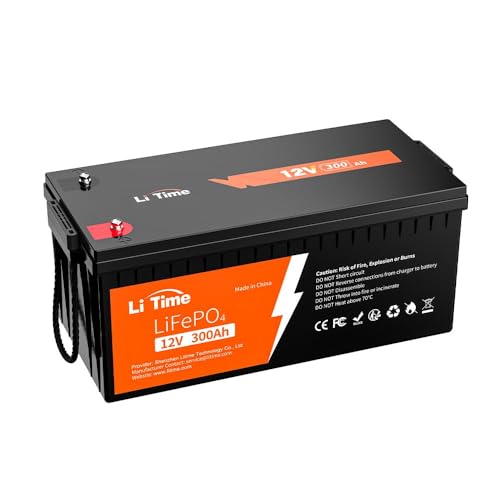
Best for high-capacity off-grid RV and travel trailer systems. It features EV-grade cells and a 200A BMS, with scalable energy and power—up to 3840Wh and 2560W in a single unit, expandable to 4P4S for up to 61.44kWh. Designed for long life, with 4000 cycles at 100% DOD. This battery is ideal when you need substantial household power for extended trips or as a home backup.
Best for: users pursuing large, expandable energy storage. Limitation: higher initial footprint and cost; ensure there is space in the storage area and appropriate charging equipment.
Buying Guide
What to consider when choosing a lithium travel trailer battery
- Voltage and capacity: Match 12V systems for RVs; increase Ah for longer runtimes or larger appliances. Consider future growth with expandable setups like 4S4P configurations.
- Group size compatibility: Group 24 and Group 31 are common in RVs. Check fitment dimensions and terminal type before buying.
- BMS protection and safety features: Look for high-current BMS, overcharge and over-discharge protection, short-circuit protection, and low-temperature cut-off if you camp in cold weather.
- Cycle life and depth of discharge (DOD): LiFePO4 cells offer 5,000–15,000 cycles depending on DOD. A higher cycle count lowers long-term replacement costs.
- Expansion potential: If planning to scale, choose batteries designed for series/parallel expansion with compatible controllers and balance management.
- Weight and footprint: LiFePO4 is lighter than lead-acid; check dimensions to ensure drop-in compatibility with existing battery boxes.
- Charging compatibility: Use lithium-specific chargers and ensure solar MPPT/PWM controllers are set to lithium mode.Avoid non-lithium chargers when possible.
FAQ
- Q: Do LiFePO4 batteries require special chargers? A: Yes. Use chargers designed for lithium (CC/CV profile, appropriate voltage). Some controllers support lithium mode; ensure compatibility.
- Q: Can I mix LiFePO4 with lead-acid batteries? A: Not recommended. Different charging profiles can lead to imbalanced charging and reduced lifespan.
- Q: What is the typical cycle life of these batteries? A: Many options offer 5,000–15,000 cycles depending on depth of discharge and usage patterns.
- Q: How do I know which Group size to choose? A: Check your RV or boat’s existing battery box dimensions and fit; common sizes include Group 24 and Group 31.
- Q: Is expansion important for RV power? A: If future power needs will grow, choose models that support series/parallel expansion to scale capacity.
- Q: Are these batteries safe in cold weather? A: Most LiFePO4 batteries include low-temperature protection to prevent charging in freezing conditions.