Best Humidity Sensor Fans for Bathroom Ventilation
Answering the need for automatic moisture control, these humidity sensor fan switches turn bathroom exhaust fans on and off based on detected humidity levels. They’re ideal for bathrooms, laundry rooms, and basements where damp air can cause mold or odor. This guide highlights top picks for different setups and gives practical buying tips for reliability and energy savings.
Buyer profiles:
– Best for: homeowners seeking simple install and neutral-wire options.
– Better for: users who want precise humidity control and a sleek look.
– Choose this if: you want a compact unit that fits standard wallboxes.
– Avoid this if: you prefer purely mechanical controls without humidity sensing.
Summary of chosen products
- Leviton DHS05-1LW / DHS05-1LT — versatile, slim profiles, neutral-wire optional
- Lutron MS-HS3G-WH — precise humidity sensing with stylish design
- TOPGREENER TDHS5 — energy-saving 20-minute cycles, 3 humidity levels
- TOPGREENER TDHS5-N — neutral-wire required, similar features to TDHS5
- Eaton HDFS3P1-W-L — simple single-pole humidity control
Leviton Humidity Sensor Switch, DHS05-1LW White

Features: Conveniently turns the bathroom exhaust fan on/off automatically; slim profile fits most wallboxes; flexible installation with or without a neutral wire.
Best for: users who value a compact, easy-to-install switch that adapts to existing wiring. This Leviton model is well-suited for smaller bathrooms or retrofit projects where space is at a premium.
Caution: Check whether your box supports a neutral wire if you plan to use the optional neutral connection.
Lutron Humidity Sensor Switch, MS-HS3G-WH

Features: Precise humidity control with XactSense; contemporary design; helps maintain comfortable humidity levels for a healthier bathroom.
Best for: buyers who want accurate sensing and a clean, modern look. Choose this if you prioritize precise humidity response over basic auto-on/off functionality.
Caution: Higher-end sensing may be more sensitive to rapid environmental changes; install per manufacturer guidelines to avoid nuisance cycling.
TOPGREENER TDHS5 Humidity Sensor and Fan Control, 2-Pack

Features: Auto humidity activated operation; fan runs for a fixed 20-minute cycle; three adjustable humidity levels (45–80% RH); 20-minute time delay with a 5-minute restart loop to prevent motor overheating.
Best for: bathrooms with variable humidity where energy savings and cycle control matter. The 20-minute timer helps avoid unnecessary operation in damp but briefly aired spaces.
Limitation: The device uses a fixed cycling pattern, which may not suit very long drying periods without manual intervention.
TOPGREENER TDHS5-N Humidity Sensor Switch, White

Features: Auto humidity activated operation; three adjustable humidity levels; 20-minute time delay ensures steady cooling and energy efficiency.
Best for: users who need a neutral-wire-required solution with similar performance to the 2-pack variant, applied in a single room or multi-room setup.
Limitation: Requires neutral wire in the switch box; verify electrical box wiring before purchase.
Leviton Humidity Sensor Switch, DHS05-1LT Light Almond

Features: Automatic on/off for bath or ventilation; slim, easy-to-install profile; can be installed with or without a neutral wire.
Best for: installations where a light almond finish blends with wall colors or existing trim. Suitable for retrofit projects requiring minimal door clearance.
Caution: Verify wallbox depth to ensure the slim unit fits without crowding adjacent devices.
Ortis New Generation Humidity Sensor Switch
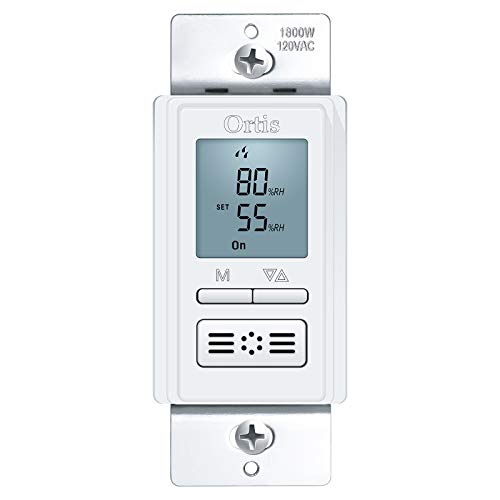
Features: Updated operation with adjustable auto-run time, humidification option, and auto/manual modes for flexible control.
Best for: users seeking advanced control and optional humidification use in dry climates or homes with variable humidity; suitable for wallbox compatibility with neutral wire.
Caution: The feature set may exceed basic needs; ensure you need humidification support before selecting this model.
Eaton HDFS3P1-W-L Humidity Sensor and Bath Fan Control

Features: Replaces a single-pole switch; automatically turns fan on/off based on preset humidity; humidity range 45%–80% RH.
Best for: straightforward humidity-triggered control in single-pole setups with a need for simple installation and predictable response.
Limitation: May not offer as many adjustable humidity levels as multi-gear models; confirm compatibility with existing wiring and box size.
Buying Guide
What should I consider before buying a humidity sensor switch?
Key factors include wiring requirements (neutral wire or not), compatibility with your existing bath fan, and the humidity range you want to trigger on. Look for a model that fits your wallbox depth and has a simple installation path.
Which features matter most for energy savings?
Automatic operation with a reasonable run-time delay reduces unnecessary cycling. Sensors with adjustable humidity thresholds offer better tailoring to different bathrooms and climates.
Single-pole vs neutral-wire models: which is better?
Single-pole units are easier to install in many existing boxes, but neutral-wire models can offer more stable sensing and flexibility in some wiring configurations. Verify your wallbox and wiring before choosing.
How important is sensor accuracy?
More precise sensors (like XactSense) respond quickly to humidity changes, keeping moisture under control while avoiding over-ventilation. This is especially important in small bathrooms or spaces with intermittent use.
What are common limitations I should expect?
Some models rely on fixed cycling times or have limited humidity ranges. Others require specific wiring or may have finish options that matter for visible installation. Read product specs to match your room and aesthetics.
FAQ
Do humidity sensor switches require professional installation?
Most can be installed by a confident DIYer with basic electrical knowledge; some models require neutral wires or more complex wiring. Follow manufacturer instructions.
Can these switches work with any bathroom fan?
They are designed to control standard ventilation fans, but verify electrical rating and compatibility with your fan’s amperage and wiring.
Do these switches save more energy than manual controllers?
Yes, by turning the fan on only when humidity rises and running for set cycles, they reduce unnecessary operation.
What humidity range should I choose for a bathroom?
Common settings lie in the 45%–80% RH range. Choose a higher trigger if your space stays dry longer, and lower if it tends to stay damp.
Is a neutral wire necessary?
Some models require a neutral wire for proper operation. If your box lacks a neutral, choose a single-pole or neutral-free option.
Can I replace a standard switch with a humidity sensor switch?
In most cases, yes, but ensure the switch box and wiring accommodate the new device’s depth and connection needs.