Best Line Level Isolation Transformers for Clean Audio and Safe Equipment
Looking for line level isolation transformers to reduce hum, ground loops, and interference in your audio or control systems? This guide selects five solid options across pro audio, medical-grade, and general isolation. The picks are best for studios, live rigs, broadcast setups, and sensitive equipment that benefit from clean, isolated signal paths. The top choices below balance isolation quality, connection versatility, and practical limitations.
| Product | Best For | Key Benefit |
|---|---|---|
| Whirlwind ISOXL Line-Level Isolation Transformer | Pro audio professionals needing XLR I/O | High-quality XLR isolation with lifetime warranty |
| Hammond Isolation Transformer (237V – 290W) | Equipment with mixed voltage outputs | Dual secondary voltages for versatile use |
| Tripp Lite Medical-Grade Isolation Transformer (IS1000HG) | Sensitive medical or lab gear | Full line isolation with hospital outlets |
| Radial Engineering Twin-Iso Bundle | Two-channel pro audio isolation | Transformer-based elimination of hum and ground loops |
| 3RS7005-1FW00 Isolation Transformer (OWMEAKNZR) | Custom isolation needs with multiple inputs/outputs | Flexible configuration with 24–240V UC input |
Whirlwind ISOXL Line-Level Isolation Transformer
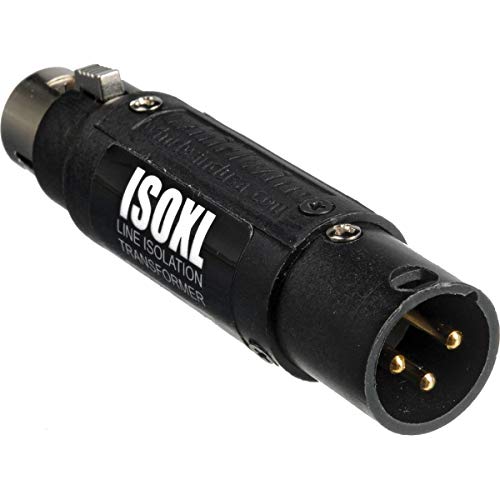
The Whirlwind ISOXL is a dedicated line-level isolation transformer with 3-pin XLR male and female connectors. It provides transformer-based isolation to reduce hum and noise between connected audio devices. This option is best for studio or live setups where XLR paths are the primary signal route and a reliable warranty is valued. The product’s stated features emphasize connector compatibility and a durable build. A potential limitation is the lack of explicit secondary voltage specifications in the available data, which may matter for unusual device pairings. Best for: professional audio engineers who rely on XLR links.
Hammond Isolation Transformer (237V, 290W)

Hammond’s isolation transformer model is described with a dual secondary output: 237V and 6.6V, suitable for devices needing a specific secondary voltage. It’s positioned for setups requiring power isolation and a configurable secondary path. This product is best for users who must run equipment with particular voltage requirements while maintaining line isolation. A caution is that exact primary voltage details beyond 120V aren’t fully listed here, so verify compatibility with your gear before purchase. Best for: technicians needing both isolation and a defined secondary voltage.
Isolation Transformer, 3RS7005-1FW00

The 3RS7005-1FW00 offers UC 24-240V input and supports 0-10V or 0/4-20mA control signals, providing flexibility for mixed signal environments. This is a good choice when you need a compact isolation solution that can interface with various control voltages. The features suggest suitability for both audio-like line signals and certain control interfaces. Best for: integrators who require voltage-range flexibility and multi-signal compatibility, with caution on ensuring correct input/output pairing for your system.
Radial Engineering Twin-Iso Two Channel Isolator

The Radial Twin-Iso focuses on two-channel line-level isolation using transformer-based technology to eliminate hum and ground loops. It’s a well-regarded choice for two separate signal paths, such as stereo sources or dual-mono gear in a studio or live rig. Best for: pro audio stations needing clean, independent isolation on two channels. Limitation: bundle contents may exceed basic needs if you only require a single channel.
Tripp Lite Medical-Grade Isolation Transformer (IS1000HG)

The Tripp Lite IS1000HG is a medical-grade isolation transformer with 1000 watts of capacity and four hospital-grade outlets. It is designed for sensitive equipment requiring complete line isolation and surge protection within clinical or laboratory settings. This product is best for environments where regulated power distribution and high isolation are essential. A caution is the hospital-grade design may impose physical size and plug type constraints in some installations. Best for: sensitive medical or lab devices that demand rigorous isolation and power safety.
Buying Guide
What to consider when choosing a line level isolation transformer:
- Signal path and connectors: If your gear uses XLR, a transformer with XLR inputs/outputs, like the Whirlwind ISOXL, is often simplest to integrate.
- Voltage and power: Check primary and secondary voltages to match your gear. Dual-secondaries and UC inputs offer flexibility in mixed environments.
- Isolation level and noise reduction: Transformer-based isolators reduce hum, buzz, and ground loops. Two-channel options are useful for stereo systems.
- Form factor and installation: Consider enclosure size, mounting options, and whether rack-mount or desktop placement fits your setup.
- Safety and compliance: Medical-grade units provide hospital-grade outlets and robust protection; verify compatibility with local electrical codes.
- Applications: Studio, live sound, broadcast, and lab contexts all benefit differently from isolation—plan around your primary use (audio vs control signals).
FAQs
- What is an isolation transformer used for in audio systems?
It reduces hum and ground loop noise by providing a separate electrical reference for connected equipment. - Do I need two channels of isolation or just one?
A single-channel solution works for most mono lines; two channels benefit stereo or dual-path setups. - Can isolation transformers power non-audio devices?
They are suitable for line-level signals; power-handling devices should follow the transformer’s rated wattage and voltage. - Will an isolation transformer fix all noise issues?
It helps with ground-loop and line-noise, but some noise sources (radiated EMI, dust, or device faults) may require additional remedies. - How do I choose between medical-grade and pro-audio isolation?
Medical-grade units emphasize hospital outlets and stricter safety standards; pro-audio units focus on signal integrity and flexibility for audio paths. - Is transformer-based isolation compatible with modern digital interfaces?
Yes, but ensure your digital signal paths (S/PDIF, AES/EBU, etc.) are supported by the specific transformer or use dedicated isolators for those formats.