Best 900 Watt Solar Panel Solutions for Homes and Off-Grid Uses
Looking for a reliable 900 watt solar panel setup? This guide compares top options that total around 900 watts and explains who each is best for. You’ll find panels suited for rooftop homes, RVs, boats, farms, and off-grid cabins. Use this to pick a system that fits your space, climate, and energy needs.
Buyer profile quick table:
< sumus>Note: A summary table of selected products is provided below for quick comparison.
Product Summary Table
- Callsun 450W Bifacial Solar Panel 2-Pack (900W Total) — Best for large rooftop arrays and off-grid builds requiring high output per panel
- Mndstek 900 Watt Solar Panel (3 Pack) — Best for budget-conscious off-grid setups needing modular 900W total
- Renogy 1180W Bifacial Solar Panels (590W x 2) — Best for optimized space and high efficiency in homes or mobile installations
- EPOCH 800W Bifacial Panels (400W x 2) — Best for RVs and marine use with reliable weather resistance
- DOKIO 800W (2×400W) — Best for simple, easy-to-install backyard or shed setups
Callsun 450W Bifacial Solar Panel 2-Pack

The Callsun 450W module uses N-Type 16BB busbars and a bifacial design to boost energy yield. It employs a dual-module parallel anti-shade layout to keep output stable when parts of the panel are shaded. Best for: home rooftops with open sky, ground-mounted arrays, or off-grid systems where maximizing energy per panel is important. Caution: bifacial gains depend on reflective surfaces and installation angle; real-world output can vary with site conditions.
Why this pick?
- High-power N-Type cells with 16BB busbars for better performance and stability
- Bifacial design captures light from rear, increasing total yield in suitable settings
- Shade-resilient dual-module arrangement reduces power drop from partial shading
DOKIO 800W (2×400W) 31V Mono Panels

Two 400W panels deliver 800W total with a 31V nominal design, aimed at 12/24V systems. Best for: garden sheds, cottages, or off-grid cabins needing a straightforward 800W setup with longer cable runs (3 m leads per panel). Caution: total output is 800W, not 900W, so your inverter and storage plan should account for the lower total if you specifically need 900W.
Why this pick?
- Outdoor-ready build with tempered glass and aluminum frame
- Compatible with various battery banks and PWM/MPPT controllers
- Fewer connection points than many 8×100W configurations, simplifying wiring
860 Watt Bifacial Panels (Star 430W × 2)

Two 430W panels total 860W with bifacial design and high-efficiency cells. Best for: compact installations where space saving and dual-sided generation are valued, such as vans, small homes, or remote cabins. Caution: total power is 860W, slightly below 900W but close in capability for many off-grid layouts.
Why this pick?
- Double-sided power with efficient cell technology
- Strong wind and snow load ratings for harsh environments
- Space-efficient, easy installation for limited areas
EPOCH 800W Bifacial Panels (Two 400W)
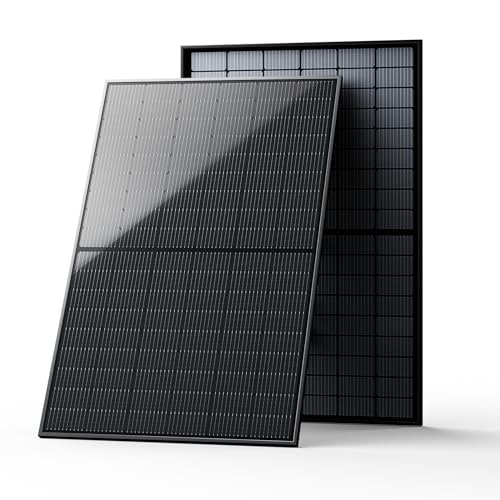
The Epoch pair uses N-Type cells with PERC and half-cut designs for improved efficiency and stability, offering up to 25% efficiency and bifacial gains. Best for: RVs and boats where rugged outdoor use and reliable performance are critical. Caution: 800W total, so plan power storage and inverters accordingly to stay near a 900W target if needed.
Why this pick?
- A+ grade cells and advanced construction resist degradation over time
- High efficiency and good performance in low-light conditions
- Strong waterproofing and IP-rated components for marine or wet environments
Mndstek 900 Watt Solar Panel (3 Pack)

Three 300W modules combine to 900W total with 18BB cell architecture and A+ N-Type cells, delivering a high conversion efficiency. Best for: off-grid homes or larger RV setups requiring modular expansion and straightforward integration. Caution: Real-world output depends on installation angle and irradiance; proximity to trees or shading reduces performance.
Why this pick?
- Advanced 18BB architecture reduces internal resistance
- High efficiency and strong output in varied light conditions
- Modular approach enables scalable systems
Buying Guide: Key Considerations for 900W+ Solar Setups
- System goals: rooftop home installation vs. off-grid cabin or RV. Larger homes may benefit from higher total wattage like 900W+ panels; compact spaces may favor bifacial or 860W configurations.
- Panel technology: N-Type vs P-Type, busbars, and bifacial designs affect efficiency, shade tolerance, and long-term stability. N-Type with 16BB busbars generally offers lower degradation and higher reliability.
- Shade and placement: Panels with anti-shade or multi-zone designs perform better under partial shading. Consider surface reflectivity for bifacial gains (white roofs, snow, sand, etc.).
- Durability: Wind and snow load ratings matter in harsh climates. Double glass and IP ratings improve weather resistance.
- Installation and wiring: Parallel vs series connections change voltage/current and cable requirements. Ensure compatibility with your charge controller or inverter (MPPT recommended for efficiency).
- Total system planning: If targeting 900W total, verify whether your controller, inverter, and battery bank can handle peak draw and voltage levels. Real-world output may be lower than STC ratings depending on conditions.
Frequently Asked Questions
- What does 900W of solar mean for my system?
It refers to the rated peak power output of the panels. The actual energy depends on sun exposure, angle, and temperature. - Are bifacial panels worth it for a small setup?
They can add extra power when installed with reflective surfaces, but gains vary by environment and shading. - Should I choose 2×450W or 3×300W configurations?
Two larger panels simplify wiring and spacing; three panels offer modular expansion but more connectors. - What is the best type of panel for RV use?
RVs benefit from compact, high-efficiency, and weather-resistant panels, often with bifacial options for extra hidden gains. - Do I need a special inverter for 900W setups?
Yes. Use an MPPT controller and an inverter rated for the system’s voltage and peak current to maximize efficiency and safety. - Can I mix different panel brands in one system?
Mixing can work, but it complicates matching voltages and current; aim for similar electrical characteristics per string.