Best L14-30 to 110V Adapters for Safe, Flexible Generator Power
If you need a reliable way to convert a 4-prong L14-30 locking outlet to common 110V household outlets, these adapters are designed to simplify temporary power access. They’re suited for different setups—from RVing and camping to home backup and job sites. This guide highlights five top options and explains who each is best for, plus practical cautions to consider when choosing.
Summary of selected products:
| Product | Best For | Key Benefit | Notes |
|---|---|---|---|
| MECMO NEMA L14-30P to 5-15R/5-20R | Home backup and generator users needing two 120V outlets | Simple 30A to 15/20A conversion | Includes 125V/3750W or 250V/7500W ratings |
| GOMEN 12 Inch 30 Amp to 110 Adapter | RV and outdoor use | Lighted end with clear power indication | 1 ft length; rugged 10 AWG wiring |
| Nema 5-15P Male L14-30R Female Power Adapter Cord | Simple 15A to 30A transfer | Compact STW 12AWG cable | Helps connect standard cords to L14-30R |
| NEMA L14-30P to 4X 5-15R/5-20R | Power multiple outlets from a generator | Four outlets from one locking plug | Best for RV or campsite power needs |
| FROSTYRIDER 30Amp to 110 Generator Adapter Cord | Three 5-15 outlets from a 30A source | LED power indicator on outlets | 1 ft length; robust 10 AWG wiring |
MECMO NEMA L14-30P to 5-15R/5-20R Adapter

Best for users who need a straightforward 30A connection to standard 15A or 20A household outlets. The adapter converts a NEMA L14-30P locking male plug into 5-15R and 5-20R receptacles, enabling common appliances to run from a generator or transfer switch. The dual-output design supports up to 125V at 3750W or 250V at 7500W, depending on the circuit. This makes it a solid choice for light to moderate home backup or on-site power distribution.
Who it’s best for: homeowners with a 30A generator seeking easy access to 120V outlets for essential devices. Why selected: simple, versatile conversion with clear power handling. Caution: verify that your generator or transfer switch can safely supply the combined load without overloading the circuit.
GOMEN 12 Inch 30 Amp to 110 Adapter
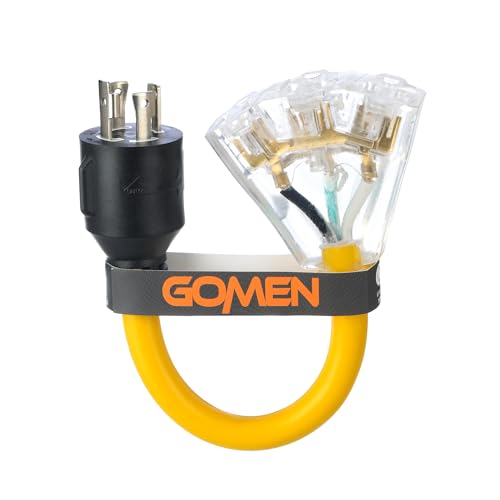
Best for RV enthusiasts and outdoor setups needing multiple 120V receptacles from a single 30A source. This adapter uses a 4-prong L14-30P male plug to feed three 5-15R outlets. It includes ten-gauge copper wiring and a robust STW jacket for weather resistance. A built-in lighted end helps users confirm power presence, which adds a safety layer during camping or job-site use.
Who it’s best for: RVers and campers who want a straightforward, visible power signal while distributing electricity. Why selected: reliability features and weather performance. Caution: the length is only 1 ft; plan cable routing to avoid tripping hazards or strain on connectors.
Nema 5-15P Male L14-30R Female Power Adapter Cord

Best for simple, direct connections from a standard 15A household outlet to a 30A L14-30R inlet. This cord provides an efficient way to feed a transfer switch or generator inlet with a 15A plug. It uses STW 12AWG wiring and is compact for portable use. This option is ideal when you need a lightweight adapter for occasional power swaps.
Who it’s best for: users with limited outlet capacity who need to connect to a generator’s 30A inlet. Why selected: compact, easy-to-handle cord for basic transfer tasks. Caution: 15A to 30A conversion means caution to avoid drawing more than 15A from the household outlet side.
MECMO NEMA 5-15P to L14-30R 4 Prong Twist Lock

Best for powering a home inlet or transfer switch from a standard 15A generator outlet. This adapter converts a 5-15P male plug to a 4-prong L14-30R locking female, delivering up to 1875W at 125V. The twist-lock feature helps secure connections to reduce disconnections during use. It’s suitable for light to moderate loads and transfer-switch compatibility.
Who it’s best for: users with a 15A generator wanting a secure, 4-prong L14-30R connection. Why selected: clear role as an adapter that bridges common generator outlets with L14-30R infrastructure. Caution: ensure the total load does not exceed the 1875W rating on the 15A side.
Buying Guide
Key considerations when choosing an L14-30 to 110V adapter include load capacity, number of outlets, and compatibility with your generator or transfer switch. Consider the type of outlets you need to feed: single or multiple 5-15/5-20R receptacles. Evaluate the length and weather rating if you’ll use the cord outdoors or at a camp site.
What should I check before buying?
- Amperage and wattage ratings to prevent overloading the circuit.
- Locking vs. non-locking connectors for secure connections.
- Wiring gauge and jacket material for safety and durability outdoors.
- Number and type of receptacles to meet your device needs.
Which setup is best for RVs, homes, or job sites?
- RVs: select adapters with multiple 5-15R outlets and weather resistance.
- Homes: prioritize adapters with clear power indicators and higher current capacity for essential appliances.
- Job sites: consider longer cords or multiple outlets to distribute power safely across equipment.
Safety and compliance tips
- Only use adapters within their listed wattage and amperage limits.
- Inspect cords for wear before each use and avoid damaged insulation.
- Ensure connectors are fully seated and locked when applicable.
- Avoid daisy-chaining adapters or plugging high-draw devices into multiple outlets at once.
FAQ
- Q: Can I use these adapters with household outlets not on a generator? A: Yes, where the outlets are within the adapter’s rated amperage and match the receptacles.
- Q: Are these adapters ETL listed or certified? A: Some listings mention ETL or similar safety attestations; verify each product page for certification details.
- Q: How do I prevent overloading my circuit with an L14-30 adapter? A: Calculate total expected watts and compare to the adapter’s stated wattage limits; distribute loads where possible.
- Q: Is a longer adapter better for distance from generator? A: Longer cords offer flexibility but may introduce voltage drop; choose appropriately rated wiring and length.
- Q: Can I use these in wet environments? A: Prefer models with weather-resistant jackets and proper outdoor ratings; keep connections dry.
- Q: What’s the difference between locking and non-locking plugs? A: Locking plugs provide a secure connection in mobile or windy conditions; non-locking are simpler but can loosen.