Best Infrared Tankless Water Heaters for Efficient On‑Demand Hot Water
Answering the common buyer question: which infrared tankless water heater best fits your home and hot-water needs? This guide highlights five electric tankless options that pair reliable performance with energy efficiency for typical American households. The top picks are best for different use cases—from compact point-of-use setups to whole-house systems. Below is a quick summary to help you compare at a glance.
| Product | Best For | GPM (Max) | Key Benefit |
|---|---|---|---|
| WINTEMP WM18V Plus | 2–3 fixtures, compact home | Up to 4.3 | Self-modulating, WiFi control |
| WINTEMP 27kW | 2–3 bathrooms, moderate climate | Up to 6.5 | Strong flow, high efficiency |
| Orbek 14kW | Single bathroom or two fixtures | Up to 3.38 | Fast instant hot water, compact |
| SIVUATEK 14kW | 1–2 points of use | Up to 3.38 | Easy install, energy efficient |
| Rheem 18kW | Whole-home with higher needs | Up to 4.4 | Digital control, durable elements |
WINTEMP WM18V Plus 18kW Tankless Water Heater

The WM18V Plus is a 18kW electric tankless model rated for 240V with a maximum current of 75A. It delivers up to 4.3 GPM of stable hot water and uses smart self-modulating technology to adjust power with flow, helping to save energy. It is ideal for homes with 2–3 points of use and is designed to minimize maintenance through a water-electricity separation design that reduces scale buildup.
Best for: small to mid-sized homes with 2–3 hot-water demand points and a capable electrical service. Choose this if you want WiFi-enabled control and reliable inline temperature stability for consistent showers.
Limitation: Requires two 40 Amp double-pole breakers and specific wiring; installation should be performed by a qualified electrician to meet electrical requirements.
WINTEMP 27kW Tankless Water Heater

This 27kW unit operates at 240V with up to 113A max current and requires a three‑breaker setup. It provides up to 6.5 GPM, suitable for uninterrupted hot water in showers and daily tasks in a 2–3 bathroom home in milder climates. It uses self-modulating technology to adjust energy use in real time, aiming for high efficiency and space savings.
Best for: homes needing higher hot-water output without upgrading to a full electric panel replacement, and for users who want stable temperatures with minimal fluctuations during showers.
Limitation: Installation calls for a robust electrical panel (200–250A recommended) and three 40A breakers, which may limit fit in smaller service panels.
Orbek 14kW Tankless Water Heater

The Orbek 14kW unit is a 240V heater designed for 2–3 points of use with a maximum of 3.38 GPM. It requires a 240V/60A two-pole breaker and includes 1/2″ NPT water connections. It emphasizes energy savings through rapid hot water delivery and a technology that reduces scale and corrosion, supporting lasting performance.
Best for: smaller homes or apartments needing dependable hot water for two fixtures at once, or for primary use in a compact space under sinks or in a utility area.
Limitation: Lower max GPM means more careful planning for simultaneous hot-water use; check your fixture load before choosing.
SIVUATEK 14kW Tankless Water Heater
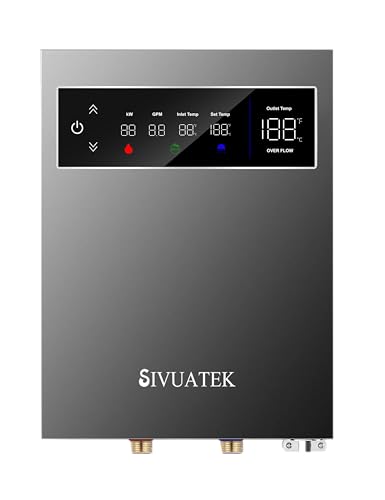
With 14kW of heating power at 240V, this model targets 1–2 usage points with a maximum of about 3.38 GPM. It features self-modulating operation and easy installation, designed to reduce idle energy use and provide steady hot water when called. The compact design supports space-saving installation under sinks or on walls.
Best for: users who want a straightforward, space-saving solution for one bathroom or a kitchen-and-bath combo, with predictable performance and simple wiring.
Limitation: As with many 14kW units, peak hot-water output may rely on supply temperature and home water temperature; confirmation of actual GPM in your climate is advised.
Rheem 18kW Tankless Electric Water Heater
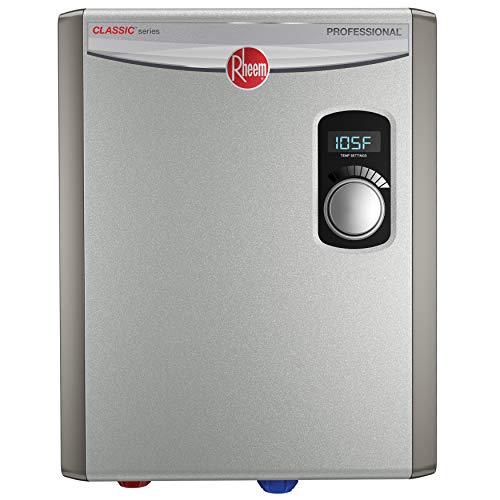
Rheem’s 18kW model features an external digital thermostatic control with LED display and self-modulation to adjust energy use based on demand. It uses durable copper immersion heating elements and claims flow rate up to 4.4 GPM. The unit is designed for field serviceability and robust performance across typical household needs.
Best for: households that want a reliable 18kW option with a digital interface and a higher GPM for moderate-to-large hot-water demand across multiple fixtures.
Limitation: Requires careful electrical planning to accommodate the power draw and space in the breaker panel; ensure capacity before purchasing.
EcoSmart ECO 11 Electric Tankless Water Heater

The EcoSmart ECO 11 is a 13KW unit at 240V, with patented self-modulating technology. It aims for endless on-demand hot water with steady performance within 1 degree of the set temperature. It is compact, roughly 11.5 x 8 x 3.75 inches, and designed for wall or point-of-use installation. It emphasizes energy efficiency and space-saving design.
Best for: smaller homes or apartments that need reliable hot water for one bathroom or a kitchen-use point, while prioritizing a compact footprint and energy savings.
Limitation: Lower maximum GPM means it may not cover multiple simultaneous uses in larger homes; plan for likely 1–2 fixtures at a time.
Buying Guide: How to Choose the Right Infrared Tankless Water Heater
- What is your hot-water demand? Count the number of fixtures that run at the same time. Units around 3–4 GPM suit single bathroom or two fixtures; 5–6+ GPM models suit multiple bathrooms or higher flow needs.
- Electrical service capacity. Most 240V tankless heaters require substantial amperage. Check your main service size (e.g., 150–250A) and available circuit breakers before purchasing.
- Water temperature and climate. Colder incoming water lowers effective flow and may require a higher wattage unit to maintain temperatures.
- Installation considerations. Larger models may need dedicated space, proper venting (if applicable), and professional wiring. Consider panel space and future home upgrades.
- Temperature stability. Look for self-modulating technology that automatically adjusts to demand to maintain a steady set temperature and save energy.
- Maintenance and durability. Features like anti-scale design and corrosion resistance help minimize upkeep over the system’s life.
- Point-of-use vs. whole-home. Point-of-use units are compact and ideal for single fixtures; whole-home units serve multiple rooms but demand more robust electrical infrastructure.
Frequently Asked Questions
- What is a tankless water heater’s main advantage?
They provide on-demand hot water with energy savings by heating only when needed, reducing standby losses compared to traditional tanks. - Do I need professional installation?
Yes, due to electrical requirements and water connections, a licensed electrician or plumbing professional is recommended for safety and code compliance. - Can a tankless heater supply hot water for multiple fixtures at once?
Yes, depending on the unit’s GPM rating and your incoming water temperature; higher wattage units are better for simultaneous use. - What maintenance is required?
Routine checks for scale buildup and periodic flushing help maintain efficiency; some models have design features to minimize scale. - Is there a portable option?
Yes, some compact 110V models are designed for under-sink use or smaller spaces, though they generally support fewer fixtures and lower GPM. - How do I compare energy savings?
Compare self-modulating features, idle power use, and the unit’s stated GPM at your typical incoming water temperature; energy savings depend on usage and climate.