Best in Roof Solar Panels for RVs and Off-Grid Setups
Choosing in-roof solar panels involves balancing efficiency, durability, and ease of installation for mobile and off-grid use. The following selections cover high-efficiency monocrystalline designs, lightweight flexible options, and robust marine/RV-focused kits. Each product is evaluated for daily output potential, weather resilience, and installation compatibility to help you compare options for roofs, vans, campers, and cabins.
Summary of chosen products:
| Product | Brand | Key Feature | Best For |
|---|---|---|---|
| ECO-WORTHY 200W Kit | ECO-WORTHY | High-efficiency monocrystalline cells; corrosion-resistant frame; IP65 junction box | RV, Camper, Off-grid |
| Renogy 200W N-Type 24V | Renogy | 25% cell efficiency; compact, space-saving design | Class B vans, tight spaces |
| Renogy Adventurer 200W Kit | Renogy | 30A PWM controller; durable aluminum frame; wide application | RVs, boats, cabins |
| Renogy ShadowFlux 200W | Renogy | Anti-shading tech; 25% efficiency; compact | Shaded areas, flexible mounting |
| Renogy 100W Flexible | Renogy | Flexible on curved surfaces; 22% efficiency; light | Curved roofs, boats |
ECO-WORTHY 200W Kit With 30A PWM Controller

The ECO-WORTHY kit uses high-performance monocrystalline cells to deliver strong daily output under favorable sun, with an estimated 800Wh/day in four peak sun hours. The system is designed for RVs, caravans, boats, and other off-grid applications, including backup power for sheds or cabins. A corrosion-resistant aluminum frame supports decades of outdoor use and withstands high winds and heavy snow. The IP65-rated junction box provides solid protection in challenging weather.
Renogy 200W N-Type Solar Panel For Van RV

This 200W N-Type panel is 7.5% smaller and 11.7% lighter, making it ideal for Class B vans where space is limited. It achieves up to 25% cell efficiency with 16BB technology, improving energy conversion and reducing microcrack risks. The 24V design lowers current loss and supports flexible installation with compatibility for both 12V and 24V battery systems.
Renogy Adventurer 200W RV Solar Kit
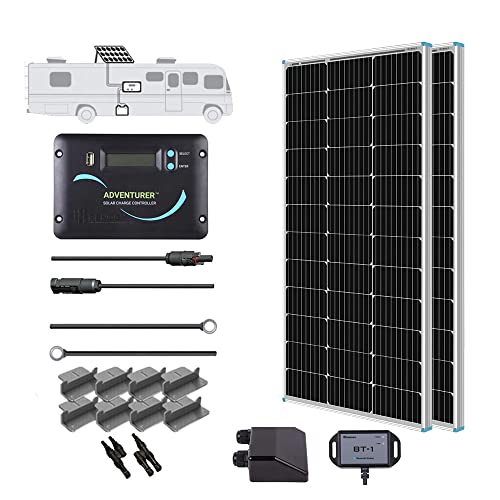
The Adventurer kit targets RV, boat, or camper setups with an 800Wh daily output assumption under optimal sunlight. It uses a 22% efficient cell design and a corrosion-resistant aluminum frame. The accompanying Adventurer-Li PWM controller provides overcharge, discharge, and short-circuit protection while enabling flush mounting on walls for a tidy installation. The kit emphasizes durability and ease of integration into compact living spaces.
Renogy ShadowFlux Anti-Shading 200W Panel

ShadowFlux technology addresses shading challenges, reducing hotspot risks and maintaining reliable power output when trees, buildings, or other obstructions cast shadows. The panel uses 16BB N-Type cells and achieves about 25% efficiency, helping to minimize microcracks and prolong lifespan. Its compact footprint makes it suitable for installations where space is at a premium, including roof installations on smaller RVs and boats.
Renogy 100W Flexible Solar Panel
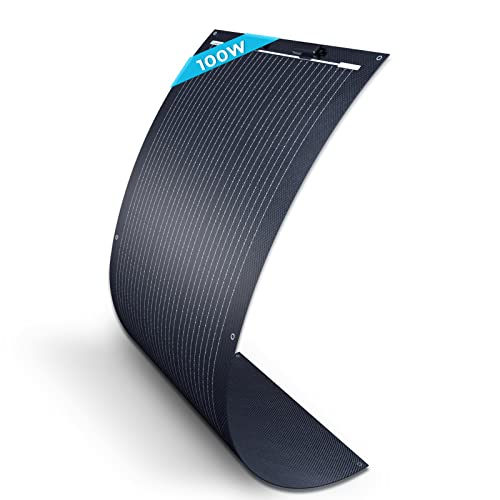
This 100W flexible panel is designed for curved surfaces, making it an excellent option for RV roofs or boat decks with irregular shapes. It can bend within 240 degrees and still deliver steady output. Half-cut PERC cells increase efficiency, while the thin profile supports easy mounting and minimal weight impact on the roof structure.
Buying Guide: Key Purchase Considerations
- Power needs and daily output: Estimate your typical sun hours and daily consumption to select a panel size that aligns with 500–1000Wh/day targets for compact RV or cabin setups.
- Cell technology and efficiency: N-Type (high efficiency) cells offer better performance in heat and shading compared to standard PERC cells. Higher efficiency panels save roof space but may come at a higher upfront cost.
- Durability and weather ratings: Look for corrosion-resistant frames, strong weather seals, and IP ratings for junction boxes to ensure longevity in coastal or cold climates.
- System compatibility: Ensure the panel voltage matches your battery bank (12V vs. 24V) and that the included or compatible charge controller supports your battery chemistry and desired protections.
- Shape and mounting flexibility: Rigid panels are robust for flat roofs; flexible panels excel on curved surfaces but may require careful sealing and mounting considerations.
- Shading resilience: Panels with anti-shading technology help maintain output in partially shaded rooftop environments, beneficial for urban canyons or tree-covered campsites.
- Weight and installation: Lighter panels ease rooftop handling, especially on smaller RVs or boats. Pre-drilled mounting holes and integrated rails simplify installation in some kits.
- Warranty and service: Review product warranties and supplier support, particularly for off-grid systems that must endure long-term exposure to the elements.
When comparing options, consider the trade-offs between compactness and maximum power, the robustness of the mounting hardware, and the ease of integration with existing RV or cabin electrical systems. The selections above emphasize a mix of high efficiency, durable construction, and versatile mounting possibilities to fit various in-roof applications.