Best Humidistat Options for Bathroom Fans You Can Trust
Humidity-sensing bathroom fans protect walls and mirrors by removing excess moisture. The right humidistat switch can automate ventilation, improve air quality, and save energy. Below is a curated guide to five top humidistat-enabled bathroom fan products, highlighting features, installation notes, and how each one addresses common bathroom moisture concerns. Use this to compare reliability, wiring needs, and control options for American homes.
| Product | Brand | Key Feature |
|---|---|---|
| Leviton DHS05-1LW Humidity Sensor Switch | Leviton | Automatic humidity-based on/off for bath fans; slim wallbox installation |
| TOPGREENER TDHS5-N Humidity Sensor Switch | TOPGREENER | Three humidity levels; auto ON/OFF; neutral wire required |
| Ortis In-Wall Humidity Sensor Switch | Ortis | Minimum run-time control; auto/manual modes; humidity detection |
| Panasonic FV-0511VFC1 WhisperFit Humidity Sensor | Panasonic | Condensation sensor; adjustable airflow 50/80/110 CFM |
| Panasonic FV-0511VF1 WhisperFit Retrofit | Panasonic | DC/ECM motor; three airflow settings; easy Flex-Z Fast installation |
The following sections present each product with practical details, installation considerations, and how its humidistat features suit typical bathroom layouts in American households.
Leviton DHS05-1LW Humidity Sensor Switch

Leviton DHS05-1LW is a compact humidity-sensing switch designed to automate a bathroom exhaust fan. Key benefits include hands-off moisture control and straightforward installation that fits most wall boxes. It supports a simple single-pole setup and can operate with or without a neutral wire, offering flexibility for older homes or newer constructions. This unit is suitable for bathrooms with standard fan loads and provides reliable automated ventilation to curb foggy mirrors and damp walls.
Quietcool Attic Thermostat With Humidistat Replacement

This product is positioned as a replacement humidistat and thermostat for powered attic ventilators, offering an adjustable thermostat range (50°F–120°F) and an adjustable humidistat (OFF to 90% humidity). While primarily used for attic ventilation, its humidistat feature provides precise humidity-based control that can be adapted for laundry rooms or bathrooms in multi-room ventilation systems. It’s best for homeowners upgrading legacy attic fans or integrating humidity control into larger ventilation schemes.
TOPGREENER TDHS5-N Humidity Sensor Switch

TOPGREENER TDHS5-N offers three humidity levels to tailor ventilation to your room. It detects excess humidity and automatically runs the fan until levels normalize, ideal for high-moisture bathrooms, laundry rooms, or basements. A notable feature is manual bypass; you can turn the fan off without changing the sensor setting when needed. This flexibility makes it suitable for bathrooms with variable usage or visitors who may not want automatic operation all the time.
Ortis In-Wall Humidity Sensor Switch
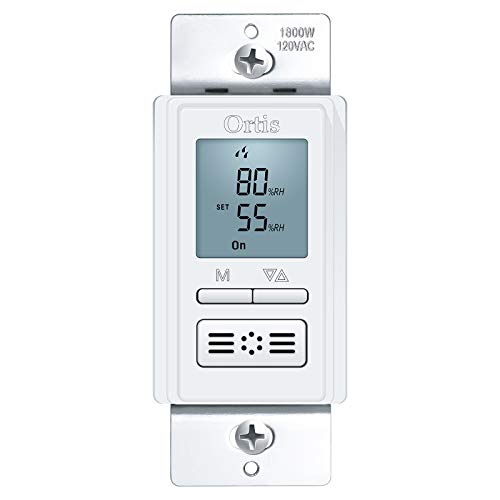
Ortis introduces a newer generation humidity sensor with adjustable run-time for auto mode and a default one-minute auto-off window, adjustable from 1 to 60 minutes. It emphasizes a microprocessor-driven sensing approach for accurate humidity detection. The unit is compatible with 120V/220V configurations and requires a neutral wire, which is common in many modern homes. This makes it a robust choice for bathrooms that demand precise humidity control and a flexible auto/manual operation.
Panasonic WhisperFit FV-0511VFC1 Humidity Sensor

The WhisperFit FV-0511VFC1 combines a humidity sensor with a condensation control feature. It offers three airflow settings—50, 80, and 110 CFM—to adapt to different bathroom sizes. The unit is Energy Star certified and uses a DC/ECM motor for efficient operation. Installation is simplified by the Flex-Z Fast Bracket and a low-profile housing that fits into typical 2×6 joist spaces, making it a strong choice for new builds and renovations seeking quiet, reliable humidity-responsive ventilation.
Panasonic WhisperFit FV-0511VF1 Retrofit
Panasonic FV-0511VF1 mirrors the WhisperFit design with a retrofit-friendly approach. It uses a DC/ECM motor and offers variable airflow via the Pick-A-Flow technology—50, 80, or 110 CFM. The low-profile housing and Flex-Z Fast Bracket support straightforward installation, especially in retrofit projects where space is constrained. This model is well-suited for renovations where maintaining quiet operation while achieving effective humidity control is a priority.
Buying Guide: Key Considerations For Choosing A Humidistat For Bathroom Fans
- Wiring and compatibility: Determine whether the unit requires a neutral wire and if it’s compatible with existing wiring in your bathroom. Older homes may need a model that works without a neutral.
- Humidity control: Look for units offering automatic ON/OFF based on preset humidity levels. Many models provide multiple humidity settings or adjustable thresholds to tailor performance to room size and usage.
- Fan load and compatibility: Check the rated fan load (HP, wattage, or VA) and ensure the sensor switch can handle your fan’s electrical requirements. Some dual-function switches also control lights, which adds convenience but requires correct wiring.
- Installation considerations: Slim wallbox fit, mounting depth, and compatibility with retrofit or new construction are important. Flexible brackets and low-profile housings help with tight spaces.
- Modes and manual overrides: Auto/manual modes and bypass options provide flexibility for guests or special ventilation needs, especially in bathrooms used for activities that generate variable humidity.
- Durability and certifications: UL-listed devices with solid humidity sensing and temperature tolerance are preferable for long-term reliability in humid environments.
- Noise and efficiency: A model with a DC/ECM motor tends to run quieter and use less power, contributing to a more comfortable bathroom experience.
In selecting a humidistat-enabled bathroom fan control, consider the balance between automatic moisture management and the flexibility of manual control. For spaces with high humidity, a model with multiple humidity levels and a reliable auto-on feature is advantageous. Retrofit installations benefit from slim profiles and easy brackets, while new-build projects can leverage units offering greater airflow control and integration with lighting or other loads.