Best Ground Rod Inspection Box and Related Grounding Tools for Safe Installations
Answering the question for buyers seeking reliable ground rod inspection and grounding solutions, this guide highlights five well-suited products. These items address real-time monitoring, easy rod installation, and high-voltage discharge safety. Ideal buyers include electricians, property owners performing DIY grounding, and landscaping professionals who need durable, corrosion-resistant components. The summary table below compares key points to help you choose quickly.
| Product | Best For | Key Benefit | Limitations |
|---|---|---|---|
| GOUNENGNAIL Observation Well | Grounding monitoring in lawns and patios | Corrosion-resistant, long service life, high load rating | Round, fixed size; may require space management |
| HQPASFY Universal Ground Rod Driver | Fast, safe rod driving | Works with 1/2, 5/8, 3/4 inch rods; reduces work at height | Requires compatible power tool access |
| Erico 615840UPC Ground Rod | Copper ground rod installation | Established brand; standard 4 ft length | Basic description; no added features listed |
| High-Voltage Discharge Rod (10kV) | Discharge safety for small to mid-range equipment | Insulated rod with conductive head; compact for storage | Multiple voltage variants; select correct rating |
| High-Voltage Discharge Rod (35kV) | Higher voltage discharge tasks | Telescopic and portable | Higher voltage requires careful handling |
GOUNENGNAIL Observation Well For Ground Rod

The grounding observation well is crafted from corrosion-resistant plastic and formed by efficient casting. It supports a maximum safe load of 5000 kg and is designed to facilitate real-time grounding monitoring. Best for lawned spaces, patios, and landscaping areas where a non-metallic, protective observation point is preferred. Using an inorganic non-metallic lining, the device exhibits high compressive strength (about 600 kg/cm²) and maintains stability over time, with seamless waterproofing to protect exposed grounding components.
Who it’s best for: property owners and technicians who require a durable, low-maintenance monitoring point in soft ground areas. Why selected: its high load tolerance and long service life make it a dependable choice for outdoor grounding facilities. Caution: ensure proper installation to maintain waterproof integrity in heavy soil loads.
HQPASFY Universal Ground Rod Driver
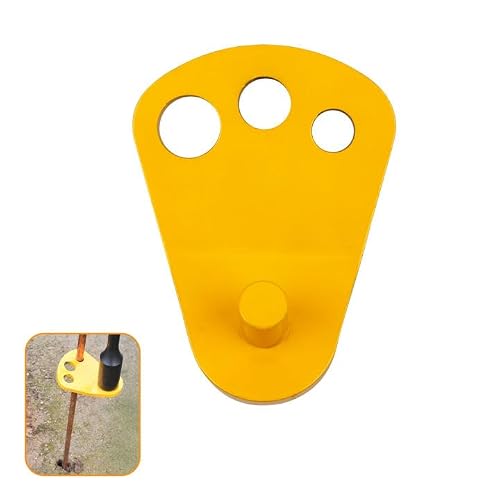
Designed to drive 1/2”, 5/8”, and 3/4” ground rods into the ground quickly with a compatible power tool, this driver minimizes ladder use and enhances safety. It’s robust enough for varied soil conditions and is ideal for electricians, linemen, and ranchers running electric fences. Best for professionals seeking faster installation with reduced fatigue. Caution: effective use depends on access to compatible rotary hammers or impact drivers.
Erico 615840UPC Ground Rod

Erico’s 4-foot, 5/8-inch copper ground rod provides a standard, reliable solution for electrical grounding. It is suitable for residential or commercial grounding installations where copper conductivity is preferred. Best for users needing a recognized, straightforward grounding rod option. Limitation: product description is concise and may require additional verification of supplier specifics before purchase.
High-Voltage Discharge Rod (10kV)

This discharge tool combines a metal operating head with an epoxy-resin insulated rod for safe and stable discharge operations. It supports direct and resistance discharge modes to fit various capacitor and cable discharge needs. Best for technicians working with moderate voltage equipment. Caution: ensure the voltage rating matches your equipment to avoid under- or over-specification.
High-Voltage Discharge Rod (35kV)
Similar construction to the 10kV variant, but designed for higher-voltage tasks. It maintains a conductive head and insulated rod, with a retractable length from 0.65 to 0.95 meters for portable storage. Best for higher-voltage discharge work. Caution: higher voltage entails stricter safety protocols and protective equipment.
High-Voltage Discharge Rod (220kV)
For the highest voltage discharge tasks, this rod combines conductive operation with a robust, insulated design. It is telescopic, retracting from 0.65 to 0.95 meters for easier transport and storage. Best for industrial or large-scale electrical maintenance. Caution: use only under appropriate safety guidelines and with proper PPE for 220kV work.
Buying Guide
What should I look for when choosing a ground rod inspection or grounding tool?
- Material and durability: Choose corrosion-resistant plastics or copper rods for longevity in outdoor conditions.
- Voltage compatibility: For discharge tools, match the rating (10kV, 35kV, 220kV) to your equipment and worksite needs.
- Portability and storage: Telescopic or compact designs help when space is limited or you must move between sites.
- Safety features: Look for insulated components, waterproofing, and secure connections to prevent accidental shocks.
- Installation speed vs. safety: Tools that speed up installation should not compromise safe handling procedures.
Frequently Asked Questions
- What is the purpose of a ground rod inspection box?
- Which ground rod driver is best for DIY projects?
- What should I consider when selecting a high-voltage discharge rod?
- Are copper ground rods better than non-metallic options?
- How important is waterproofing for grounding components?
- Is a professional inspection recommended for critical grounding systems?
A ground rod inspection box or observation well provides a protected point to monitor grounding systems, protecting exposed components from moisture and corrosion while enabling real-time checks.
A universal ground rod driver that supports common rod sizes (1/2, 5/8, 3/4 inch) and is compatible with typical power tools is suitable for many DIY tasks, offering safer, quicker installations.
Match the rating to your equipment’s voltage requirements (10kV, 35kV, 220kV) and ensure proper safety gear and training for high-voltage work.
Copper rods provide excellent conductivity and corrosion resistance but may be more expensive or require specific installation conditions; non-metallic observation wells can offer long-term protection in certain environments.
Waterproofing prolongs the life of exposed grounding components by delaying corrosion, especially in moist soils or outdoor installations.
For critical infrastructure, professional assessment helps ensure safety standards, regulatory compliance, and reliable long-term performance.