Best High Pressure Water Booster Pumps for Home Use
When you need stronger, steadier water pressure in a home setting, a high pressure water booster pump is the answer. This guide highlights five reliable options suited for households, apartments, and small properties. Each product section explains who it’s best for, why it was selected, and any important caveats. The table below summarizes key points to assist quick comparisons.
| Product | Best For | Main Benefit |
|---|---|---|
| Aquastrong Smart 45 | Homes with variable demand | Automatic, constant pressure with smart control |
| ECO-WORTHY Fresh Transfer 70PSI | Installations needing simple on-demand boost | Self-priming, compact diaphragm design |
| ECO-WORTHY 33-Series | RVs, boats, or small off-grid setups | Low power, self-priming with smart switch |
| Tdrsuper Diaphragm Pump | General home use with reliable start/stop | Automatic start/stop with stable around-70 PSI baseline |
| GWANZI 1.2HP Model | Whole-house boosting with high head | High head, stainless shell, wireless app control |
Aquastrong Smart 45: Whole-House Boost with Constant Pressure

The Aquastrong Smart 45 is designed for domestic boosting with automatic, variable speed control. It monitors water demand and adjusts to maintain constant pressure at all taps. Best for homeowners who want steady performance across showers, faucets, and appliances without manual tweaking. Maximum flow is 1500 GPH with a head up to 150 ft. The pressure range spans 1.5–5.5 bar (22–80 PSI), preset at 3 bar (44 PSI).
Best for: households seeking intelligent pressure management that adapts to usage patterns. The all-in-one design includes a stainless steel impeller and maintenance-free pressure tank. Quiet operation (~55 dB) and energy efficiency are key advantages. A potential limitation is the higher setup complexity for precise integration into some existing plumbing systems.
ECO-WORTHY Fresh Transfer Diaphragm Pump

This on-demand diaphragm pump delivers 5.5 GPM and is set to 70 PSI. It offers self-priming up to 9.8 vertical feet and a lift of up to 131 feet. The unit includes a robust pressure switch and a protection feature to prevent overheating. It’s suitable for irrigation, garden hoses, and household water boosting where simple, reliable on/off operation is desired.
Best for: users who want straightforward, self-contained boosting with predictablepressure. It can be quieter and safer due to thermal protection. Limitations include a fixed 70 PSI default and the possibility that complex multi-tap systems may require additional tuning for uniform pressure.
ECO-WORTHY 33-Series Diaphragm Pump
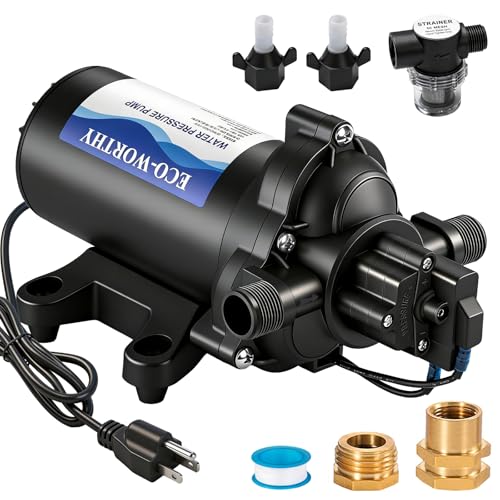
This 110V diaphragm pump provides 4.0 GPM at 50 PSI, with self-priming up to 9.8 vertical feet. It uses a smart pressure switch to start/stop on demand and supports an adjustable pressure range of 45–70 PSI. It includes thermal overload protection to safeguard the motor and uses an AC power supply, avoiding the need for auxiliary power sources in mobile setups.
Best for: RVs, boats, or small off-grid installations needing a compact, reliable, on-demand booster. Choose this if you want a pressure switch that automatically adapts to taps. Caution: maximum flow and pressure may be lower than larger home systems, limiting performance under heavy simultaneous usage.
Tdrsuper Diaphragm Pump: Automatic On/Off Boost

The Tdrsuper model is a 110V AC diaphragm pump delivering 5.5 GPM with a baseline 70 PSI and 9.8 ft self-priming. It automatically starts when a tap is opened and stops when it’s closed, reducing waste and energy use. It employs copper motors for durability and includes overload protection and corrosion-resistant valves. It supports dry-running protection for motor safety and reduced maintenance.
Best for: homes needing reliable automatic boost with a straightforward install. It can be the right fit when a 70 PSI baseline meets daily needs. Limitation: performance variations may occur if significant simultaneous demands are placed on multiple fixtures.
GWANZI 1HP Whole House Booster: Wireless Control
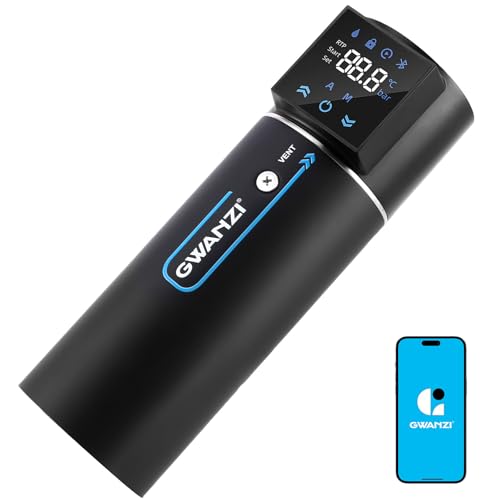
This 1HP GWANZI booster features an 800W motor, 110–120V, 60Hz, with a maximum head up to 150 feet and a 1 to 6 bar (15–90 PSI) adjustable range. It delivers up to 1320 GPH, providing a complete constant pressure boost for kitchens, bathrooms, and whole-house systems. Constructed with a thick stainless steel outer shell and a rust-resistant interior, it emphasizes durability and safe water delivery. OTA upgrades are supported through the SmartFarintl APP for firmware updates.
Best for: users who want high head capability and app-based control for a larger home. Choose this if you need strong performance across multiple fixtures. Limitation: mains water pressure and tank-based pressure can influence the achievable maximum pressure in some setups.
Buying Guide: Key Considerations for High Pressure Water Boosters
- Pressure needs: Determine the target pressure (PSI) for your taps. Many home systems aim for 40–60 PSI, but 70–90 PSI can be helpful for showers and multi-fixture use.
- Flow rate vs. head: Higher GPH supports more outlets, while higher head supports tall buildings or long runs. Balance GPH and head for your home layout.
- Power and efficiency: Look for energy-efficient motors and inverter technology, especially for 24/7 operation. Noise levels are a practical consideration for living spaces.
- Self-priming capability: Essential if the pump may run dry or if it’s mounted above the water source. Self-priming up to at least 9.8 feet is common in these models.
- Protection features: Thermal overload protection and dry-run protection reduce risk of motor damage. Consider corrosion resistance if using hot water or hard water.
- Control and connectivity: Some models offer smart controls or apps for firmware updates and remote monitoring. Ensure compatibility with existing plumbing and electrical systems.
- Installation context: Whole-house systems suit built-out homes; smaller diaphragm pumps are typically better for RVs, boats, or apartments with specific supply lines.
Frequently Asked Questions
- What is a high pressure water booster pump used for?
It increases water pressure and maintains a steadier flow across multiple fixtures, especially where supply pressure is low or inconsistent. - How do I choose the right PSI for my home?
Common targets are 40–60 PSI for typical households; bathrooms and showers may benefit from 50–70 PSI, depending on pipe length and elevation. - Is a smart pump worth it for a single-family home?
Yes, if you value constant pressure with automatic adjustment to changing demand, reducing fluctuations at various taps. - Can these pumps run on a battery or solar system?
Most listed units are mains-powered (110–120V). Some models can be adapted to alternative sources with proper power design and safety considerations. - What maintenance is required?
Typically minimal; watch for leaks, ensure electrical connections are secure, and replace worn valves or seals as needed per manufacturer guidance. - Do these pumps work with hot water?
Some models tolerate hot water (up to specified temperatures). Always verify max temperature ratings and ensure materials are compatible with your water conditions.