Best 24V Solar Charge Controller for Efficient Battery Management
Choosing the right 24V solar charge controller is essential for protecting batteries and maximizing energy from your solar array. The following selections cover PWM and MPPT options, with features ranging from load control and firmware updates to waterproofing and Bluetooth monitoring. This guide presents five compatible models, highlighting how each one handles charging phases, temperature protection, and battery type compatibility to suit RVs, boats, and off‑grid setups.
The table below summarizes the five featured products to help compare at a glance.
| Product | Brand | System | Key Strength |
|---|---|---|---|
| Renogy Wanderer 10A | Renogy | 12V/24V PWM | Advanced 4-stage charging, negative ground |
| Renogy Voyager 20A | Renogy | 12V/24V PWM | IP67 waterproof, robust protections |
| Renogy Adventurer 30A | Renogy | 12V/24V PWM | Negative-ground compatibility, LCD display |
| Depvko 30A Solar Controller | Depvko | 12V/24V PWM | Auto adaptation, dual USB output |
| Renogy Rover 40A | Renogy | 12V/24V MPPT | High current with lithium recovery |
These selections emphasize practical, real‑world use cases for 24V systems in RVs, boats, and off‑grid installations, including weather resistance, user‑friendly displays, and multiple battery chemistries.
Renogy Wanderer 10A PWM Charge Controller
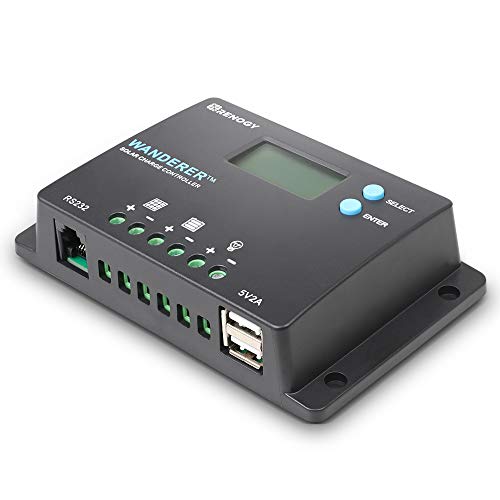
The Wanderer 10A controller provides 12V/24V PWM operation with a negative ground design. It supports AGM, Gel, Flooded, and Lithium batteries and features a 4‑stage charging protocol (Bulk/Boost/Float/Equalization). The unit emphasizes system protection with safeguards against overcharge, over-discharge, short circuits, and temperature compensation. Its compact form and LCD display support straightforward monitoring and configuration for RV and marine applications.
Renogy Voyager 20A PWM Solar Charge Controller

The Voyager 20A controller employs 4‑stage PWM charging (Bulk/Absorption/Float/Equalization) for reliable battery care across AGM, Gel, Flooded, and Lithium chemistries. It carries an IP67 waterproof rating, making it suitable for outdoor use in RVs, trailers, boats, and other exposed settings. Protective features include safeguards against reverse polarity, overcharge, short circuits, reverse current, overload, and over‑discharge, helping to maintain battery health in challenging environments.
Renogy Adventurer 30A PWM Controller

The Adventurer 30A unit offers automatic detection of 12V/24V systems and supports Lithium, AGM, Gel, and Flooded batteries. Its 4‑stage charging, negative‑ground compatibility, and a flush mount design enable seamless integration into RV and marine installations. The LCD display provides real‑time data, helping users monitor charging status and battery health within compact control panels.
Depvko 30A Solar Charge Controller

This upgraded controller supports automatic 12V/24V adaptation and includes a dual USB port for charging devices. It is designed for lead‑acid batteries (open, sealed, colloid) and uses auto‑recognizing voltage to protect the battery from misuse. It emphasizes memorized parameters for easier setup after initial configuration, making it practical for users who want straightforward operation with basic monitoring.
Renogy Rover 40A MPPT Charge Controller

The Rover 40A MPPT controller handles 12V/24V systems and supports gel, sealed, flooded, and lithium batteries. Its dual‑peak MPPT approach improves efficiency in shaded or partially cloudy conditions and can recover more energy from the array. It includes protections for reverse polarity, overcharge, short circuit, and voltage fluctuations, plus LD TVS lightning protection and a temperature compensation feature for stable performance in variable climates.
Buying Guide
Key factors to consider when selecting a 24V solar charge controller include:
- System voltage and type: Confirm your battery chemistry (lithium, AGM, gel, flooded) and whether the controller supports 12V and/or 24V operation.
- PWM vs MPPT: MPPT controllers are typically more efficient, especially in larger or partially shaded arrays; PWM units are usually simpler and less expensive, suitable for smaller setups.
- Current rating: Choose a controller with a current rating at or above your array’s maximum current to prevent overheating and ensure reliable charging.
- Protection features: Look for overcharge, overdischarge, short‑circuit, reverse polarity, and temperature compensation protections for battery longevity.
- Environmental durability: IP ratings (e.g., IP67) and temperature ranges matter for outdoor installations on RVs, boats, or off‑grid sites.
- Monitoring and control: LCD data displays, Bluetooth/Wi‑Fi connectivity, and companion apps help track performance and fine‑tune charging parameters.
- Physical integration: Size, mounting style (flush vs surface), and negative‑ground compatibility can affect how easily the controller fits in a given space.
- Future scalability: If you plan to grow the solar array, consider a controller with higher amperage or one that supports lithium battery recovery and multi‑panel configurations.
For consumers prioritizing rugged outdoor use, IP67 waterproofing and negative‑ground designs are beneficial. If peak efficiency and battery longevity are the focus, MPPT controllers with broad voltage compatibility and lithium support provide long‑term value. Always verify that the chosen model lists the exact battery chemistries you plan to use and check installation requirements for RV or marine environments.