Best Hall Effect Current Transducers for Accurate Non-Contact Sensing
Hall effect current transducers offer precise, non-contact measurement of current in a variety of environments, from hobby projects to industrial monitoring. This guide highlights five reliable options, covering different ranges, outputs, and form factors to fit motor control, power monitoring, and safety-critical applications. Each entry is evaluated on accuracy, isolation, installability, and environmental tolerance to help you choose the right sensor for your system.
Summary of chosen products
| Product | Brand | Current Range | Output | Notes |
|---|---|---|---|---|
| Hall Effect Current Transducer Out 1.65V | Oulores | 10–100 A | 2.5V/2V | Wide temp range, IP65 |
| WCS1600-100A Hall Effect Sensor | HanOaki | 0–35/70/100 A | mV per A | 1.5 kV isolation |
| SHIHUANI Hall Current Transducer 400A | SHIHUANI | 50–400 A | 2.5V±2V | Split-core, durable casing |
| QNHCK2-16 Split Core Current Sensor | LOKLNEYK | 10–150 A | 2.5V±2V | Open core design |
| WayinTop ACS712 30A Module | WayinTop | ±30 A | Analog 66mV/A | Dual-voltage voltage sensing option |
Oulores Hall Effect Current Transducer Out 1.65V

This Hall-effect transducer provides non-contact current sensing with high precision. A key feature is its low error margin, reported around ±0.5%, enabling accurate readings for motor control and power monitoring. It operates across a wide temperature span (-40°C to 125°C) and includes IP65 protection to resist dust and water intrusion. The sensor supports linear and switch modes to suit diverse applications, from smart homes to industrial monitoring, offering robust performance in challenging environments.
HanOaki Hall Effect Current Sensor 2-Pack
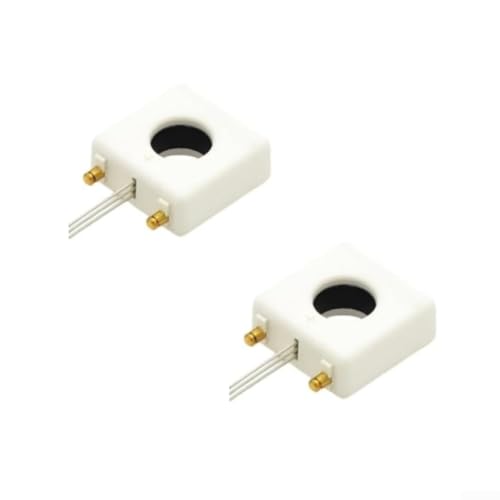
This two-pack Hall current sensor supports 0–35 A, 70 A, or 100 A ranges and provides a low-output signal suitable for calibration and interfacing with microcontrollers. It features galvanic isolation of up to 1.5 kV, safeguarding MCUs and PLCs. The device is compatible with 3.3 V and 5 V logic, ideal for Arduino projects and industrial controllers. Its fast response captures transients for protective actions like overcurrent events and motor inrush control.
SHIHUANI Hall Current Transducer 400A

This high-range Hall current transducer is designed for AC current monitoring and overload protection with a split-core, through-hole design for easy installation. The device emphasizes safe isolation between input and output and uses durable, self-extinguishing outer casing. Its wide current capability supports applications from power supplies to solar inverters, where high-current monitoring is critical for protection and performance tuning.
QNHCK2-16 Split Core Current Sensor

The QNHCK2-16 provides precise real-time current monitoring with a split-core design that supports easy installation on existing lines. It emphasizes electrical isolation between primary and secondary to protect control electronics. The open core construction simplifies integration into equipment where retrofitting is needed, making it a practical option for both lab setups and field installations.
WayinTop ACS712 Hall Effect Current Sensor Module

This module combines current and voltage sensing for DIY electronics and educational projects. The ACS712ELC-30A can measure positive and negative current with an analog output of about 66 mV per ampere, suitable for microcontroller interfaces. The accompanying voltage sensor module extends measurement capabilities to DC voltage up to 25 V, broadening its utility in hobbyist projects and introductory power monitoring experiments.
MusRock ACS758ECB-200B Hall Effect Sensor

The MusRock ACS758ECB-200B offers high-precision current monitoring with 10 mV/A sensitivity and robust isolation. It supports a wide operating range, tempered by a fast response time and strong isolation to protect sensitive electronics. With a broad -40°C to +85°C operating range, it is suited for demanding environments such as industrial power systems and field deployments requiring stable accuracy under temperature variation.
Oulores Hall Effect Current Transducer Out 1.65V (Alternate Range)
This alternative offering from Oulores preserves high-precision Hall-effect sensing with non-contact measurement of position, speed, and current. It supports a linear/switch dual mode, enabling flexible motor control and smart-home monitoring. The device is designed for reliability in rugged environments, with wide temperature tolerance and IP65 protection for durable field use.
Buying Guide: Key Considerations For Hall Effect Current Transducers
Choosing the right Hall effect current transducer depends on several factors. Consider current range and bandwidth to ensure the sensor covers expected loads and dynamic transients without saturation. Output type matters: linear mV outputs are common for direct ADC interfacing, while some models offer a fixed voltage reference for simpler conditioning. Isolation voltage is critical when interfacing with microcontrollers and industrial controllers—look for galvanic isolation in the kilovolt range for safer operation. Installability varies by design; split-core sensors simplify retrofits, while solid-core devices may require disconnecting circuits.
Environmental tolerance is another key factor. Temperature range, IP rating, and shielding from electromagnetic interference influence measurement stability in harsh environments. For motor control and inrush monitoring, fast response times help detect faults early. Calibration characteristics, including sensitivity and zero offset, determine how easily readings map to real current values. Finally, consider the ecosystem: some sensors pair well with Arduino or Raspberry Pi, while others target industrial PLCs and SCADA systems. Matching your control architecture ensures reliable data processing and protection against faults.
Practical guidance for selection:
- Use split-core designs for easy retrofits without cutting lines.
- Prefer higher isolation voltage when integrating with sensitive electronics.
- Choose the appropriate output format for your ADC reference and grading needs.
- Assess environmental ratings—temperature, humidity, and enclosure protection.
- Evaluate response time if you need fast fault detection and protection.