Best Grid Tie Inverter Limiter Options for Clean Solar Power
Finding a grid tie inverter with an integrated limiter helps protect your system and optimize power delivery. This guide highlights five top choices designed to automatically limit output to match load, while maximizing efficiency through MPPT technology. Each selection includes key input ranges, battery compatibility, and practical notes to help you compare setups for US-based solar or hybrid systems.
Summary Table of Chosen Products
| Product | Input Range | Output Range | Limiter / MPPT | Notes |
|---|---|---|---|---|
| Y&H 1000W Grid Tie Inverter Power Limiter | 22-60V DC | AC 110V/240V | Limiter sensor; MPPT up to 99% | Battery discharge mode; 66 ft wiring recommended |
| Y&H 2000W Grid Tie Inverter Power Limiter LCD | 50-90V DC | AC 185-265V | Limiter with MPPT; stackable units | Battery compatibility; easy installation |
| Y&H 1200W Grid Tie Inverter Power Limiter LCD | 55-90V DC | AC 110V | Limiter sensor; MPPT status LCD | Suitable for 48V/60V battery setups |
| TINGEN 1000W Solar Grid Tie Inverter with Limiter | 22-65V DC | AC 95-265V | Smart limiter; MPPT | Supports 2 panels in series, then parallel pairing |
| Marsrock 1000W Grid Tie Inverter with Power Limiter | 45-90V DC | 110V/240V AC | Limiter sensor; MPPT up to 99% | 50/60 Hz suitability; 200W min panel recommended |
Each product below includes a concise overview, practical features, and how the limiter and MPPT capabilities help maximize safe, efficient solar or hybrid operation in American installations.
Y&H 1000W Grid Tie Inverter Power Limiter
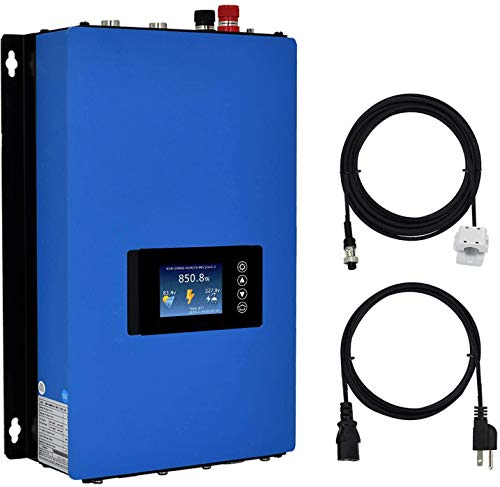
The 1000W model from Y&H is designed for DC input in the 22-60V range, with a startup voltage around 26V. It is compatible with 110V or 240V AC outputs and emphasizes output efficiency by keeping the solar input under 60V Voc. A built-in limiter sensor delivers exactly the power the load requires, reducing waste and protecting the grid connection. MPPT efficiency claims reach up to 99%, with a peak conversion rate near 80%. The inverter supports battery use (36V/48V banks) and includes a discharge optimization feature. For wiring, a practical guideline is to keep controller wiring within 66 feet. This unit is well-suited for smaller residential solar arrays paired with a limiter-aware system.
Key benefits for users include guaranteed load-matching through the limiter, an MPPT-driven approach to maximize energy harvest, and straightforward battery integration. A circuit-breaker is advised when batteries are used to ensure safe operation. The compact footprint and dual-voltage output make it adaptable for various American grid configurations, and the product’s documentation emphasizes stable, automatic power adjustment rather than continuous oversupply.
Y&H 2000W Grid Tie Inverter Power Limiter LCD

This higher-capacity model operates within a DC input range of 50-90V and outputs to 185-265V AC, aligning with American 240V systems. It supports 1000W+ solar arrays, and its MPPT design seeks up to 99% efficiency. A configurable battery mode is available, with a recommended 60V/72V battery setup for extended operation. The LCD helps monitor MPPT status, input/output parameters, and fault conditions. Importantly, multiple units can be stacked to scale output, a feature useful for expanding solar installations while maintaining limiter-driven control over grid feed-in. A circuit breaker is again advised when using batteries.
Buying and operating this model is appealing for users planning to expand energy capacity without sacrificing the limiter’s protective function. The LCD display provides real-time visibility into performance, which is valuable for troubleshooting and optimizing system behavior in different weather or load conditions.
Y&H 1200W Grid Tie Inverter LCD Display

The 1200W variant provides an LCD display to show working status, including PV/battery mode options and fault information. Its input range of 55-90V and 110V AC output position it well for typical US residential installations with 48V to 60V battery banks. The limiter sensor ensures the inverter supplies only the necessary power for the connected load, reducing grid draw during low-light days and preventing overproduction at the point of connection to the grid. The product’s documentation emphasizes MPPT-driven energy capture and stable performance across typical home solar environments.
This model is a balanced choice for homes that want robust limiter capabilities and a clear interface for monitoring performance. It suits systems that want reliable battery integration without oversizing inverters for modest solar arrays, while still enabling scalable operation through MPPT and limiter control.
TINGEN 1000W Solar Grid Tie Inverter with Limiter

The TINGEN 1000W grid tie inverter supports a DC input of 22-65V and a wide AC output range of 95-265V. It is designed for single-phase operation and can connect to 48V battery banks if needed. The device accommodates solar panels arranged in two-in-series, with two such strings connected in parallel, and it profiles high MPPT efficiency to maximize energy harvest. A smart limiter function tracks load demand and ensures the inverter provides only the required power. The device’s LCD offers accessible parameter readouts, enabling straightforward operation and maintenance for homeowners and installers targeting limiter-enabled systems.
From a system design perspective, this unit is appealing for those who prefer modular panel configurations and a flexible MPPT approach. Its limiter capability supports safe transfers to the grid and can help avoid excessive feed-in during sunny periods when local loads do not require all available energy.
Marsrock 1000W Grid Tie Inverter with Power Limiter

Marsrock’s 1000W unit specifies a DC input window of 45-90V and a dual-voltage AC output of 110V/240V. It employs an MPPT controller with high efficiency (up to 99%) and a peak conversion around 80%, helping to extract maximum energy from solar arrays with consistent panel specifications. The product includes a limiter sensor to align output with actual load requirements, minimizing wasted energy. For battery integration, it targets 48V systems and advises the use of a circuit breaker when batteries are employed. This model is suitable for US grid-tied installations where a straightforward limiter-enabled inverter is desirable for stability and safety.
Choosing Marsrock provides a reliable balance of MPPT capability, limiter awareness, and compatibility with standard US residential grids. The 110V/240V output range makes it adaptable to different home electrical configurations, while the limiter feature adds a level of protection for the grid and electrical infrastructure.
Buying Guide: Key Purchase Considerations And How To Compare
When shopping for grid tie inverters with limiter capabilities, consider the following factors to ensure you select a unit that matches your system and local electrical code requirements:
- Input voltage window: Ensure the DC input is compatible with your PV array voltage under cold conditions. A wider range helps accommodate panel aging and temperature variations.
- Output voltage and phase: Most US homes use 120V single-phase or 240V split-phase. Confirm the inverter can reliably operate within your available service configuration.
- Limiter technology: A true limiter sensor reduces delivered power to match load, preventing overfeed and grid disturbances. Look for explicit limiter and MPPT descriptions, and whether the system can be adjusted post-installation.
- MPPT efficiency: Higher MPPT efficiency translates to better energy harvest in varying light conditions. Near 99% is common in premium models but verify real-world results from reviews or datasheets.
- Battery compatibility: If you plan to include battery storage, verify voltage ranges (common 48V or 60V systems), required circuit breakers, and whether the inverter supports battery discharge control.
- Scalability: If you anticipate expanding capacity, check whether additional inverters can be stacked or connected in parallel, and how the limiter behaves in multi-unit configurations.
- Wiring length and safety: Many products specify a recommended maximum wiring distance between the controller and inverter. Adhere to these guidelines to maintain performance and safety.
- Monitoring: LCDs or mobile/web monitoring help track performance, MPPT status, and fault alerts. This can simplify maintenance and troubleshooting.
- Certifications and compliance: Verify that the unit meets local electrical codes and any interconnection standards required by your utility or building authority.
In choosing among the five options above, align the selected model with your array size, battery strategy, and home electrical configuration. For expanding systems, prioritized features include scalable inverters with robust MPPT and a proven limiter mechanism, along with reliable monitoring tools. For simple, small-scale setups, a compact unit with clear display and straightforward installation can provide dependable performance without unnecessary complexity.