Best Generators for RV Trailers: Quiet, Reliable Power on the Road
Choosing the right generator for an RV trailer involves balancing power needs, noise levels, fuel type, and portability. The options below highlight popular, RV-ready models that deliver dependable output for campouts and road trips while keeping noise to a minimum. This guide compares five well-regarded units to help you select a model that fits your trailer’s power demands without sacrificing convenience.
Selected products overview:
| Product | Brand | Power (W) | Fuel Type | Portability |
|---|---|---|---|---|
| WEN 4800-Watt Portable Inverter Generator | WEN | 4800 surge / 4000 running | Gas | Moderate |
| WEN 3600-Watt Portable Inverter Generator | WEN | 3600 surge / 2900 running | Gas | Lightweight |
| Champion Power Equipment 4000-Watt RV Ready Inverter | Champion | 4000 starting / 3000 running | Gas | Light |
| WEN Quiet 6800-Watt Dual Fuel Inverter | WEN | 6800 surge / 5100 running (gas) and 6000 surge / 4500 running (propane) | Gas/Propane | Moderate |
| Westinghouse 4650 Peak Watt Portable Generator | Westinghouse | 4650 peak / 3600 running | Gas | Moderate |
WEN 4800-Watt Portable Inverter Generator

The WEN 4800-Watt inverter combines RV-ready reliability with clean power suitable for sensitive electronics. Its 224cc engine delivers up to 4800 surge watts and 4000 running watts, supporting essential appliances and electronics without excessive fuel use. A compact 1.9-gallon tank supports up to about seven hours at half load, offering a practical balance between runtime and portability for most camping trips.
WEN 3600-Watt Portable Inverter Generator

Designed for easy transport, the WEN 3600 offers RV-friendly power with a lightweight frame. Its 149cc engine provides up to 3600 surge watts and 2900 running watts, while delivering clean electricity to protect devices like smartphones and laptops. The unit’s portability—weight around 46 pounds—makes it convenient for on-the-road setups and simple storage when not in use.
WEN 5600-Watt Portable Generator

The WEN 5600 offers robust RV-ready power with 5600 starting watts and 4500 running watts, plus a 4.3-gallon tank that can support roughly half a day of operation at moderate load. Its wheel-and-handle kit simplifies moving the unit between campsites, while the higher wattage provides ample headroom for essentials and small appliances during trips.
Champion Power Equipment 4000-Watt RV Ready Inverter

This compact inverter from Champion weighs less than 49 pounds and produces about 4000 starting watts with 3000 running watts, making it suitable for basic RV needs and camping setups. It operates at around 64 dBA from 23 feet, which positions it as a quiet option for quiet evenings and basic home backup use. An optional parallel kit lets you double your output by pairing with another unit.
WEN Quiet 6800-Watt Dual Fuel Inverter

The WEN DF680iX combines dual-fuel capability with a substantial output. Its 224cc dual-fuel engine runs on gasoline (6800 surge / 5100 running) or propane (6000 surge / 4500 running), broadening fuel options for longer trips. A bonded-neutral 240V configuration supports Level 2 charging for EVs, and the built-in CO shutdown sensor adds a safety layer for indoor or semi-enclosed use.
Westinghouse 4650 Peak Watt Portable Generator
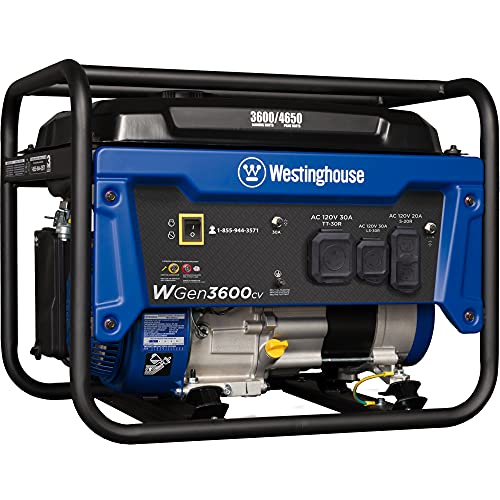
Westinghouse delivers a versatile RV-ready option with 4650 peak watts and 3600 running watts. A four-gallon fuel tank supports long runtimes, and multiple outlets—including RV-ready and standard 120V receptacles—offer flexible connections for campers. A recoil start keeps maintenance simple while ensuring quick operation when needed.
Buying Guide
- Power needs: Assess total wattage for lights, HVAC, appliances, and electronics. Favor models with a comfortable margin between peak and running watts for startup surges of motors and compressors.
- Fuel type and availability: Gasoline is common and widely available, while dual-fuel units add flexibility for longer trips or fuel shortages. Consider propane compatibility if you already stock propane for grills or heaters.
- Run time and tank size: Larger tanks mean longer runtimes between refuels. Balance tank size with portability, especially for smaller RVs or infrequent hookups.
- Noise level: Look for units advertised as RV-ready or quiet with decibel ratings. Lower noise improves comfort at campsites and reduces perimeter disturbance.
- Portability and setup: Weighing less and including wheels or handles makes it easier to move and store units. Some models offer parallel capability to scale output when needed.
- Safety features: CO sensors, automatic shutoff, and bonded-neutral configurations help protect occupants and electrical systems. Consider automatic shutoff for enclosed spaces or near sleeping areas.
- Electrical compatibility: Ensure the generator provides suitable outlets and bundle options for RV connections (RV TT-30, L5-30, or standard 120V). Inverters typically offer cleaner power that’s safer for sensitive electronics.
- Reliability and service: Brand reputation and available parts support influence long-term use and maintenance. Look for units with widely available parts and dealer networks.