Best Flexible Solar Panels for Metal Roofs: Durable, Lightweight Options for RVs, Boats, and Vans
Metal roofs offer longevity and better drainage, but they can be challenging for solar installations due to curvature and weight. Flexible solar panels provide a reliable solution, delivering strong efficiency on curved surfaces without rigid mounting hardware. This guide highlights five top-rated flexible panels ideal for metal roofs, comparing power output, installation ease, durability, and flexibility to help you choose a setup that maximizes shaded and sunlit hours.
Summary of chosen products
- Renogy 200W Flexible Solar Panel
- Renogy 100W Flexible Solar Panel
- ECO-WORTHY 130W Flexible Solar Panel
- ECO-WORTHY 260W Flexible Panel Kit
- Renogy 100W Ultra-Light Flexible Panel
Renogy 200W Flexible Solar Panel

Renogy’s 200W flexible panel is designed for curved surfaces, including metal roofs on RVs and boats. It delivers an average daily energy output around 1000 watt-hours in typical sunny conditions, a figure driven by high-efficiency cells and a flexible frame that bends up to 240 degrees. The panel’s ultra-lightweight construction halves the weight of rigid panels, easing transport and installation on limited roof space. Its all-black appearance minimizes glare and reflects a low-profile look on metal rooftops. The half-cut PERC cell technology enhances light capture, contributing to dependable performance in variable sun exposure.
Practical strengths for metal roofs include the panel’s transportability, compatibility with curved surfaces, and a glare-free finish. With 200W of rated output, this option helps you balance power needs for typical camping and off-grid use, especially when paired with an appropriate charge controller and battery bank. The combination of advanced cell tech and flexible mounting makes it a strong candidate for metal-roof applications where ventilation and weight reduction matter.
Renogy 100W Flexible Solar Panel
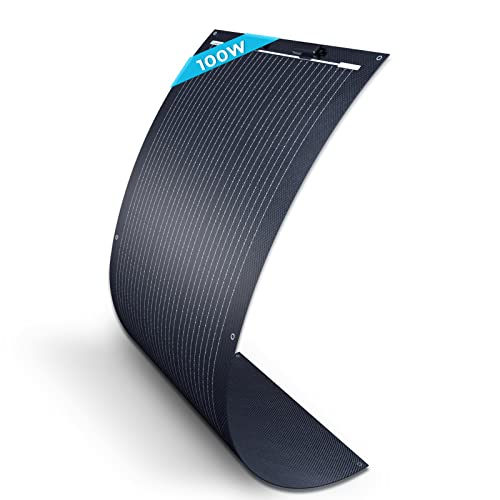
The Renogy 100W flexible panel is a compact, lightweight solution for curved metal surfaces. It can deliver about 500 watt-hours per day under favorable sun conditions, making it useful for smaller setups or supplemental charging on RVs, boats, or vans. Like the 200W version, this panel bends within 240 degrees, enabling installation on rounded roofs without heavy mounting hardware. It weighs roughly a third of rigid panels, supporting easier handling and reduced roof load. The panel uses half-cut PERC cell technology, optimizing efficiency and energy harvest for limited space.
Ideal use scenarios include campers with modest power demands, weekend travelers, and boat owners who require a low-profile, easy-to-install solution on metal decks. The 100W panel’s blend of portability and efficiency makes it a practical starter option that can be scaled by adding additional units or combined with a suitable power management system for greater autonomy.
ECO-WORTHY 130W Flexible Solar Panel

This ECO-WORTHY panel delivers 130W of flexible power with a focus on surface adaptability. It emphasizes excellent flexibility for irregular surfaces like RVs, boats, cabins, and curved roofs, with a markedly lighter weight due to polymer construction. The 130W output represents a meaningful power boost over smaller flexible panels, allowing for more daily generation—up to an estimated 520Wh per day under four hours of optimal sun. The kit-level design prioritizes ease of transport and simple installation, which is beneficial on metal roofs where weight distribution and wind resistance matter.
Key considerations for metal roofs include how well the panel adheres or is mounted on a smooth, curved metal surface, the potential for edge wear, and compatibility with standard solar connectors and controllers. The polymer-based design reduces weight while maintaining surface durability, helping extend life in marine or vehicle environments where vibration occurs.
ECO-WORTHY 260W Flexible Solar Panel Kit

This 2-piece ECO-WORTHY kit provides a total of 260W of flexible solar capacity, designed for off-grid setups including RVs, boats, and irregular roofs. The kit includes two 130W panels, a 30A 12V charger controller, solar cable, tray cable, and Y-branch connections, enabling relatively rapid deployment on metal surfaces. The claimed daily output around 1040Wh under four hours of strong sun aligns with higher daily energy needs and supports charging multiple devices or batteries. The polymer construction keeps weight manageable while offering the flexibility required to conform to curved metal roofs.
For buyers aiming to run higher-demand electronics or battery banks, this kit offers a modular approach that can scale with energy needs. When selecting a mounting strategy on metal surfaces, consider adhesives or hardware compatible with curved, weather-exposed environments and ensure proper sealing to avoid moisture intrusion.
Renogy Flexible 100W Mono Panel (Ultra-Light)

Renogy’s 100W off-grid charger emphasizes extreme lightness and stealthy installation. It weighs about 70% less than traditional panels, aiding roof load management on metal surfaces. The ultra-thin lamination makes the panel visually discreet when mounted on curved or sloped metal roofs, a benefit for aesthetic considerations on vehicles or boats. The panel’s Flexibility makes it suitable for installations where space is constrained or where a low profile is essential for aerodynamics and clearance. It is designed for a variety of curved surfaces and aligns with mobile, off-grid applications where weight is a critical constraint.
Consider this option when your installation prioritizes minimal roof intrusion and ease of transport. If the system includes a robust controller and battery bank, the 100W panel can be part of a modular array that expands with future energy needs on metal rooftops.
Buying Guide: Key Purchase Considerations For Flexible Panels On Metal Roofs
- Flexibility and curvature rating: Look for panels that bend within a high degree (e.g., 240°) to fit metal-roof curves without requiring aggressive mounting hardware. Flexible panels excel on contoured surfaces but require careful edge protection.
- Weight and installation method: Lighter panels reduce roof load and simplify mounting on metal roofs. Consider whether adhesive, mounting rails, or non-penetrating solutions suit your roof type and weather exposure.
- Cell technology and efficiency: Half-cut PERC cells improve energy capture in mixed sun conditions. Higher efficiency means more power in limited roof space, which is common on vehicles and small cabins.
- Durability and weather resistance: ETFE or advanced polymer surfaces enhance impact resistance and UV stability. Waterproofing around seals and connectors is essential on metal roofs exposed to rain and salt.
- Power management: Pair flexible panels with a compatible charge controller and properly sized battery bank. Higher wattage panels may necessitate more robust wiring, fuses, and balancing to maximize daily output.
- System size and expansion: Consider a modular approach—start with one or two panels and scale up as power needs grow or as roof space allows. This approach helps distribute weight and manage costs.
- Compatibility with mounting surfaces: While many flexible panels are designed for RVs and boats, verify compatibility with metal roof coatings and paints. Smooth surfaces yield better adhesion and longer-lasting performance.
- Warranty and service: Check device manufacturer warranties and availability of replacement parts or service centers. Flexible panels can be susceptible to edge cracks if mishandled during transport or installation.
When evaluating these products, consider your roof curvature, the available roof area, and whether your goal is supplemental or primary power. A balanced system with a suitable battery and charge controller will maximize the daily energy harvest from metal-roof installations, while the flexibility of these panels enables installation on curved surfaces without compromising aesthetics or aerodynamics.