Best Flexible 100 Watt Solar Panels for Off-Grid Power
When choosing a flexible 100 watt solar panel, the focus is on lightweight design, bendability, and dependable charging for off-grid setups such as RVs, boats, campers, and cabins. This article highlights five leading options, examining their flexibility, weight, mounting ease, and durability to help you compare performance on curved surfaces and uneven rooftops.
| Product | Brand | Power | Key Benefit |
|---|---|---|---|
| DOKIO 100W | DOKIO | 100W | Ultra-light, 30° bend, portable off-grid power |
| Renogy 100W Flexible | Renogy | 100W | High efficiency with PERC cells, low weight |
| Renogy Flexible 100W (Semi-Flexible) | Renogy | 100W | Extremely flexible, ultra-thin, rugged for curved surfaces |
| Callsun 100W Ultra-Thin | Callsun | 100W | 240° bendability, marine-grade coating |
| XINPUGUANG 100W | XINPUGUANG | 100W | 260° bend, lightweight, IP67 rated |
Note: All five options are suitable for RVs, boats, trailers, and irregular roofs. They offer strong light-to-weight ratios and practical mounting features to support portable solar setups without permanent roof installation.
DOKIO 100W Flexible Solar Panel

DOKIO’s 100W panel is designed for mobile off-grid charging. It weighs about 2.3 pounds and is only 0.03 inches thick, making it highly portable for travel, camping, and seasonal use. It safely bends up to 30° to fit curved surfaces on vans, campers, or boats. For installation, ensure adequate ventilation and avoid mounting on combustible materials to prevent heat buildup and potential damage. The panel is best used as a flexible charging solution rather than a permanent roof replacement.
Renogy 100W Flexible Solar Panel
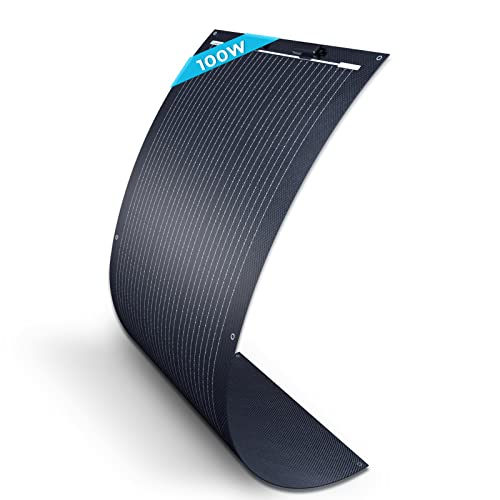
This Renogy 100W panel emphasizes high power output with a bendable design that adapts to curved surfaces. It is lightweight—about a third the weight of a rigid panel—and features half-cut PERC cell technology for better light capture and efficiency. The 240° flexibility makes it suitable for RV roofs, boats, and other irregular installations. The panel’s backers and coating are designed to resist harsh outdoor conditions, helping to sustain performance in varied climates.
Renogy Flexible 100W Semi-Flexible

This Renogy model highlights extreme flexibility and ultralight construction. Weighing substantially less than rigid panels, it is easy to transport and install. The panel’s ultra-thin lamination minimizes visibility on surfaces and reduces weight while remaining durable enough for irregular installations. It is an attractive option for stealthy setups in caravans and RVs where a low-profile solar solution is desired.
Callsun 100W Ultra-Thin Flexible Panel
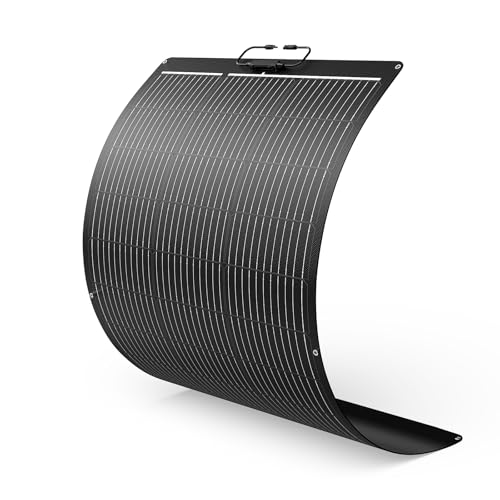
Callsun’s 100W panel offers a 240° bendable design with a lightweight, ultra-thin profile. The panel uses ETFE coating and a robust multi-layer construction to resist UV exposure, salt spray, and weathering—an important consideration for marine and RV use. It integrates well with portable power stations and solar generators, providing a reliable charge for battery banks on irregular surfaces.
XINPUGUANG 100W Flexible Panel

This XINPUGUANG model uses high-efficiency 210mm monocrystalline cells and offers 260° bend tolerance. It weighs about 4.0 pounds and is framed with a fiberglass structure for durability. An IP67 rating helps resist water ingress and weather exposure, making it suitable for RVs, boats, and other off-grid installations where flexibility and ruggedness are required.
Topunive 100W Flexible Panel

Topunive’s 100W panel emphasizes extreme flexibility with a compact form factor. It specifies a minimum bend radius of about 17.7 inches, allowing installation on many curved surfaces. At roughly 4.4 pounds, it remains portable, and the 9 Busbar (9BB) design improves current flow and efficiency. The panel is designed to reduce microcracks and extend service life on dynamic installations such as RVs and yachts.
Buying Guide: Key Purchase Considerations
- Flexibility and bend radius: Check manufacturer claims for maximum bending angle and minimum mounting radius. A smaller radius enables installation on tighter curves but may affect longevity if bent excessively.
- Weight and thickness: Lighter panels are easier to handle for portable setups. Ultra-thin laminates reduce visibility on roofs but ensure adequate mounting support to avoid flex damage.
- Cell technology: Panels with PERC or multi-busbar (9BB/11BB) designs typically offer better light capture and higher efficiency, especially in low light.
- Durability: Look for ETFE or high-quality coatings, IP ratings (IP67), and robust frames or laminates to withstand rain, salt spray, and wind.
- Compatibility: Consider how well the panel pairs with existing battery banks, controllers, and solar generators. Plug-and-play connectors can simplify setup.
- Installation method: Plan for mounting hardware and ventilation. Avoid sealing panels on combustible materials and ensure sufficient airflow beneath the panel to manage heat.
- Warranty and support: Check the warranty terms and manufacturer support for long-term reliability on off-grid adventures.