Best Fan and Light Controller for Smooth, Smart Comfort
Looking for a reliable way to manage ceiling fans and their lights from a single control or app? This guide highlights five top fan and light controllers that fit common AC and DC ceiling fans, with clear suitability notes for different setups. Each option is explained by who it’s best for, what it controls, and a practical caution to help you avoid mismatches. The products below are ranked for easy comparison and quick decision-making, whether you want a wall control, a remote kit, or a smart hub that works with voice assistants.
Summary of selected products:
| Product | Best For | Key Advantage | Note |
|---|---|---|---|
| LPHUMEX Universal Ceiling Fan Remote Kit | Traditional AC motor fans with remote preference | 3-in-1 remote with timing, speed, and light control | Not compatible with DC motors |
| UC9050T Universal Ceiling Fan Control | Remote-free wall control users | Three speeds with a main power switch and light dimmer | Requires a separate receiver for full function |
| Kasa KS240 Smart Ceiling Fan Control | Smart homes and voice control users | 4 speeds and adjustable brightness with HomeKit/Alexa/Google | Wi‑Fi only, needs compatible wiring |
| uaelua Universal DC Ceiling Fan Remote | DC motor fans needing remote with 6 speeds | 6-speed and 3 timing settings, light on/off | Not suitable for AC motor fans |
| Leviton SureSlide Ceiling Fan Control | Users needing separate fan and light control | Dedicated fan speed and compact dimming for LED compatibility | Requires compatible wiring and LED dimming support |
LPHUMEX Universal Ceiling Fan Remote Kit
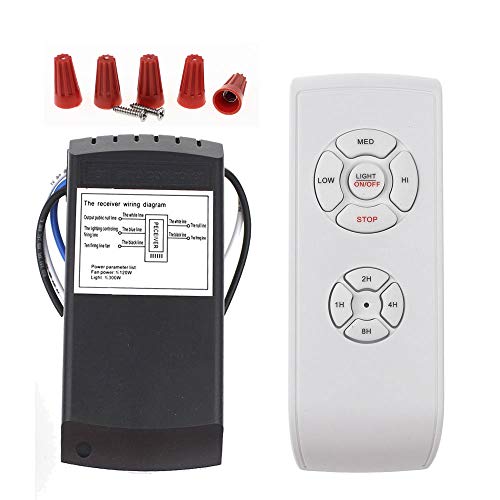
Best for traditional AC motor ceiling fans that need a single remote for speed, light, and timer functions. This kit installs without removing the light kit or blades, using a standard 5-wire hookup. It is explicitly labeled for AC motors only, with a caution to verify motor type before purchase. The receiver size is 4.53″x1.97″x1.06″, so check canopy space to ensure a proper fit. Choose this if you want a straightforward, integrated remote experience.
Who this is for: Homeowners with regular AC-powered ceiling fans seeking remote convenience without complex wiring. Ideal for upgrades from a basic pull chain remote.
Why selected: Combines simplicity of installation with broad compatibility across common fan brands, plus a clear limitation note to prevent incompatibility with DC motors.
Caution: Not compatible with DC motor fans or slim canopies where the receiver won’t fit. If your canopy space is tight, consider an Ultra-Small Receiver option from the same family.
UC9050T Universal Ceiling Fan Control

This option acts as a transmit-only wall unit that works with a separate receiver. It provides three fan speeds and a main power switch, along with a lighting adjustment that is suitable for incandescent bulbs. Reverse functionality depends on the fan’s own wiring. Choose this when you want a dedicated wall control with simple, reliable operation and you already plan to pair it with a compatible receiver.
Who this is for: Homes with a wall-mounted control preference and existing compatible receivers. Good for users who want a traditional wall experience without a comprehensive smart hub.
Why selected: Clear speed controls and a built-in main power switch offer intuitive operation, while the lighting control supports basic dimming in compatible setups.
Caution: It is a transmitter-only unit; a receiver must be installed separately for full fan and light control.
Kasa KS240 Smart Ceiling Fan Control

Best for smart-home enthusiasts who want voice control and app-based customization. The KS240 supports four fan speeds and adjustable brightness, with compatibility for Apple HomeKit, Amazon Alexa, and Google Assistant. It requires 2.4 GHz Wi-Fi and suitable wiring with a neutral line. This is a strong pick if you want to integrate lighting and fan control into routines and scenes.
Who this is for: Households investing in a smart home ecosystem who want hands-free control and scheduled automation.
Why selected: Combines flexible fan speeds with dimmable lighting and broad voice assistant compatibility, making it a future-proof choice for smart homes.
Caution: Requires compatible wiring and a functioning neutral line; setup may be more complex than traditional remotes.
uaelua Universal DC Ceiling Fan Remote

Best for DC motor ceiling fans seeking six-speed control plus timing and light on/off. This remote is designed specifically for 24V DC motors and should not be used with AC motor fans. It offers high/medium/low speeds, 1H/2H/4H timers, and forward/reverse control, with a dedicated light on/off button. Choose this if your fan uses a DC motor and you want precise speed customization and timing features.
Who this is for: DC motor ceiling fans where a remote with many speed options and timer settings is desired.
Why selected: The six-speed capability and multiple timing options provide refined control for DC motors, enhancing comfort and energy use management.
Caution: Not compatible with AC motors; verify motor type before purchase to avoid incompatibility.
Leviton SureSlide Ceiling Fan Control

Best for users who want separate fan and dimmer controls in a single device. This Leviton unit is designed to work with ceiling fans that have lights, offering independent fan speed and light dimming. It is particularly suitable for LED lighting and incandescent, halogen, and CFL bulbs, with an adjustment switch to minimize flicker. Consider this if you need precise division of functions on a single wall control.
Who this is for: Homes that want a dedicated fan speed control alongside a dimmer for lighting, especially with LED-friendly performance.
Why selected: Clear separation of fan and light control, plus features aimed at reducing flicker and improving dimming range for compatible bulbs.
Caution: Ensure your wiring supports a single-pole dimmer alongside a separate fan control and that your bulbs are dimmable.
Buying Guide
What should you check before buying a fan and light controller?
- Motor type: Confirm AC vs DC. Some remotes or kits work only with AC motors, others with DC motors. Using the wrong type will cause non-function or damage.
- Receiver space: If the canopy is tight, measure carefully. Some receivers require more room than slim fixtures provide.
- Wiring and neutral: Certain devices need a neutral wire and a compliant single-pole or multi-pole wiring setup. Verify your ceiling box configuration.
- Smart home compatibility: For voice assistants, ensure your hub or device supports your ecosystem (HomeKit, Alexa, Google). Check 2.4 GHz network requirements where applicable.
- Dimmer compatibility: LED compatibility varies. Some dimmers only work with incandescent or guzzle-lamp types. Check bulb compatibility before buying.
- Installation complexity: Some products are wall-mounted controls, others are remote kits inside the canopy. Choose based on your installation preference and DIY comfort.
- Future-proofing: If you plan to upgrade to a smart home setup, prioritize products with ongoing updates and broader ecosystem support.
FAQ
- Do these controllers work with all ceiling fans?
- Is a receiver required for wall control models?
- Will these work with smart home systems?
- Can I install these myself?
- Do dimmers affect LED brightness differently?
- What if the canopy is too small?
Not always. Some are designed for AC motors, others for DC motors. Always check motor type and compatibility notes before purchasing.
Many wall controls require a separate receiver to enable full fan and light control. Verify whether the product bundle includes a receiver or requires one.
Smart options like KS240 provide compatibility with HomeKit, Alexa, and Google Assistant. Other models may rely on simple infrared or radio remotes without smart integration.
Most kits are designed for DIY installation, but some require wiring changes. Follow the manufacturer’s instructions and ensure power is off during installation.
Yes. Some dimmers support LED bulbs without flicker, while others may cause flicker at low levels. Check the dimmer’s LED compatibility notes.
Check for an ultra-small receiver option or consider a different product designed for slim fixtures.