Best 4-Way Solenoid Valves for Pneumatic Systems
This article explores top 4-way solenoid valves from reliable brands, highlighting key specs, operating voltages, and practical use cases. Whether you’re upgrading a control system or designing a new pneumatic setup, these valves offer reliable 2-position, 5-way configurations suitable for various actuation needs in industrial and hobbyist projects.
| Product | Brand | Voltage | Configuration | Notes |
|---|---|---|---|---|
| TAILONZ PNEUMATIC 4V210-08 DC24V | TAILONZ PNEUMATIC | DC24V | 2-Position, 5-Way | Junction Box design |
| 4-Way Solenoid Valve 1/4″ (12-Volt) | HFX | DC12V | 2-Position, 4-Way | Air flow direction shift; good lift capacity |
| Buyers Products BAV050SA | Buyers Products Company | Not specified here | 2-Position, 4-Way | Remote control compatible; adaptable to multiple systems |
| Velvac 320178 | Velvac | Not specified here | 2-Position, 4-Way | Air-piloted assist; robust hardware |
| CNZG PNEU 4V210-08 DC12V | CNZG PNEU | DC12V | 2-Position, 5-Way | Out of Line kit; comes with fittings |
Choosing the right 4-way solenoid valve involves evaluating voltage compatibility, port configuration, and environmental tolerance. The selections below cover a range of voltages (12V and 24V DC, plus an AC option), mounting styles, and connection types, helping you match a valve to your actuator, cylinder type, and control logic. Each product includes practical features that influence ease of installation, maintenance, and long-term performance.
TAILONZ PNEUMATIC 2-Position 5-Way DC12V Valve

The TAILONZ DC12V model is a 2-position, 5-way valve with an outlet wire configuration. It operates on DC12V and supports a working pressure range of 25 to 116 psi, with a temperature range from 32 to 140 °F. Its principle toggles the valve open when powered off and closes when powered on, enabling straightforward control in compact pneumatic circuits. The design suits compact automation projects and hobbyist rigs that require reliable valve behavior with minimal wiring complexity.
TAILONZ PNEUMATIC 4V210-08 DC24V Valve With Junction Box

This version uses DC24V with a junction box for convenient wiring and integration into larger control panels. It features a 2-position, 5-way configuration and shares the same electrical behavior: the valve opens when power is removed and closes when power is applied. Its compact footprint makes it suitable for space-constrained installations, including automated hobby rigs and lightweight industrial setups.
HFX 4-Way Solenoid Valve 1/4″ 12-Volt

The HFX valve uses a 1/4″ port size with a 12-volt coil, designed for 4-way operation and enhanced air flow. It includes an exhaust port for venting and supports improved lift performance for certain pneumatic fixtures. The valve accommodates single-acting cylinders with or without bleed paths, with venting through the exhaust port if opened. This makes it a versatile choice for hobbyist projects requiring higher lift or quick cycling.
Buyers Products BAV050SA 4-Way Valve

The Buyers Products BAV050SA handles 4-way, 2-position control with the flexibility to convert to 3-way operation. It is commonly used in tailgate cylinder applications and broader pneumatic installations. Its remote-control compatibility and straightforward installation support streamlined integration into vehicle-mounted or stationary pneumatic systems, enabling remote actuation and safer operation in field environments.
Velvac 320178 4-Way 2-Position Valve

The Velvac 320178 model features a four-way, two-position configuration with air-piloted assist and stainless steel hardware for durability. It is designed for higher reliability under demanding cycles and typical operating pressures around the 100 psi range. The valve supports standard On/Off control and is compatible with single-acting or pressure double-acting cylinders, making it suitable for vehicle and industrial pneumatic systems alike.
TAILONZ PNEUMATIC 4V210-08 AC110V Valve
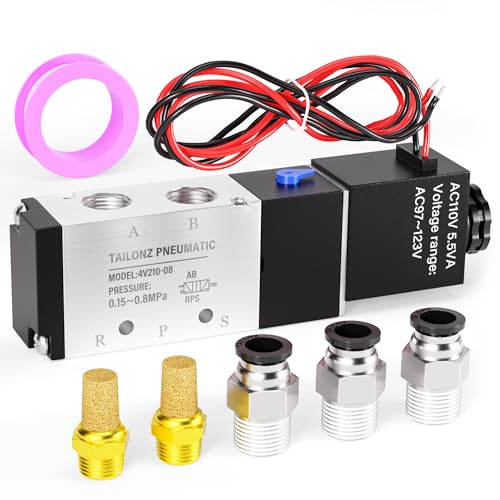
This AC110V version mirrors the DC counterparts with the same 2-position, 5-way configuration and outlet wire setup. It supports the same operational principles—valve opens when powered off and closes on power. The AC variant is suitable where 120V supply is standard and can be integrated into fixed automation panels or industrial control circuits requiring AC operation.
Buying Guide: Key Purchase Considerations
When selecting a 4-way solenoid valve, consider the following factors to ensure compatibility and reliability across applications:
- Voltage and power supply: Choose a DC12V, DC24V, or AC variant that matches your system’s power source and switching logic. Ensure your control electronics can drive the coil without excessive current draw.
- Port configuration and size: Confirm port counts (1/4″ NPT is common) and the exact arrangement (inlet, outlet, exhaust) to fit your cylinder type and piping layout. An exhaust port is important for venting in most setups.
- Pressure and temperature range: Verify operating pressure and ambient temperatures to avoid valve damage or performance loss in harsh environments.
- Actuation behavior: Most 4-way valves operate so that the coil being powered off yields an open state, while powering the coil closes the valve. Ensure this aligns with your control logic and safety requirements.
- Mounting and enclosure: Junction box versions simplify wiring, while compact inline models fit tight spaces. Consider IP ratings or enclosure options if dust, moisture, or outdoor use is a factor.
- Material and durability: Look for corrosion-resistant housing and robust seals for longevity in industrial settings. Stainless components and reinforced seals extend life in demanding cycles.
- Installation support: Some packages include fittings, mufflers, and PTFE tape, which can reduce setup time. Review included accessories to gauge total setup effort.
- Maintenance and serviceability: Valve design that allows easy inspection, cleaning, and replacement of seals improves uptime in continuous operation.
These considerations help balance performance, cost, and installation complexity. For beginners, starting with a valve that includes wiring harnesses or a junction box can simplify the initial setup. For advanced automation, choose components with remote actuation options and rugged housings to withstand industrial duty.