Best Energy Meter Monitoring System for Real-Time Home Power Tracking
Answering the key question, this guide highlights top energy meter monitoring systems that help you track real-time electricity usage, detect solar/net metering activity, and optimize household energy efficiency. These picks are suited for homeowners, renters managing shared spaces, and property managers seeking reliable, UL-certified options. Each product section explains who it’s best for, why it was selected, and a practical limitation to consider. A concise buying guide and FAQ follow to help compare features and align with your setup.
| Product | Best For | |
|---|---|---|
| Emporia Vue 3 | Single-family homes with solar/net metering | UL Listed safety and panel installation |
| Fusion Energy Monitor | Rental homes and shared apartments | 16 sensors for broad circuit coverage |
| Eyedro Home | Smart budgeting with cloud access | Real-time data and solar/net metering support |
| LyteSolar Smart Monitor | Homes with Tuya/Smart Life ecosystem | Dual-channel real-time monitoring |
| DAE P254/P256 Series | Multi-circuit or commercial-scale meters | UL/cUL listings and cloud metering options |
Emporia Vue 3 Home Energy Monitor
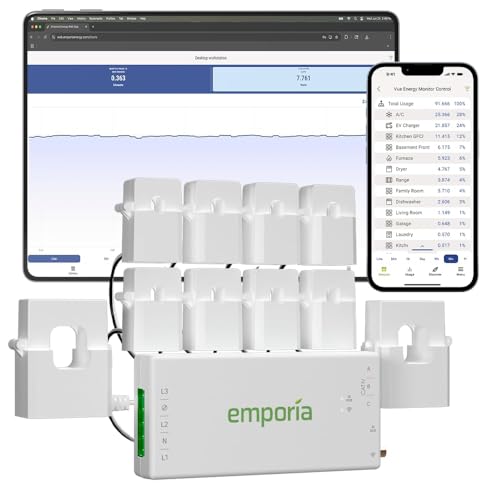
The Emporia Vue 3 is a UL Listed home energy monitor designed for safe, real-time energy tracking. Its installation in the circuit panel uses clamp-on sensors and supports single-phase, split-phase, and certain three-phase configurations with an additional sensor sold separately. This model shines for buyers seeking strong safety certification and robust solar/net metering monitoring, making it well suited for homeowners who want continuous, automated energy management with peace of mind.
Best for: Homeowners prioritizing UL safety certification and straightforward panel installation. Why selected: Trusted safety standards, continuous monitoring, and solar/net metering visibility help manage energy use and costs. Limitation: Larger three-phase setups may require the extra 200A sensor for full coverage.
Fusion Energy Smart Home Monitor (16 Sensors)

This model provides 16 50A sensors to independently monitor major circuits and high-power appliances. It is compatible with standard US single-phase and three-phase systems and integrates with Home Assistant for broader smart home automation. It’s a solid choice for renters or multi-occupant spaces where you want detailed per-circuit visibility and cloud-enabled access without a subscription.
Best for: Rental homes or shared apartments needing per-circuit insight. Why selected: Broad sensor coverage and flexible phase compatibility. Limitation: Some users may need extra sensors or bundles for different phase configurations.
Eyedro Home Energy Monitor

The Eyedro Home Energy Monitor offers real-time electricity usage data with robust solar/net metering support and built-in reporting via the MyEyedro cloud. It functions as a whole-home monitor or solar meter, giving cost-focused visibility and the ability to visualize watts, amps, and volts. It is suitable for households seeking 24/7 monitoring with cross-device visibility and easy cloud access without ongoing subscriptions.
Best for: Households aiming to track power costs in real time with cloud access. Why selected: Clear dollar-based insights and solar/net metering compatibility. Limitation: Requires cloud access setup and may need network stability for uninterrupted monitoring.
LyteSolar Smart Home Monitor 2×80A

This dual-channel monitor uses two independent 80A sensors to track major household circuits and higher-demand appliances. It works with Tuya/Smart Life apps for real-time data and offers bi-directional monitoring—helpful for homes with solar or backup power. Best for: Smart home users who want Tuya/Smart Life integration and clear, channel-by-channel insight. Limitation: 160A total monitoring capacity may be limiting for very large or heavily branched circuits.
DAE P254-400 Submeter Kit

The DAE P254-400 Kit is UL/cUL listed for 3-phase 4-wire and 3-phase 3-wire configurations with the option for 2- or 3-CT setups. It supports cloud metering via the CC2030 Gateway, enabling data collection and basic TOU billing reports. This kit is well suited for property managers and larger installations seeking scalable submetering with cloud access.
Best for: Multi-tenant buildings needing scalable, UL-listed metering. Why selected: Comprehensive phase support and cloud metering options. Limitation: Indoor-only focus unless additional enclosures are used.
DAE P256-1000 KIT

The P256-1000 KIT expands capacity with a UL 1000A rating and 3 CTs suitable for larger commercial or multi-tenant setups. It includes RS485 communications and optional cloud metering through the CC2030 Gateway, enabling remote data access and TOU reporting. This option is ideal for property managers overseeing larger electrical installations.
Best for: Larger scale or commercial-grade metering. Why selected: High amperage capacity and flexible cloud metering integration. Limitation: Higher complexity may require more careful installation planning.
Buying Guide
What should influence your pick? Start with safety certification, ease of installation, and the number of circuits you need monitored. If you have solar, ensure net metering visibility is included. Consider whether you prefer cloud access without ongoing subscriptions, and whether app ecosystems (like Home Assistant or Tuya/Smart Life) will integrate with your existing smart home setup.
Key considerations
- Certification and safety: UL/cUL listings indicate compliance with electrical safety standards.
- System type: Confirm single-phase, split-phase, or three-phase compatibility with your electrical service.
- Sensor count and amperage: Match the number and rating of CTs to your main circuits and high-load appliances.
- Remote monitoring: Cloud access vs. local data storage; look for data history and export options.
- Solar and net metering: Ensure compatibility to track solar production and grid interaction.
- Integration: App support and compatibility with smart home ecosystems you already use.
Practical questions
- Is UL safety certification important for you? If yes, prefer models like Emporia Vue 3 or Meross with UL/ETL compliance.
- How many circuits do you need to monitor? Choose a kit that covers your total circuit count or offers scalable expansion.
- Do you need multi-tenant monitoring? Look for cloud metering and TOU reporting features in larger kits.
- Do you require real-time alerts? Models with smart alerts can flag abnormal usage and potential issues.
FAQ
- What is an energy meter monitoring system? An energy meter monitoring system tracks real-time electricity usage, often across multiple circuits, and can include solar/net metering data for comprehensive energy management.
- Do these systems require professional installation? Many systems install in the circuit panel with clamp-on CT sensors, but some configurations may benefit from professional wiring for complex three-phase setups.
- Can I monitor solar production with these meters? Yes, several options provide solar or net metering data alongside main power usage.
- Will these monitors work with smart home platforms? Several models support Home Assistant, Tuya/Smart Life, or cloud-based dashboards for remote access.
- What is a CT sensor, and why does it matter? CT sensors clamp around a conductor to measure current; the sensor rating determines what amperage you can safely monitor.