Best Electric Charging Stations for Cars: Top Home Chargers for 2026
Choosing the right home charging station can simplify daily electric vehicle (EV) ownership. This guide highlights five reliable options, spanning hardwired, plug-in, and smart-networked chargers. Each product is evaluated for power, ease of use, safety, and connectivity to help American drivers pick a model that fits their garage, driveway, and lifestyle. Use the buying guide at the end to compare key considerations and see how these chargers stack up against common needs.
| Product | Brand | Type | Key Strength |
|---|---|---|---|
| ChargePoint HomeFlex (Hardwired) | ChargePoint | Level 2, J1772 | High flexibility and broad network access |
| ChargePoint HomeFlex (NEMA 14-50) | ChargePoint | Level 2, J1772 | Plug-and-play with 14-50 outlet compatibility |
| EVIQO Level 2 48 Amp | EVIQO | Hardwired | Fast charging with app-based scheduling |
| NexCyber Level 2 EV Charger | NexCyber | WiFi-enabled, 48A | Versatile plug-or-hardwire options |
| EVIQO Level 2 EV Charger (NEMA 14-50 Plug) | EVIQO | NEMA 14-50 Plug | Easy setup for 40–48A with smart controls |
ChargePoint HomeFlex Hardwired for EVs

ChargePoint’s HomeFlex provides flexible Level 2 charging with J1772 compatibility. Built for home, business, and fleets, it includes 24/7 support and access to a vast network of charging locations. The accompanying ChargePoint Mobile App enables charger control, reminders, smart home integration, and data access. Connectivity may require WiFi for full functionality, ensuring users can troubleshoot and receive feature updates.
ChargePoint HomeFlex with NEMA 14-50 Plug

This version offers the same trusted ChargePoint experience with a NEMA 14-50 plug, enabling quick, plug-and-play installation where a hardwired setup isn’t practical. The charger still leverages the ChargePoint app for monitoring, scheduling, and smart home integration, backed by a broad North American network.
EVIQO 48 Amp Level 2 Charger
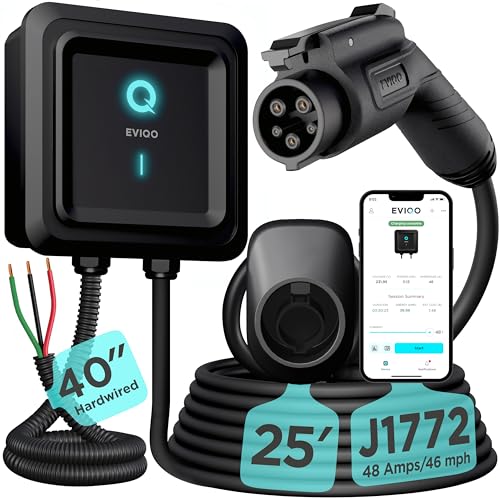
EVIQO’s wall-mounted Level 2 charger delivers up to 11.5 kW on a 60A circuit and offers 3-year warranty. It supports adjustable current via the app and hardware controls, with safety certifications (UL, Energy Star, ETL, FCC). The unit is designed for indoor or outdoor use, with weatherproof housing and smart scheduling to optimize charging costs.
NexCyber Level 2 EV Charger

NexCyber offers a versatile Level 2 EV charging solution with 48A capacity and a 25-foot cable. It supports both plug-in (NEMA 14-50) and hardwired configurations, with J1772 compatibility for most North American EVs and PHEVs. The charger is ETL and FCC certified, and includes app-based control and remote firmware updates to enhance performance over time.
EVIQO Level 2 EV Charger (NEMA 14-50 Plug)

This EVIQO model uses a NEMA 14-50 plug for easy installation and supports up to 40A (9.6 kWh) or 48A with hardwiring. It is UL, Energy Star, and IP-rated for weather resistance, with a user-friendly app for schedules, usage tracking, and firmware updates. The combination of safety certifications and smart features makes it a practical home charging option.
Buying Guide: Key Purchase Considerations
- Power needs: Determine whether you need a 32A, 40A, or 48A charger. A higher amperage charger can shorten charging times but may require a dedicated circuit and professional electrical work.
- Hardwired vs. plug-in: Hardwired units typically offer a neater installation and potentially better protection, while plug-in units provide easier relocation or replacement.
- Connector compatibility: All listed products use the J1772 connector, which covers most non-Tesla EVs. Tesla owners may need adapters or a different solution for full compatibility.
- Smart features: Look for app control, charging scheduling, energy usage data, and firmware updates. WiFi or network connectivity may be essential for full functionality.
- Weather and durability: Outdoor-rated housings with proper IP ratings and UL/ETL certifications ensure safe operation in varying climates.
- Network access: Some chargers rely on roaming networks or require subscription for location access. Consider how important roaming access is for your trips.
- Installation considerations: Check for required clearances, circuit capacity, and whether a licensed electrician is needed for installation or hardwiring.
- Warranty and support: A longer warranty and robust customer support can reduce long-term ownership risk, especially for home setups.
- Future-proofing: If you anticipate upgrading to faster charging or expanding to multiple EVs, choose a charger with scalable amperage or flexible installation options.
These options balance reliability, ease of use, and network connectivity. For many homeowners, a Level 2 charger with smart app features and a flexible installation approach provides the best mix of speed, convenience, and future-proofing.