Best Electric Roof Heating Cables for Ice Dam Prevention and Roof Protection
Electric roof heating cables are designed to prevent ice dams, melt snow, and protect gutters and downspouts. This guide showcases five reliable options from Frost King, TOPDURE, and HEATIT, highlighting who each product suits best, notable limitations, and why they’re chosen. Ideal buyers include homeowners seeking simple, pre-assembled kits for mid-sized to large roofs, DIYers planning seasonal de-icing, and property managers needing dependable installation-ready solutions.
| Product | Length | Wattage |
|---|---|---|
| Frost King RC160 | 160 ft | 800 W |
| Frost King RC100 | 100 ft | 5 W/ft (approx 500 W) |
| Frost King RC200 | 200 ft | 1000 W |
| TOPDURE 160 ft | 160 ft | 5 W/ft |
| HEATIT 100 ft | 100 ft | 8 W/ft (approx 800 W) |
Frost King RC160 Electric Roof Cable Kit

Product overview shows 120V and 800W power with 160 feet of cable. It is pre-assembled and ready to install, with instructions included for straightforward setup. Best for medium- to large-sized roof edges where a single, long run is needed. The kit’s pre-assembled design reduces DIY complexity and install time, making it suitable for homeowners who want a quick, turnkey solution. A potential limitation is that the entire run is fixed; verify roof dimensions before purchase to avoid gaps in coverage.
Frost King RC100 Automatic Roof Cable Kit

This 100-foot kit operates at 120V with 5 watts per foot, offering automatic de-icing with pre-assembled components and included instructions. It’s well-suited for smaller roof sections or corners where heat should focus on critical areas like gutters and eaves. It’s a solid choice for budget-conscious homeowners who want a simple, ready-to-install solution. A caveat is that shorter runs may not cover larger roof spans without additional extensions or multiple kits.
Frost King RC200 Electric Roof Cable Kit

RC200 expands coverage with 200 feet of heated cable at 120V and 1000W. It’s designed for larger roof areas or sites with deeper eaves where more warmth is needed. The kit remains pre-assembled for easier installation, with clear instructions. Best for homeowners needing broader ice-dam protection across longer gutter lines. Limitation: higher wattage may require careful circuit planning to accommodate multiple devices on the same circuit.
TOPDURE 160ft Roof and Gutter Heat Cables

TOPDURE’s 160-foot cable uses a constant wattage approach and emphasizes safety certifications (ETL and CSA). It is engineered to prevent ice dam formation on roofs, gutters, and downspouts, with suitability for metal or plastic gutters and various roof types. It’s a strong option for buyers prioritizing certified safety and a shield against leaks and water damage. A notable caution is to avoid letting heated sections cross or overlap with other cables to prevent overheating or electrical issues.
HEATIT 100ft Self-Regulating Roof Cable
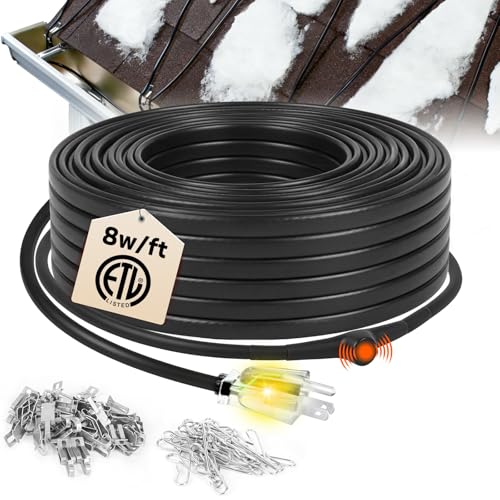
HEATIT’s 100-foot self-regulating cable features ETL certification with full cable safety, and a self-regulating design that reduces risk of overheating by adjusting power along the length. Best for homeowners who want adaptive heat that responds to ambient conditions, while still offering robust coverage for smaller to mid-sized roof sections. It may be less ideal for very large roofs unless paired with multiple runs. The product also emphasizes versatility beyond roofs, including pipe freeze protection and gutters.
Buying Guide
- Match the total length to your roof edge, gutters, and downspouts. Longer cables cover more area but require careful planning for circuits and power supply.
- Wattage and power delivery: Higher wattage provides quicker melt but demands a larger electrical load. Plan circuits to avoid tripping breakers.
- Self-regulating vs fixed wattage: Self-regulating cables adjust heat along the length, reducing overheating risk; fixed-wattage cables provide uniform heat but require proper spacing and placement.
- Certifications: ETL and CSA certifications indicate compliance with safety standards. Prefer fully certified products for comprehensive safety assurances.
- Installation and maintenance: Pre-assembled kits simplify DIY setup. Consider mounting hardware, weatherproofing, and inspection routines for seasonal use.
- Roof material compatibility: Ensure compatibility with your roof surface (metal, asphalt shingles, tile, etc.) and downspout configurations.
FAQ
- What is an ice dam? An ice dam forms when melted snow refreezes at the roof edge, causing water backup and potential leaks.
- Do these cables require professional installation? Many kits are designed for do-it-yourself installation, but always follow manufacturer instructions and local electrical codes.
- Can I run multiple cables on one circuit? Yes, but ensure the total wattage does not exceed the circuit rating and use GFCI protection where required.
- How do I choose between self-regulating and fixed wattage? Self-regulating cables adapt to temperature, reducing risk of overheating. Fixed wattage is reliable when heat needs are predictable.
- Are these cables suitable for pipes and gutters too? Many models support both roof de-icing and gutter protection, but confirm application compatibility in the product specs.
- What maintenance is needed? Inspect cables and connections annually, ensure weatherproofing remains intact, and remove debris from heat path areas.