Best Dual Technology Occupancy Sensor Guide for Modern Spaces
Dual technology occupancy sensors combine passive infrared (PIR) and ultrasonic or other sensing to improve accuracy and reduce false triggers. This guide highlights top dual-tech sensors ideal for offices, corridors, classrooms, and restrooms. Each entry covers key features, coverage, and installation considerations to help facility managers choose the right model.
| Product | Brand | Key Coverage / Range | Technology |
|---|---|---|---|
| ENERLITES MDC-50L-Stickered Ultrasonic and PIR Dual Technology Occupancy Sensor | ENERLITES | 360° field of view, up to 1,600 sq ft | PIR + Ultrasonic |
| Enerlites MWOS-W Motion Sensor Switch | ENERLITES | Room-scale detection, suitable for offices | PIR + Ultrasonic |
| ENERLITES Ultrasonic and PIR Dual Technology Occupancy Sensor MDC-50V-W | ENERLITES | 1,600 sq ft coverage (ceiling mount) | PIR + Ultrasonic |
| SensorSwitch Ceiling Motion Sensor, PDT Dual Technology | Lithonia Lighting | Up to 360° coverage in typical ceilings | PIR + Microphonics |
| Lutron MS-B102-WH Maestro Dual Tech Occupancy Sensor | Lutron | Multi-location capable, 6A lighting | PIR + Ultrasonic |
ENERLITES MDC-50L-Stickered Ultrasonic and PIR Dual Technology Occupancy Sensor

This dual-tech ceiling sensor combines passive infrared and ultrasonic detection to deliver highly accurate occupancy sensing. The ultrasonic element can detect fine movements, such as typing or page-turning, helping prevent false offs. It operates on low voltage for energy efficiency and offers six trigger modes that blend PIR and ultrasonic sensing. Adjustable time delays (5 seconds to 30 minutes) via dip switches allow tailoring to room use and occupancy patterns. Ideal for large conference rooms, lobbies, and open plan offices where precise control is critical.
Enerlites MWOS-W Dual Technology Motion Sensor Switch

The MWOS-W combines PIR and ultrasonic sensing in a single motion sensor switch, designed to detect fine movements such as typing or reading. The dual-tech approach reduces false positives by ensuring the lights stay on when the space is still occupied. This model is suitable for private or executive offices, meeting rooms, restrooms, libraries, and classrooms where movements are limited but occupancy should be reliably detected. It requires neutral wiring and includes a white wall plate for easy installation.
ENERLITES Ultrasonic and PIR Dual Technology Occupancy Sensor MDC-50V-W
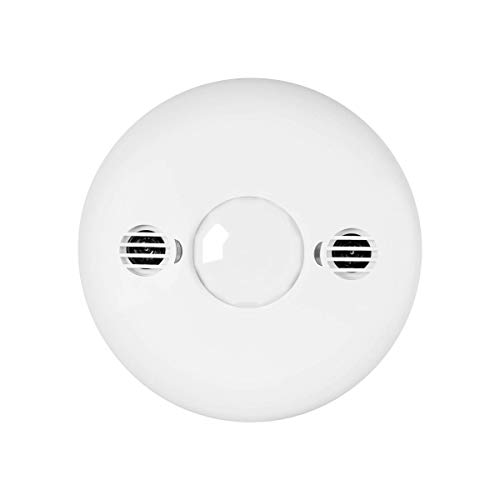
This ceiling-mounted dual-technology sensor covers up to 1,600 sq ft and uses both PIR and ultrasonic detection for reliable occupancy sensing. It features six trigger modes that combine PIR and ultrasonic data to minimize false triggers while maintaining sensitivity to genuine movement, including fine actions like pages turning. The unit is designed for commercial-grade performance and includes adjustable time delays from 5 seconds to 30 minutes, making it versatile for large offices, classrooms, and retail spaces.
SensorSwitch Ceiling Motion Sensor, PDT Dual Technology

From Lithonia Lighting, this dual technology (PIR plus microphonics) ceiling sensor provides 360° conical coverage, optimized for detecting subtle motions within a 12 ft radius. It is designed for easy ceiling installation and includes mounting hardware suitable for ceiling tiles, grids, or octagonal boxes. The PDT approach helps minimize nuisance trips in shared spaces like private offices, conference rooms, and suites, ensuring lighting remains on when occupancy is present.
Lutron MS-B102-WH Maestro Dual Tech Occupancy Sensor

The Lutron MS-B102-WH combines PIR and ultrasonic sensing for accurate occupancy detection across multi-location setups. It provides a 6-amp lighting capacity, with straightforward setup to adjust timeout and sensitivity. The dual sensing technology helps detect very fine motion, such as typing at a desk or reading, improving energy savings without compromising user comfort in offices, classrooms, or conference rooms.
Buying Guide: Key Purchase Considerations
- Coverage and mounting: Determine room size and ceiling height to choose a sensor with appropriate range and ceiling-mount capability. Large spaces may benefit from dual-tech models with 360° coverage and higher sq ft ratings.
- Detection technologies: Compare PIR with ultrasonic, microphonics, or humidity-linked sensing. Dual-tech often reduces false shutdowns due to minor or non-occupant movements, but may require more complex installation.
- Wiring and voltage: Verify supply requirements (line voltage vs. low voltage, neutral wire needs) and ensure compatibility with existing electrical boxes and circuits.
- Time delays and sensitivity: Look for adjustable dip switches or programming that tailor timeout delays from seconds to minutes, and sensitivity settings to match room usage.
- Installation environment: Consider moisture sensitivity, cleanroom or restroom use, and compatibility with ceiling tiles or grid systems for quick mounting.
- Fixture compatibility: Check if integration with existing lighting controls or building management systems is needed, including 3-way or multi-location configurations for places with multiple entry points.
- Maintenance and diagnostics: Some models offer status indicators, test modes, or warranty terms. Evaluate long-term serviceability and replacement parts.
- Cost vs. benefit: While dual-tech sensors may have higher upfront costs, savings from energy efficiency and reduced maintenance can justify the investment in commercial settings.
These reviewed models emphasize reliability in busy environments, with features designed to minimize false triggers while ensuring lights respond promptly to occupancy. When selecting a unit, prioritize coverage, mounting compatibility, and the type of sensing technology that best matches room usage patterns and wiring capabilities.