Best Dual Power Transfer Switches for Reliable Backup Power
Answering the need for uninterrupted power, these dual power transfer switches (ATS) provide automatic or manual switching between primary and backup power sources. They’re best for homeowners, small business operators, RV enthusiasts, and DIY installers who require quick, reliable transfer with safety features. The following picks emphasize clear operation, solid safety protections, and practical compatibility with common 110V/120V and 120/240V setups.
Summary of top picks
| Product | Power Rating / Voltage | Best For |
|---|---|---|
| 125 Amp 3P Dual Power Automatic Transfer Switch (JINDOUZI) | 125A, 120/240V | Industrial, commercial, and residential environments needing robust protection |
| 110V Dual Power Automatic Transfer Switch (Zgqmcgy) | 63A, 110V | Smaller setups requiring rapid transfer and dual-mode control |
| 100 Amp AC110V Automatic/Manual Transfer Switch (IGEYAPA) | 100A, 110V | Home generators and simple two-source redundancy |
| JOTTAELE Automatic Transfer Switch 2P (63A, 110V) | 63A, 110V | Emergency backup for single-phase applications |
| Mini ATS 2P 63A 110V (IGEYAPA) | 63A, 110V | DIN rail installations and compact secondary power switching |
125 Amp 3P Dual Power Automatic Transfer Switch (JINDOUZI)

Best for high-demand setups requiring seamless transitions between mains and standby power. This switch is designed for industrial, commercial, or residential environments and supports uninterrupted power to gas generators, solar, dryers, stoves, and more.
- Best for: Large homes, small businesses, or facilities needing reliable power transfer.
- Why selected: High amperage (125A) and three-pole design provides robust protection and smooth switching.
- Caution: The unit includes a lockable key feature; ensure proper handling to prevent unintended activation during maintenance.
110V Dual Power Automatic Transfer Switch (Zgqmcgy)
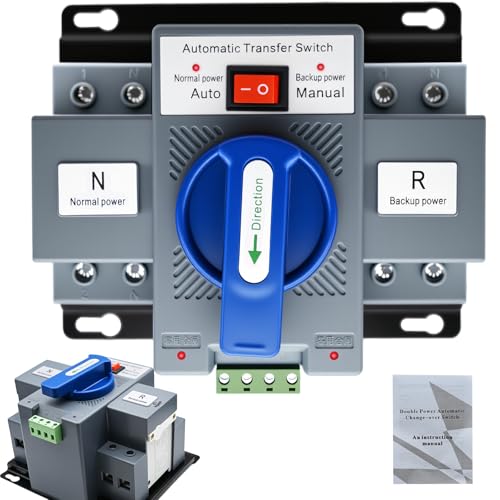
Best for compact installations that require reliable automatic switching with straightforward control. The device supports rapid transfer (about 2 seconds) and operates under 50/60Hz frequencies, making it versatile for many regional systems.
- Best for: Small workshops, cabins, or apartments needing automatic continuity.
- Why selected: Fast transfer and dual-mode operation offer flexible control for daily use.
- Caution: Verify compatibility with existing wiring and ensure proper enclosure for safety in your locale.
100Amp AC110V Automatic/Manual Transfer Switch (IGEYAPA)

Best for two-source redundancy in home or small business settings where testing resilience and ensuring continuous power matter. It supports automatic switching with rapid response and includes manual override options.
- Best for: Homes with a generator or alternative power source and basic auto/manual control needs.
- Why selected: Clear auto-switching logic and explicit wiring paths for both sources.
- Caution: The manual mode requires deliberate operation; ensure you are trained before switching sources manually.
JOTTAELE Automatic Transfer Switch 2P (63A, 110V)

Best for emergency backup for single-phase applications where two power sources must be alternated with minimal interruption. It supports auto-switching with a 2-second transfer time and offers manual mode for immediate control when needed.
- Best for: Small offices or cabins requiring reliable backup power with simple operation.
- Why selected: Balanced capabilities for automatic and manual modes with clear indication of source status.
- Caution: Ensure voltage and frequency match your local grid before installation.
Mini ATS 2P 63A 110V (IGEYAPA)

Best for DIN rail installations and compact secondary power switching where space is limited. This unit provides fast transfer and a simple auto/manual option set, suitable for small-scale UPS or essential circuits.
- Best for: DIN rail setups in electrical panels and space-constrained installations.
- Why selected: Small footprint with essential dual-source transfer capabilities.
- Caution: Verify the DIN rail compatibility and mounting clearance in your panel.
Buying Guide
What to consider when choosing a dual power transfer switch
- Voltage and current requirements: Match the switch rating to your load and source capabilities (e.g., 63A vs 125A, 110V vs 120/240V).
- Mode of operation: Decide between automatic only, manual only, or a switchable auto/manual mode to suit your installation.
- Safety features: Look for insulation protection, ground fault protection, phase loss detection, and lockable enclosures for maintenance safety.
- Physical size and mounting: Ensure enclosure type (outdoor indoor) and mounting style (DIN rail, panel) fit your space.
- Response time and transfer behavior: Faster transitions reduce risk of device shutdown or data loss in sensitive circuits.
- Connectivity and wiring: Confirm the number of poles, source compatibility (mains, generator, solar), and wiring options.
FAQ
What is an automatic transfer switch (ATS)?
An ATS automatically transfers power from the normal source to a backup source when it detects a power outage, then switches back when the normal source is restored.
Can I install an ATS myself?
Installation should follow local electrical codes. Many ATS units are designed for DIYers with basic electrical knowledge, but professional installation is recommended for high-amperage or outdoor systems.
What does “2P” or “3P” mean?
2P means two-pole switching, typically for 110V circuits. 3P means three-pole switching, used for 120/240V configurations and higher power setups.
Do ATS devices require special enclosures?
Yes, outdoor units need weatherproof enclosures or housings, while indoor units should be installed in a clean, dry panel.
What sources can an ATS connect to?
Most ATS units connect to mains power, generators, and sometimes solar or PV inverters, depending on the model and wiring.