Best 220V Split Phase Inverter Solutions for Reliable Off-Grid Power
If you need a 220V split-phase inverter setup, you’re seeking dependable pure sine wave performance for sensitive electronics, HVAC, and home appliances. This guide highlights five well-matched options, explains who they’re best for, and compares key capabilities like MPPT charging, parallel capability, and battery versatility. Whether you’re powering a tiny cabin, a RV, or a home backup system, these inverters are selected to balance efficiency, flexibility, and reliability for American buyers.
| Product | Best For | Key Feature |
|---|---|---|
| CCChosmo 5000W Hybrid Solar Inverter | Full-home off-grid setups | Parallel ready and LCD display |
| ECO-WORTHY 5000W UL1741 | Flexible parallel configurations | Battery-free operation option |
| Y&H 6.2KW Hybrid Inverter | High-demand off-grid systems | Built-in MPPT controller |
| WZRELB 4000W Split Phase | Compact, reliable split-phase power | Two 120V outputs plus hardwire |
| VEVOR Hybrid Solar Inverter | All-in-one power solution | 120A MPPT and 6kW output |
CCChosmo 5000W Hybrid Solar Inverter

Best for: Off-grid enthusiasts who need a robust, parallel-ready inverter for a home or RV setup. This unit converts 24V DC to 110V/220V AC with pure sine wave output, suitable for sensitive electronics and general household appliances. The LCD display provides real-time monitoring of input, output, and protection states, helping you manage battery health and load balance.
Why selected: The CCChosmo model emphasizes parallel expansion and energy storage compatibility, offering high efficiency (about 95%) and dual cooling fans for endurance in hot environments. It is designed to handle diverse loads while maintaining clean power delivery.
Limitations to note: While it offers a wide input range, users should confirm compatibility with their battery chemistry and ensure adequate ventilation in enclosed spaces.
ECO-WORTHY 5000W UL1741 Solar Inverter
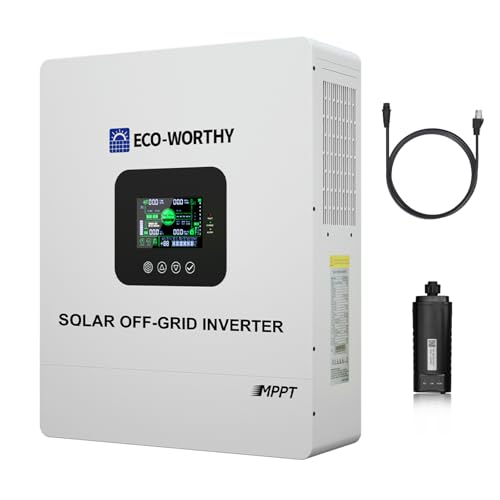
Best for: Buyers seeking flexible parallel configurations and a battery-free running option for continuous load support during grid interruptions. This inverter can operate in single or parallel configurations, producing 120V/240V outputs when multiple units are paralleled.
Why selected: It supports multiple charging modes (Only Solar, Mains Priority, Solar Priority, and Mains & Solar Hybrid), which helps tailor charging to local conditions and save energy. It’s suitable for off-grid cabins or workshops that rely on solar input and occasional mains support.
Limitation: To achieve 220V output, a minimum of two units must operate in parallel; plan for space and wiring accordingly.
Y&H 6.2KW Hybrid Inverter

Best for: Large off-grid systems where a reliable, integrated MPPT controller and pure sine wave output are essential. It supports 230VAC single-phase output and can run without batteries in some configurations, appealing to users who want flexible operation with solar power.
Why selected: The 120A MPPT controller provides strong solar charging capability, and the high PV input rating (6500W) allows abundant solar energy capture. The model balances robust charging with stable output, making it a strong option for homes facing frequent outages.
Limitation: The unit’s technical detail indicates careful management of battery voltage is needed to avoid unintended shutdowns in certain configurations.
WZRELB 4000W Split Phase Inverter

Best for: Users seeking a straightforward split-phase solution with clear dual 120V outputs and a dedicated 240V circuit option. It’s well-suited for apartments, workshops, or cabins needing reliable, clean power with straightforward wiring.
Why selected: With 4000W continuous and 8000W peak, it handles demanding loads while offering an LCD display for monitoring. The dual outputs and hardwire terminal provide flexible integration into household circuits.
Limitation: Higher loads may approach the lower end of its continuous rating; plan loads to stay within safe operating margins.
VEVOR Hybrid Solar Inverter

Best for: All-in-one power stations where versatility matters. This unit blends an inverter with a 120A MPPT controller, delivering a strong 6000W pure sine wave output at 220/230V AC and compatibility with a range of battery types.
Why selected: The integrated MPPT controller enhances solar conversion efficiency up to 94%, and a broad PV input range supports diverse solar setups. It is well-suited for off-grid homes that want a compact, reliable hybrid solution.
Limitation: Compatibility with certain battery chemistries may require configuration, and users should verify the battery bank design matches the system’s charging profile.
Buying Guide: Key Purchase Considerations
- Voltage and phase compatibility: Ensure the inverter supports 220V split-phase output for your home circuits and equipment.
- Output power and surge handling: Match continuous wattage and peak surge to your heaviest loads, like air conditioners or pumps.
- MPPT charging: Look for a high MPPT current (amperage) and a wide PV input range to maximize solar harvest in different conditions.
- Parallel capability: If you plan to scale, choose inverters that can be paralleled safely for higher total output.
- Battery compatibility: Confirm supported battery chemistries (lead-acid, LiFePO4, Li-ion) and the ability to run with or without batteries.
- Efficiency and heat management: Higher efficiency reduces losses; consider units with effective cooling for longer life.
- Monitoring: LCD displays or app-based monitoring help track voltage, current, power, and protection events in real time.
- Installation space and weight: Heavy, transformer-based models need sturdy mounting and adequate ventilation.
Frequently Asked Questions
- What is a split-phase inverter?
A split-phase inverter provides 120V and 240V outputs from a single unit, suitable for typical U.S. home circuits and 220V appliances in an off-grid setup.
- Do these inverters require batteries?
Many offer battery-free operation for short-term runs or PV-backed continuity. Batteries extend runtime and storage for outages.
- Can I run multiple inverters in parallel?
Yes, several models support parallel operation to increase total power, but follow manufacturer instructions and proper wiring to ensure safe operation.
- What should I consider for MPPT charging?
Choose models with high MPPT current and a wide PV voltage range to extract maximum energy from panels under variable conditions.
- Which is best for a cabin vs a home backup system?
Cabins benefit from rugged, hybrid inverters with battery support and reliable cooling. Home backup often requires higher continuous power and parallel scalability.
- Is pure sine wave essential?
Yes. Pure sine wave output protects sensitive electronics and ensures smooth operation of motors and compressors.