Best Double Pole Line Voltage Thermostats for Electric Heaters
Answering buyers’ needs for reliable, safe, and energy-efficient control of electric baseboards and wall heaters, this guide highlights top double-pole line voltage thermostats. These models fully disconnect power during off cycles, which is ideal for colder climates or complete shutoff requirements. The selections below cover durable mechanical options and versatile digital controls for different installation needs. The top picks are best for: homeowners aiming to maximize energy savings, renters requiring straightforward replacements, and builders needing robust, code-friendly units.
| Product | Best For | Key Benefit | Limitations |
|---|---|---|---|
| Stelpro SWT2F | Cold climates, complete shutoff | Fully disconnects power with a precise 50–90°F dial | Mechanical, no programming |
| Cadet T522-W | Hard-wired baseboard or wall heaters | Double pole, 4-wire installation with positive off | Basic mechanical control |
| Dr. Infrared DR-001 | Flexible wiring and remote applications | Supports 4 wires, multiple voltages, flush wall mount | Manual controls may require setup |
| YeloDeer Dual Voltage | Varied voltage systems (110–265V) | High accuracy, 4-wire compatibility | Manual, not programmable |
| Honeywell TL8230A1003 | Programmable comfort control | 7-day programming, silent operation | Single-pole option may limit isolation on some circuits |
Stelpro SWT2F Double-Pole Thermostat

The Stelpro SWT2F is a 22A line voltage thermostat designed for 120–277V systems. It uses a mechanical dial to set a 50–90°F range, offering reliable, intuitive control. Best for: customers who want a robust, non-programmable option with full power disconnection for safer operation in harsher climates. Limitation: lacks programmable features for energy scheduling.
- Works with most electric heaters up to 22 amps
- Durable plastic housing provides long-term use
- Double-pole design ensures complete power cut-off
Honeywell TL7235A1003 Line Volt Pro

This non-programmable digital thermostat is designed for 240V systems with broad compatibility. It is suitable for baseboards and wall heaters that require straightforward temperature control. Best for: buyers who prefer digital interfaces and a simple setup. Caution: not explicitly a double-pole switch in every variant; verify wiring before installation.
- On-Demand backlight for readability
- Electronic temperature control
- Simple, reliable operation
Cadet T522-W Double Pole Mechanical Thermostat

The Cadet T522-W is a 22 Amp double-pole mechanical thermostat designed for 4-wire installations. It easily replaces most line voltage wall thermostats and includes color-coded wires for straightforward installation. Best for: homeowners who want a quick, safe replacement with full disconnect capability. Limitation: mechanical control means no programmable schedules.
- Double pole (4-wire) with positive off
- Easy replacement for older line voltage units
- Color-coded wiring simplifies wiring
Dr. Infrared Heater DR-001 Wall Thermostat
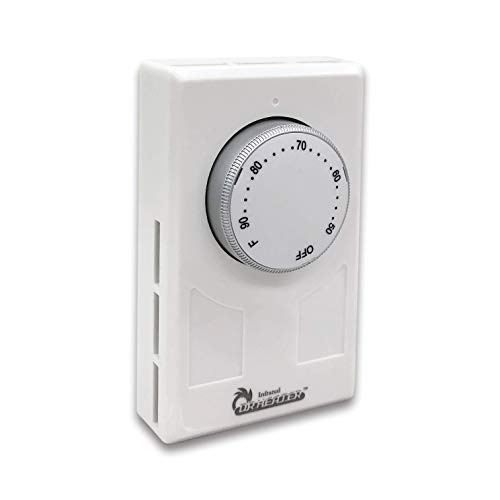
Dr. Infrared DR-001 supports 120–277V with a 3360–7756W rating, depending on voltage. It includes C and F control dials and is designed for wall-mounted installation flush against the wall. Best for: users needing a flexible thermostat that can operate across a wide voltage range. Caution: check the wattage rating for your heater to avoid oversizing the control.
- 3350W at 120V to 7756W at 277V
- Includes C and F dials (temperature control)
- Wall-mounted, compact design
YeloDeer Dual Voltage 4-Wire Thermostat

YeloDeer offers a dual voltage platform (110–265V) with a 4-wire setup and strong accuracy for 120V and 240V heating systems. Best for: households upgrading from older, less precise thermostats that need better temperature control. Caution: manual operation means no programmed schedules.
- Max. 20A; 2400W at 120V; 4800W at 240V
- Precision electronic control
- Wide voltage compatibility
Buying Guide
What is a double-pole thermostat and why choose one?
A double-pole thermostat completely disconnects power to the load when off, reducing heat loss paths and improving safety. It is especially beneficial for long, cold seasons or where full shutoff is preferred for energy efficiency.
Mechanical vs. digital controls
Mechanical thermostats are simple, reliable, and typically cheaper. Digital or programmable models offer schedules and more precise control, which can save energy over time. Consider your preference for simplicity versus automation.
Wiring and compatibility considerations
Most double-pole units use 4-wire setups. Verify voltage (120–277V ranges common for baseboards) and heater wattage ratings. If you rent or plan a retrofit, ensure the unit matches existing wiring and mounting configurations.
Installation tips
- Turn off main power before wiring
- Match wire colors with the device instructions
- Confirm full disconnect with a test after installation
FAQs
- Do double-pole thermostats require professional installation? Not always. Most residential installations can be DIY if you are comfortable with wiring and local codes, but professional help is recommended for complex wiring.
- Can double-pole thermostats work with 240V only systems? Yes, many models support 240V, but check the voltage range in the product specs before purchasing.
- Are programmable double-pole thermostats worth it? Programs can reduce energy usage by aligning heat with your schedule, potentially lowering utility costs over time.
- What does “positive off” mean? It ensures the circuit is fully disconnected when in the off position, improving safety and reducing standby losses.
- Is a digital model necessary for energy savings? Digital models offer scheduling and precise control, which can enhance savings, but a well-chosen mechanical model can still be energy efficient.