Best Outdoor Low Voltage Wiring for Landscape Lighting: Top 5 Options
Answering the most common buyer question: which outdoor low voltage wiring is best for reliable landscape lighting? This guide covers five well-rounded choices, highlighting who they’re best for, why they stand out, and any notable limitations. Ideal for homeowners, DIY enthusiasts, and professionals setting up garden, path, or deck lighting. The table below provides a quick snapshot of the featured products.
| Product | Conductor | Approx. Length | Best For |
|---|---|---|---|
| SUNVIE 12/2 Low Voltage Landscape Wire (250 ft) | 12 AWG | 250 ft | Long runs; direct burial |
| GOSDENG 12/2 Low Voltage Landscape Wire (250 ft) | 12 AWG | 250 ft | Budget-friendly; flexible |
| Wirefy 14/2 Low Voltage Landscape Wire (100 ft) | 14 AWG | 100 ft | Smaller projects; easier handling |
| SUNVIE 100 ft 12/2 Low Voltage Wire | 12 AWG | 100 ft | Mid-length runs; direct burial |
| SUNVIE 100 ft 16/2 Low Voltage Wire | 16 AWG | 100 ft | Shorter runs; flexible installations |
SUNVIE 12/2 Low Voltage Landscape Wire — 250 ft
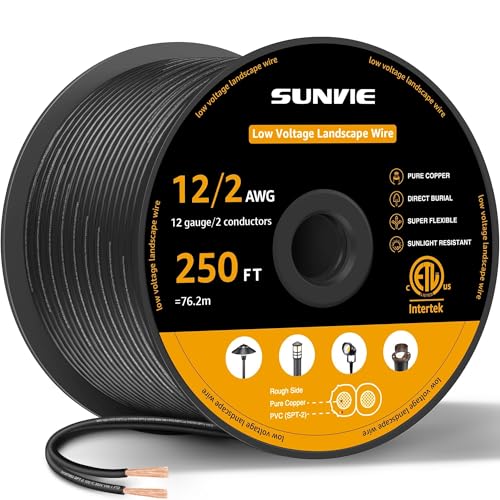
Specification highlights: 250 ft length, 12/2 conductors, SPT-2 black PVC insulation, pure copper, VW-1 fire resistant, maximum working voltage 300V. Direct burial capable and designed for long-term outdoor use.
Best for: Homeowners planning longer landscape runs where direct burial is preferred. This model’s pure copper construction helps minimize voltage drop over extended distances, making it a solid choice for front yards or large backyards.
Caution: At 250 ft, ensure your run planning accounts for potential voltage drop across distance; verify transformer sizing accordingly.
GOSDENG 12/2 Low Voltage Landscape Wire — 250 ft
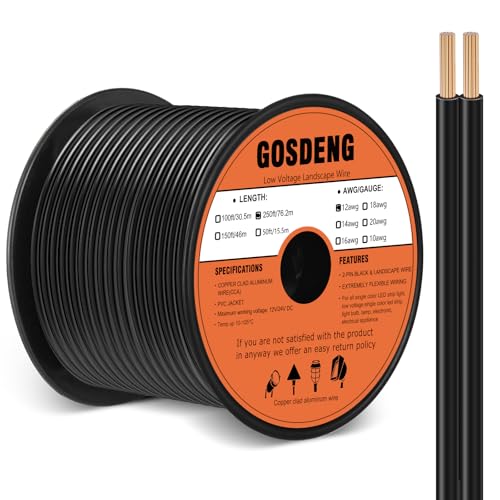
Specification highlights: 250 ft, 12 AWG with black 2 conductors and PVC jacket. Emphasizes good conductivity, flame retardancy, anti-aging properties, and moisture/damp resistance. Notes copper-clad aluminum (CCA) as an option in some cables.
Best for: Budget-conscious projects that still require robust durability and moisture resistance. Suitable for paths, garden lighting, or small outdoor installations where weight and flexibility are favorable.
Caution: CCA can offer lighter weight and cost advantages, but copper-based wires typically yield more consistent conductivity over longer runs; consider project length when deciding.
Wirefy 14/2 Low Voltage Landscape Wire — 100 ft

Specification highlights: 100 ft length, 14/2 conductors, SPT-2 black PVC insulation, pure copper, VW-1 fire resistant, maximum working voltage 300V. Designed for direct burial and outdoor reliability. Flexible and easy to strip.
Best for: Smaller or DIY-friendly projects where ease of handling matters. The 14 AWG copper wire is often easier to work with for fence lines, smaller garden beds, or accent lighting around patios.
Caution: Slightly higher voltage drop risk on longer runs; pair with a transformer sized for the circuit length to maintain brightness.
SUNVIE 100 ft 12/2 Low Voltage Wire
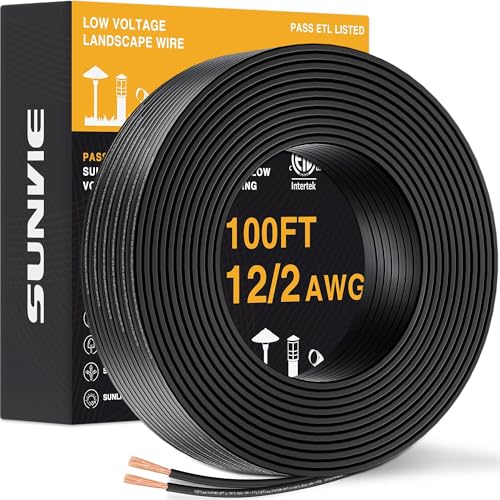
Specification highlights: 100 ft, 12/2 conductors, SPT-2 black PVC insulation, pure copper, VW-1 fire resistant, up to 300V. Able to be buried directly for long-term installations. Focuses on stable, efficient power delivery.
Best for: Medium-length projects where direct burial and copper conductivity are priorities. Useful for residential landscapes with closer lighting clusters or medium yard setups.
Caution: Shorter run length means more frequent splicing or transformer taps; plan runs to minimize connections for reliability.
SUNVIE 100 ft 16/2 Low Voltage Wire

Specification highlights: 100 ft length, 16/2 conductors, SPT-2 black PVC insulation, pure copper, VW-1 fire resistant, maximum working voltage 300V. Direct burial compatibility for outdoor use.
Best for: Shorter runs and flexible installations where wires need to weave around plantings or tight spaces. The 16 AWG copper design helps with bending around corners and obstacles.
Caution: Thinner gauge may lead to greater voltage drop on longer circuits; combine with appropriate transformer capacity to maintain brightness.
Buying Guide: Key Purchase Considerations
- Project length: For long runs, 12 AWG typically offers lower voltage drop than 14 or 16 AWG. Consider direct burial capabilities to reduce trenching work.
- Copper vs copper-clad aluminum (CCA): Copper provides consistent conductivity over distance; CCA is lighter and cheaper but may exhibit higher voltage drop in some setups.
- Direct burial suitability: If your wiring will be buried, ensure the selected cable explicitly supports direct burial and UV resistance.
- Ambient conditions: Look for cables with moisture resistance, abrasion resistance, and UV stability for sun-exposed landscapes.
- Included insulation and rating: A PVC insulation with VW-1 rating and a compatible maximum working voltage (often 300V) is common in residential low voltage systems.
- Install practicality: Higher flexibility (especially in 14/2 or 16/2) eases routing around paths, corners, and plantings, reducing installation time.
- Electrical planning: Pair wire choices with transformer capacity and run counts to maintain voltage integrity and lighting brightness.
Frequently Asked Questions
- What gauge should I choose for a long run? Answer: For longer runs, 12 AWG is typically preferred to minimize voltage drop, especially beyond 100 feet.
- Is direct burial necessary for outdoor landscape lighting? Answer: Direct burial options simplify installation by avoiding conduit; ensure the wire is rated for direct burial and UV exposure.
- Can I use copper-clad aluminum wires? Answer: CCA wires can work for many projects, but copper wires generally provide better conductivity and stability over longer distances.
- How do I plan transformer sizing with low voltage wires? Answer: Calculate total wattage of all fixtures, divide by transformer voltage (commonly 12V), and choose a transformer with some headroom. Longer runs may require extra consideration for voltage drop.
- Should I buy 14/2 or 16/2 for small paths? Answer: For tight paths and easier handling, 14/2 or 16/2 is suitable; for brighter output over a modest length, 14 AWG is a common middle-ground choice.
- What is the advantage of pure copper conductors in these cables? Answer: Pure copper maintains better conductivity with less resistance, helping maintain brightness and efficiency across runs.