Best 12V Deep Cycle Lead-Acid Battery for RV and Solar Systems
The following 12V deep cycle lead-acid batteries are among the top options for RVs, boating, solar storage, and off-grid setups. This guide highlights five solid choices, each offering maintenance-free design, reliable discharge performance, and suitability for repeated cycling. Compare specifications, construction, and compatibility to pick the right size, capacity, and form factor for your needs.
| Product | Brand | Type | Capacity |
|---|---|---|---|
| Weize Deep Cycle AGM 12V 100Ah | WEIZE | AGM Lead-Acid | 100Ah |
| Renogy Deep Cycle AGM Battery 12V 200Ah | Renogy | AGM Lead-Acid | 200Ah |
| WEIZE 12V 100Ah Deep Cycle Battery (Group 31) | WEIZE | AGM Lead-Acid | 100Ah |
| Mighty Max ML100-12 12V 100Ah SLA | Mighty Max Battery | SLA Lead-Acid | 100Ah |
| Newport Vessels | AGM Lead-Acid | 50Ah |
Weize 12V 100Ah AGM Deep Cycle Battery
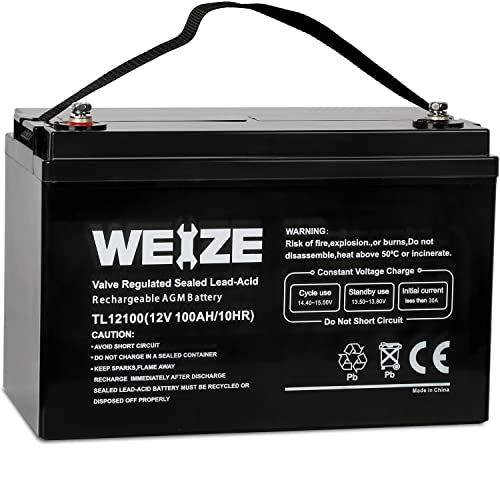
The Weize 12V 100Ah AGM deep cycle battery is designed for low-maintenance operation with an AGM separator system that helps prevent acid leaks. Its compact dimensions (approximately 12.99 x 6.73 x 8.43 inches) fit in many recreational vehicle and off-grid setups. A key feature is its low self-discharge, enabling longer storage between charges. While rated for 1,100A max discharge in short bursts, the overall cycle life benefits from keeping the battery within recommended temperatures and a charged state. It uses a standard two-terminal layout with a left-positive, right-negative configuration for straightforward wiring.
Renogy Deep Cycle AGM 12V 200Ah Battery

Renogy’s deep cycle AGM battery provides a higher capacity option for heavy-use off-grid systems, RVs, and cabins. Its AGM design minimizes maintenance while delivering strong discharge performance and a long shelf life. The battery supports high current draws and is designed to resist leakage, making it suitable for mobile and marine environments. Renogy emphasizes low self-discharge and a robust construction for reliable performance across frequent cycling. The battery is a common drop-in choice for systems requiring more energy density without increasing weight dramatically.
WEIZE 12V 100Ah Deep Cycle Battery (Group 31)

This WEIZE model is a Group 31 sealed lead-acid battery designed for long service life and straightforward installation. Its 12.99 x 6.73 x 8.43-inch footprint matches many standard battery boxes, and its maintenance-free, spill-proof design is suitable for RVs, trolling motors, and off-grid systems. The 100Ah capacity supports extended power draws between charges, while the lower self-discharge rate helps with storage during sporadic usage. The terminal arrangement follows conventional positive-left, negative-right orientation for simple wiring layouts.
Mighty Max ML100-12 12V 100Ah SLA Battery
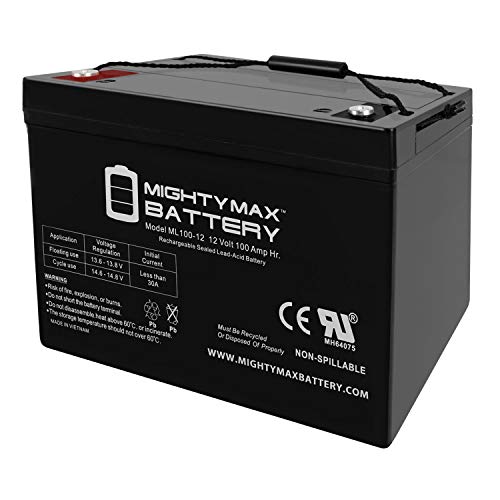
Mighty Max Battery’s ML100-12 is a classic sealed lead-acid option offering maintenance-free operation and UL certification. With a 12V, 100Ah rating, it suits a range of deep cycle applications, including mobility aids, backup power, and off-grid storage. This model emphasizes reliability in stationary and semi-mobile environments where routine cycling occurs. The unit’s design supports safe handling and straightforward installation in standard battery compartments, with typical lead-acid performance characteristics that are familiar to many users.
Newport 12V 50Ah Deep Cycle AGM Battery

Newport Vessels offers a lightweight 12V 50Ah AGM battery designed for trolling motors and portable marine power. With a sealed design and easy handling, this option prioritizes weight savings for smaller vessels while maintaining reliable performance for day trips and compact setups. The sealed AGM construction reduces maintenance, and its form factor supports straightforward storage in tight spaces aboard boats or cabins. It is particularly suitable for smaller power budgets and shorter duration runs where weight is a consideration.
Buying Guide: Key Purchase Considerations And Comparisons
When choosing a 12V deep cycle lead-acid battery, several factors influence performance and suitability for your application. Consider the following perspectives to balance capacity, size, weight, and cost.
- Capacity and discharge: Higher Ah ratings deliver longer runtime between charges but come with greater size and weight. For RVs and boats with larger power draws, 100Ah–200Ah models are common, while smaller setups may suffice with 50Ah–100Ah units.
- Maintenance and safety: AGM (absorbed glass mat) and SLA (sealed lead-acid) designs reduce maintenance and prevent acid leaks. Sealed constructions are preferable for portable or enclosed spaces.
- Physical fit and terminals: Confirm the battery dimensions and terminal layout (positive/negative positions) to ensure compatibility with existing mounts, cable runs, and connectors in your vehicle or vessel.
- Weight considerations: Heavier batteries may require reinforced mounting or dedicated supports, especially in marine and RV applications. Lighter 50–100Ah models can ease installation and handling.
- Cycle life and temperature: Deep cycle performance improves with proper charging and appropriate ambient temperatures. Consider batteries rated for extended cycle life if you expect frequent cycling or storage in varied climates.
- Charging compatibility: Ensure your charger or solar controller supports lead-acid chemistry and matches the battery’s voltage and current needs. AGM and SLA units typically tolerate standard 12V charging profiles.
- End-use scenario: For trolling motors and marine use, consider peak discharge capabilities and vibration resistance. For off-grid cabins, prioritize higher Ah for longer autonomy across cloudy days.
- Maintenance frequency: AGM and SLA batteries generally require less maintenance than flooded options, but periodic checks of electrolyte levels (for non-sealed types) and terminal cleanliness remain important in any system.
- Cost of ownership: While higher-capacity units may have a higher upfront price, their longer life cycles and better performance can result in lower total cost of ownership over time.
For balanced performance, pair a battery with a compatible deep-cycle design (AGM or SLA), your intended load profile, and a charging system that maintains optimal voltage and temperature. In mobile or marine contexts, ensure mounting and wiring meet safety and weight distribution requirements. Always follow manufacturer guidelines for charging, storage, and installation to optimize life span and reliability.