Best PWM DC Motor Speed Controllers and How to Choose the Right One
For hobbyists and professionals working with DC motors, a reliable speed controller is essential. This guide reviews five popular PWM DC motor speed controllers, covering voltage ranges, current handling, and key features. Read on to compare options from JOVNO, RioRand, EC Buying, Gebildet, and BOJACK, and visit each product’s page for full specifications. The selections focus on devices suitable for 7–60V ranges, with adjustable duty cycles and protections that help prolong motor life and improve performance.
| Brand | Name | Voltage Range | Current |
|---|---|---|---|
| JOVNO | PWM DC Motor Speed Controller with 30A Fuse | 7–70V | Up to 30A |
| RioRand | 7-70V PWM DC Motor Speed Controller | 7–70V | Up to 30A |
| EC Buying | DC Motor Speed Controller, 9V-60V/12A/500W | 9–60V | Up to 12A (20A peak) |
| Gebildet | Mini DC Motor PWM Speed Controller, 5V-35V | 5–35V | Up to 5A |
| BOJACK | Low Voltage DC Motor Speed Controller | 1.8–12V | Up to 2A |
Note: The table lists featured devices selected for a range of common DC motor applications, including hobby projects, small machines, and DIY generators. Each product supports PWM-based speed control, with varying protection features and wiring options. Always verify compatibility with your specific motor type and power supply before purchasing.
JOVNO 30A PWM DC Motor Speed Controller

The JOVNO controller supports a wide input range from 7 to 70V and handles up to 30A, making it suitable for a broad set of DC motors. A 30A fuse provides overcurrent protection, and a separate potentiometer pull-out option allows flexible wiring installations. The board includes a RUN/STOP/BRAKE switch with a reference wiring method shown in accompanying images. It is designed for DC brush motors and is not intended for AC or brushless motors. This unit is ideal for users needing strong current handling with straightforward control for medium-sized DC motors.
RioRand 7-70V PWM DC Motor Speed Controller

RioRand’s model is designed for a wide voltage range from 7 to 70V and can deliver up to 30A. It features an on-board RUN/STOP/Brake switch and adjustable potentiometer with a separable knob lead. The device is optimized for smooth motor operation with reduced vibration and a visible power indicator, supporting long-duration use. It is compatible with DC brush motors and requires a separate DC power supply for the controller itself, not an AC line connection. This controller is well-suited for projects that need reliable speed modulation and compact packaging.
EC Buying DC Motor Speed Controller

EC Buying’s controller supports DC operation from 9V to 60V with a high current rating and a broad frequency range. The module is designed to manage up to 12A continuous (20A peak) and up to 500W, with adjustable duty cycle and frequency ranges. A digital display shows the current duty cycle and frequency. The device includes wiring options suitable for connecting to a control source or a switch signal and can be configured to respond to 3.3V logic signals. The unit stores set values when power is turned off, facilitating quick resumes after power cycles. This controller is appropriate for precise speed tuning in compact DC motor applications.
Gebildet Mini DC Motor PWM Speed Controller

This compact controller targets low-voltage DC motors with a voltage range of 5–35V and a current rating up to 5A. It uses PWM to provide smooth speed adjustments from 0 to 100%, with a 20 kHz PWM frequency to minimize audible noise. The module is designed for easy integration and includes standard connections for simple motor and load wiring. The small form factor makes it ideal for embedded projects, microcontroller-powered devices, and DIY gear that requires precise speed control without bulky hardware.
12V 30W Permanent Magnet DC Motor With Controller
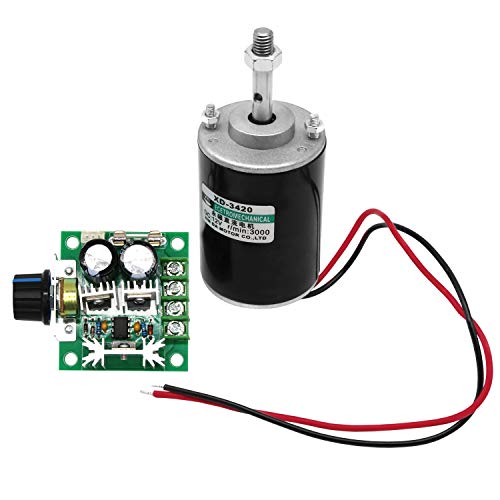
This 12V motor operates at up to 3000 RPM, offering CW/CCW control and a built-in PWM-based speed controller for loads up to 30W. It’s positioned for DIY generators and small mechanical projects, with a recommended operating range of 12–40V. The included speed controller provides basic adjustable control, enabling a simple setup for fans, small gear mechanisms, or hobbyist projects. The motor’s copper windings and reverse-polarity protection contribute to durability in brief test cycles and continuous use scenarios.
Choosing the right PWM DC motor speed controller involves balancing voltage range, current capacity, and control features. The five options above provide a spectrum of capabilities—from high-current, wide-range controllers to compact, low-voltage modules. When selecting a unit, consider motor type (DC brushed vs. brushless), required protection (reverse polarity, overcurrent), control interface (potentiometer, digital encoder, or switch), and whether you need onboard indicators or a separate power supply for the controller.
Buying Guide
Key purchase considerations:
- Voltage and current requirements: Ensure the controller’s voltage range and continuous current rating match or exceed your motor’s specifications.
- Control interface: Decide between a potentiometer, digital encoder, or simple on/off plus brake signals. Some units offer removable knobs for flexible installations.
- Protection features: Look for reverse polarity protection, short-circuit protection, and optional brake or run/stop indicators to safeguard both motor and controller.
- PWM frequency and noise: Higher PWM frequencies reduce audible humming; check frequency ranges to fit your application noise tolerance.
- Installation and wiring: Consider form factor, connector types, and whether the controller requires a separate power supply. Verify compatibility with DC brushed motors.
- Durability and heat: For continuous operation, assess heat dissipation and enclosure quality, especially in higher-current setups.
- Documentation and support: Availability of wiring diagrams, usage guidelines, and manufacturer support can simplify integration.
Across these options, users seeking broad motor compatibility with robust current handling may prefer higher-current, wider-voltage units like JOVNO or RioRand. For compact, low-voltage projects, Gebildet offers a handy mini module, while EC Buying provides advanced features such as digital readouts on the control interface. Always align your selection with motor type, load, and duty cycle to ensure reliable, efficient performance.