Best Cycling Refrigerated Air Dryer Options for Efficient Bike Shop Pneumatic Tools
Answering the question: these refrigerated air dryers are best for workshop or small- to mid-sized shop setups that use bicycle maintenance tools or other pneumatic gear. The top picks below are suited for users who need dry, oil-free compressed air for spray painting, tire inflation rigs, or precision pneumatic tools. Each product is chosen for reliability, cooling efficiency, and compatibility with common compressor sizes. See a quick summary table of the five selected models after this intro.
| Product | Best For | Key Benefit | CFM | Voltage |
|---|---|---|---|---|
| VEVOR 85 CFM Refrigerated Dryer | Mid-sized workshop | Color screen control for easy monitoring | 85 | 110-120V |
| VEVOR 125 CFM Refrigerated Dryer | Higher-demand shop | Higher flow for multiple tools | 125 | 110-120V |
| HPDAVV 35 CFM Refrigerated Dryer | Garage or small shop | Solid 0.58 kW cooling, compact | 35 | 110V |
| Schulz 35 CFM With Regulator Pre-Filter | Beginner to mid-tier setups | Complete kit with pre-filter + water separator | 35 | 110V |
| Ingersoll Rand 42 CFM Dryer | Reliability-focused | Low-GWP refrigerant with efficient design | 42 | Not shown |
VEVOR 85 CFM Refrigerated Dryer for 15/20 HP Compressors

Best for mid-range industrial setups that run 15 to 20 HP compressors. Designed with a color touchscreen control panel and automatic drainage, this unit handles up to 85 CFM and works across a wide pressure range (87–232 PSI). Dew point is kept between 35.6 and 50 °F, providing reliable moisture removal for air tools and spray equipment. Choose this if you operate a small shop with multiple air tools and need straightforward control in one integrated system.
Who it’s best for: workshop owners upgrading from basic filtration to refrigerated drying, and those who want easier operator controls. Limitation: heavier upfront footprint and requires proper clearance for heat exchange components.
Key data to consider:
– Flow: 85 CFM
– Inlet/Outlet Compatibility: RC 3/4″
– Refrigerant: R134a
– Dew point: 35.6–50 °F
VEVOR 125 CFM Refrigerated Dryer for 20/25/30 HP Compressors
Best for higher-demand industrial setups or shops running multiple heavy tools in parallel. It handles up to 125 CFM with a large-area evaporator for fast moisture removal and efficient heat exchange. The unit uses R410a refrigerant and supports compressors in the 20–30 HP range. This model is ideal when you need to feed several air lines without sacrificing dryness or air quality. Caution: ensure your piping and fittings match RC 1″ connections for optimal performance.
Who it’s best for: larger shops or garages needing abundant dry air for multiple tools; better for ongoing, heavier use than the 85 CFM model. Limitation: higher power draw and bigger footprint.
HPDAVV 35 CFM Refrigerated Dryer
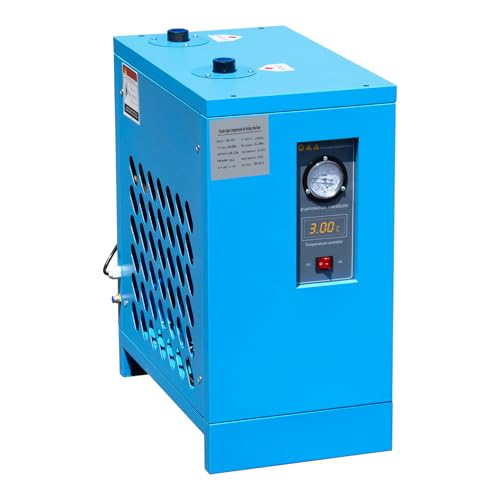
Best for compact workshop setups needing dependable moisture elimination for essential pneumatic tools. This unit is designed for 7.5–10 HP class compressors and provides clean, dry air with an energy-efficient R134a cooling system rated at 0.58 kW. It delivers 35 CFM and is well-suited for garages, small auto shops, or CNC workstations where space is at a premium. Caution: ensure your compressor output remains under 175 PSI to avoid overloading the dryer’s inlet stage filters.
Who it’s best for: home hobbyists or small shops with one or two essential air tools; better for tight spaces than larger, more powerful dryers.
Schulz 35 CFM With Regulator Pre-Filter

Best for buyers seeking an all-in-one kit that includes moisture and oil removal components. This 35 CFM Schulz refrigerated dryer comes with an industrial water separator and an oil-removing coalescing filter. It’s designed for 100 PSI operation with a 1/2″ inlet/outlet and a 41 °F dew point, while the max inlet is 200 PSI. Choose this if you want a complete solution with pre-filter options and don’t want to source components separately. Limitation: ensure the compressor output stays within the recommended range to protect the filters.
Schulz Refrigerated Air Dryer Stand-Alone

Best for standalone dryer needs where space or existing pre-filters are already in place. This Schulz 35 CFM non-cycling refrigerated dryer is a 115V unit designed to pair with pre-filter strategies, including stage 1 water separators and stage 2 oil coalescing filters. It’s ideal when you want to tailor the filtration setup to your system with optional add-ons. Caution: use a pre-filter before the dryer to protect the unit’s internal stages and warranty.
Ingersoll Rand 42 CFM Non-Cycling Dryer

Best for users prioritizing energy efficiency and durable components. This non-cycling dryer adopts an R513A refrigerant with low GWP, which helps meet sustainability targets. It emphasizes low pressure drop to reduce energy use and features dependable heat exchangers and valves. Choose this if energy efficiency and long-term reliability are top concerns. Caution: verify compatibility with your existing piping and spare parts, as some setups may require adapters.
Buying Guide
What to consider when selecting a refrigerated air dryer for cycling or workshop use:
- Compatibility with your compressor: match CFM and HP range to ensure sufficient drying capacity.
- Dew point and air quality: a lower dew point means drier air; consider tools and finishes that require ultra-dry air.
- Refrigerant type and efficiency: newer refrigerants with low GWP are better for energy use and compliance.
- Control features: color screens and automated drainage simplify operation and maintenance.
- Filtration options: some units include pre-filters or water separators—evaluate whether you need a complete kit or separate components.
- Space and installation: consider footprint, inlet/outlet connections, and required clearances for heat exchange.
- Maintenance: plan for filter changes and routine checks to prevent performance drops.
FAQ
- What is a refrigerated air dryer used for in a bike shop?
It removes moisture from compressed air to protect pneumatic tools, spray equipment, and finishes from moisture-related defects.
- How do I choose between 85 CFM and 125 CFM models?
Consider the number of tools and simultaneous uses; more CFM supports multiple devices at once, reducing dew points under heavy load.
- Is R134a or R410a better for air dryers?
R134a is common in smaller units; R410a is used in higher-capacity dryers and can offer different efficiency characteristics.
- What does a dew point indicate?
The dew point shows how dry the air is; lower values indicate drier air, which is better for sensitive tools and finishes.
- Do I need a pre-filter with a refrigerated dryer?
Not always, but pre-filters can extend dryer life by removing oil and particulates before the dryer stages.
- Can these dryers be used with any compressor?
Most are designed for common shop compressors; verify HP, CFM, and inlet pressures to ensure compatibility.