Best Copper Busbar Bending Machines for Metalwork Pros
Answering the core buyer question: these copper busbar bending machines are designed to shape copper and aluminum busbars accurately with hydraulic or manual power. They’re best for electrical installers, panel builders, small workshops, and maintenance crews who need consistent bends without distortion. This guide highlights top picks, explains who each model suits best, and compares key features to help you choose.
Buying at a glance: the table below lists five strong options, with their main strengths and ideal use cases. Use this to shortlist models before reading detailed sections.
| Product | Best For | Key Benefit | Limitations |
|---|---|---|---|
| KAKA INDUSTRIAL CB-150D | Professional workshops | 20T force; horizontal design prevents distortion | Requires floor space |
| INTSUPERMAI 3 in 1 | Versatile small shops | Punching, cutting, bending in one unit | Complex setup for first-time users |
| MXBAOHENG CB-150D | Cu/Al busbars with quick changes | Openable body for easy removal | Possibly heavier to move |
| SOFEDY 20T CB-200A | Wide busbars and mixed materials | Up to 200mm width; 12mm copper/aluminum | Requires compatible pump |
| QUNZIDRESS 20T with Angle Indicator | Precise angle work | Angle indicator for accurate bends | Manual or pump-assisted operation |
KAKA INDUSTRIAL Hydraulic Busbar Bending Machine CB-150D

The KAKA INDUSTRIAL CB-150D delivers a robust 20-ton output force and handles copper busbars up to 0.47 inches thick and 5.9 inches wide. Its horizontal design minimizes distortion during bending, and a supporting frame helps align copper or aluminum rows. Best for professional panels and high-precision bending tasks in fabrication shops. Caution: the unit requires suitable workspace and stable mounting for best results.
INTSUPERMAI 3 in 1 Busbar Processor

INTSUPERMAI combines punching, cutting, and bending in a single hydraulic machine. With 20-ton cutting force, 31-ton punching, and 16-ton bending, it supports up to 5.90″ x 0.39″ cutting width/thickness and 7.87″ x 0.47″ bending. It’s well-suited for shops that handle multiple busbar operations in one workflow. Advantage: reduces tool swapping. Limitation: more settings to master, especially for first-time users.
MXBAOHENG Copper Busbar Bending Machine CB-150D

MXBAOHENG’s CB-150D is designed for bending copper and aluminum busbars with a focus on accommodating different cross-sections. Notable feature: an opening tool body that allows easy removal of bent pieces, which can improve workflow when handling tight spaces. Best for shops that frequently adjust bent geometry. Caution: ensure the opening clearance matches your typical busbar length to avoid interference.
SEDE TOOLS Copper Busbar Bending Machine CB-150D

SEDE TOOLS offers a CB-150D model focused on copper busbar bending as part of its DIY electrical tools lineup. This option is positioned for hands-on professionals who value straightforward hydraulic operation and a compact footprint. Best for small electrical installations and hobbyist panels. Limitation: may lack some advanced alignment features found on higher-end models.
HUIWOSEN Acrylic Bending Machine CB-150D

This acrylic-bending variant targets clear visibility and portable use for switch boxes and control panels. It supports 90-degree bends and is marketed for separate, easy-to-carry setups. Best for fieldwork or compact installations where visibility of the bend is beneficial. Caution: may have a narrower capacity compared to heavy-duty hydraulic units.
OKANEN Acrylic Bender CB-150D
OKANEN’s acrylic bender focuses on 90-degree bends for copper or aluminum runs in a split hydraulic system. It’s suited for portable setups and quick-turn wiring projects where a lightweight tool is favored. Best for on-site repairs and small panel builds. Limitation: may offer less depth capability for thick busbars than heavier industrial models.
SOFEDY 20T Hydraulic Busbar Bender CB-200A

SOFEDY’s 20T CB-200A offers substantial bending force and a wide capacity (up to 200mm width). It handles copper, aluminum, and mixed materials and supports various pumping options (hand, foot, or electric). Best for mid-to-large scale electrical projects requiring a sturdy, versatile tool. Caution: pump compatibility should be checked for your preferred power source.
QUNZIDRESS Hydraulic Busbar Bender with Angle Indicator
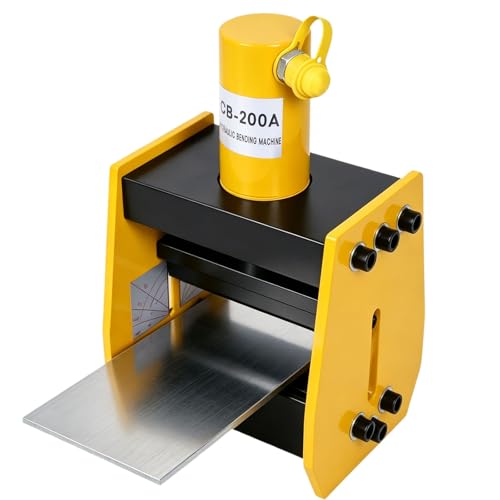
QUNZIDRESS emphasizes precision with an integrated angle indicator for accurate bends. This all-in-one tool supports copper, aluminum, and iron bends and offers 20T of force. Best for operations that require repeatable angles and dependable control. Limitation: angle indicators require calibration to maintain accuracy over time.
Buying Guide: Key Considerations for Copper Busbar Bending Machines
- Material compatibility: Confirm whether the machine supports copper, aluminum, and steel, and the maximum thickness each material can bend safely.
- Force and capacity: Match the required bending force (tons) to the busbar width and thickness you work with most often.
- Control method: Choose hydraulic, manual, or electric options based on your typical workflow and available power sources.
- Bend quality features: Look for horizontal designs, adjustable dies, and angle indicators to reduce distortion and improve accuracy.
- Ease of use: Consider opening or removable tool bodies, quick-change components, and clear safety features for faster setup.
- Portability vs. stationarity: Heavier units offer stability but require transport aids; portable models suit field work.
- Maintenance and safety: Check for accessible seals, common spare parts, and safe operating procedures.
Frequently Asked Questions
- What busbar sizes can these machines bend?
Answer: Most models handle copper and aluminum ranges up to around 0.47 inches thick and widths around 5–8 inches, with some 200mm-wide capacities in heavier units. - Do these machines require special pumps?
Answer: Several models work with hand, foot, or electric pumps; compatibility varies by model and build. - Should I buy a 3-in-1 machine?
Answer: If you need punching, cutting, and bending in one unit and you have the workflow to utilize all functions, a 3-in-1 can save space and setup time. - Is a larger tonnage always better?
Answer: Not necessarily; match tonnage to your most common busbar thickness to avoid overkill and reduce tool wear. - What maintenance helps accuracy?
Answer: Regularly inspect hydraulic seals, lubricate moving parts, and verify angle indicators and dies for wear and alignment. - Can these be used in field service?
Answer: Yes, several models are designed for portability and different power options, but verify weight and pump compatibility for each job site.