Best BLDC With Hall Sensor Controllers and Motors for Diy Projects and Automation
Answering the search for reliable BLDC solutions with Hall sensors, this guide highlights five practical options. Each product is suited to different users—from hobbyists wiring DIY robotics to engineers building PLC-driven automation. The top picks emphasize clear speed and direction control, protective features, and straightforward wiring. Use this overview to compare form factors, control methods, and compatibility with 6-60V systems. The following buying table summarizes the chosen products to help you scan quickly before diving into individual details.
| Product | Brand | Type |
|---|---|---|
| DC 6-60V 400W 3 Phases Hall Brushless Motor Controller Board | GODIYMODULES | BLDC Controller |
| RioRand 350W 6-60V 3-Phase PWM BLDC Controller | RioRand | BLDC Controller |
| 2PCS DC 6-60V 400W BLDC Controller With Hall | YELUFT | BLDC Controller |
| UMLIFE 1PCS DC 6-60V 400W BLDC Controller | UMLIFE | BLDC Controller |
| 2804 Hollow Shaft BLDC Motor With Encoder | LeTkingok | BLDC Motor With Hall Encoder |
GODIYMODULES 400W BLDC Controller With Hall
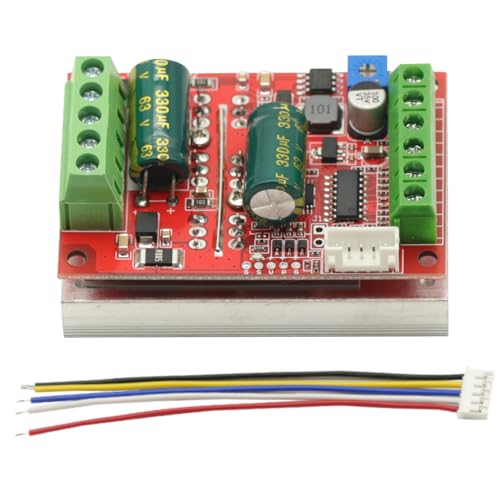
This three-phase driver accepts 6-60V input and handles Hall sensors with MA, MB, MC phase lines, plus +5V and GND for Hall power. It offers forward/reverse control and a brake option. The board supports PWM or analog speed control via 0-5V signals. Best for compact 400W class projects where simple wiring and robust reverse protection are priorities. Avoid if you need integrated fuse protection on the main circuit; external fusing is recommended in certain setups.
RioRand 350W BLDC Controller With Hall

This 6-60V controller is designed for 120° angle BLDC motors with Hall sensors. It delivers 200-300W continuous power (350W peak) and 16A continuous current (20A peak). It supports PLC-compatible 0-5V analog or PWM control. Its forward/reverse, brake, and stop features suit automated systems, conveyors, or robotics. Practical notes include a built-in overcurrent protection but no fuse in the main circuit; add external protection. Reversing polarity can damage the board, so correct wiring is essential.
YELUFT 2-Pack: 400W BLDC Controller With Hall
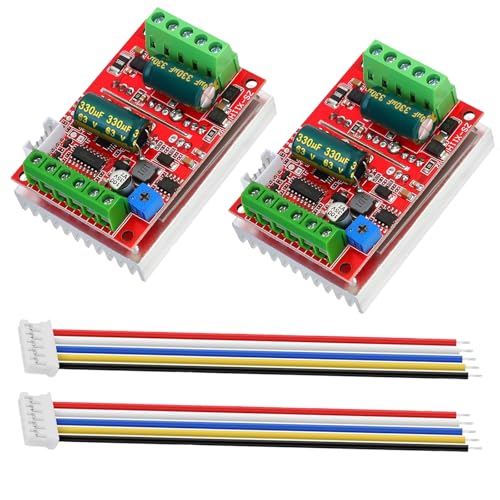
Two controllers share a 6-60V range and 400W rating, designed for 120° Hall-based motors with three Hall signal lines and a separate power supply for Hall sensors. Features include PWM and 0-5V speed control, plus MA/MB/MC phase outputs and DA/DB/DC style signal ports. They are ideal when wiring multiple motors to the same control system. A potential limitation is the lack of built-in main circuit fusing; ensure appropriate external protection and correct wiring to prevent damage.
UMLIFE 1PCS 400W BLDC Controller For 6-60V

The UMLIFE controller supports 6-60V input with a 400W rating and three-phase hall-equipped motors. It accepts PWM and 0-5V analog speed control signals, making it a flexible option for PLC-driven applications or DIY robotics. It ships with a straightforward main power interface and hall signal connections. Best for projects needing a single-controller solution across several voltages, though external protection and proper heat sinking improve longevity under high current.
2804 Hollow Shaft BLDC Motor With Encoder

This hollow-shaft, outer-rotor BLDC motor includes an AS5600 encoder and Hall sensor integration, designed for precise feedback and FOC-ready control. The motor features a Ø6.5mm hollow shaft and a strong magnetic setup to support encoder accuracy. It suits projects requiring precise speed and position sensing, such as automated tooling or robotic joints. A limitation is that it often pairs with external controllers and may require additional mounting hardware for optimal performance.
Buying Guide
What should you consider when selecting a BLDC controller with Hall sensors?
- Voltage range and current capacity: Match the driver to your motor and supply (6-60V, 200-400W or higher).
- Control method: Choose between PWM, 0-5V analog, or combined speed-control options based on your control system (PLC, microcontroller, or analog signal source).
- Hall sensor wiring: Ensure correct mapping of Ha/Hb/Hc or AB line conventions and confirm power supply for Hall sensors.
- Protection features: Look for overcurrent protection, heat sinking, and external fuse recommendations to protect power electronics.
- Forward/reverse and braking: If your project requires frequent direction changes, verify that the driver supports safe switching and required brake modes.
- Wiring clarity and documentation: Clear pinouts, terminal blocks, and examples ease assembly and reduce wiring errors.
- Motor compatibility: 120-degree angle motors often use specific controllers; confirm Hall wiring and phase connections match the driver.
Who should consider these options?
- Hobbyists with DIY robotics projects needing straightforward PWM or analog speed control.
- Engineers integrating BLDC systems into PLC-based automation or small industrial tools.
- Users seeking multiple controller options for parallel motors, using a common 6-60V supply.
Key comparison points
- Power rating: 200-400W typical for 6-60V class controllers; select based on motor load.
- Control inputs: 0-5V analog vs PWM; hybrids may offer both for flexibility.
- Protection: External fuses recommended where the main circuit lacks internal fusing.
- Hall wiring: Five-wire Hall motors require proper identification of power and signal lines.
- Mechanical fit: Hollow-shaft motors demand compatible couplings and mounting options.
FAQ
- What voltage should I use for these BLDC controllers?
Most controllers in this set support 6-60V input. Choose a supply that matches your motor rating and leaves headroom for startup current.
- Do these controllers require a fuse?
Many have overcurrent protection but do not include a main-circuit fuse. Add external protection as recommended in each product notes.
- Is 120° motor wiring compatible with all controllers?
No. Some controllers are designed specifically for 120° angle motors and may not work with other angle configurations without adjustments.
- Can I use PWM or analog speed control?
Yes. Most controllers support either or both. PWM is common for dynamic control, while 0-5V analog works well with PLCs and certain microcontrollers.
- What safety considerations exist when reversing direction?
Forward/reverse operations can cause inrush; reduce throttle below 50% before reversing to protect components.
- Is external protection always required?
For main power circuits without an internal fuse, external fusing and protection is strongly advised to prevent damage.