Best Control Box for Linear Actuator: Top 5 12V Controllers
Finding the right control box for a 12V linear actuator can improve reliability, safety, and performance. This article highlights five top options, focusing on multi-actuator support, safety features, speed, and ease of installation. Each product is evaluated against common needs such as dual-channel control, remote operation, and durable construction.
| Product | Brand | Key Benefit |
|---|---|---|
| PA-30 DC Motor Controller | Progressive Automations | Dual-channel, parallel control for up to two actuators |
| RVMARINEPAT Electric Actuator Kit | RVMARINEPAT | Integrated control box with high-speed, 12V actuation |
| PA-28 Wireless Controller Kit | Progressive Automations | Dual-channel, individual actuator control |
| ECO-WORTHY Controller Kit | ECO-WORTHY | Forward/reverse control with simple remote setup |
| DC HOUSE Forward/Reverse Controller | DC HOUSE | Wide voltage range with remote control capability |
Progressive Automations PA-30 12V 30A Dual-Channel Controller

The PA-30 is designed for parallel control of up to two linear actuators within a single housing. It accepts a 12V input and provides up to 15A per channel, enabling robust performance with compatible 12V actuators. Safety features include both momentary and non-momentary operation modes and an inline fuse to protect against short circuits. This makes the PA-30 suitable for projects needing coordinated control of two actuators without separate controllers for each unit.
RVMARINEPAT 12V 12-Inch Stroke Heavy-Duty Linear Actuator Kit
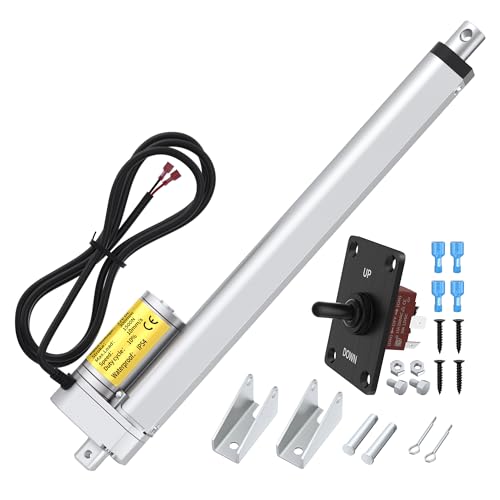
This kit combines a 12V actuator with a control box designed for automotive and home use. It delivers high-speed motion (approximately 10 mm/s) with a 12-inch stroke and a maximum 330 lb push/pull load. The actuator’s aluminum alloy housing contributes to durability, while a built-in limit switch and safety lock help position control and reduce runaway motion. It is well-suited for heavy-duty lifting tasks where speed and strength matter, though users should verify fit with their control electronics.
Progressive Automations PA-28 Wireless Dual-Channel Controller Kit

The PA-28 offers individual control for two separate actuators in one compact unit. It provides 12V input handling up to 15A per channel, with both momentary and non-momentary options and an inline fuse for short-circuit protection. This makes it a flexible choice for projects that require separate operation modes or independent positioning of two actuators, such as adjustable furniture or multi-axis automation setups.
ECO-WORTHY Linear Actuator Controller Kit

This kit focuses on forward and reverse control for linear actuators with a DC input in the 8–35V range. It includes reverse-connection protection and a manual switch, providing straightforward operation for users who want reliable directional control without complex programming. It is suitable for projects requiring simple, robust control with reasonable voltage tolerance and basic safety features.
DC HOUSE Forward/Reverse Controller With 12V Adapter

This controller supports forward and reverse operation for a wide input range (8–30V) and includes a 12V AC/DC adapter. It offers high-current output up to 5A and a remote control distance up to 70 meters, making it suitable for larger installations where distance and power handling matter. The device is designed for a broad array of linear actuators and related motors, with straightforward installation for remote management.
Buying Guide: Key Purchase Considerations
When selecting a control box for a linear actuator, consider these factors to ensure the best fit for your project:
- Number of actuators: If you need to run two actuators in sync, choose a dual-channel or parallel-capable unit like the PA-30 or PA-28. For independent control, dual-channel options with separate outputs work well.
- Voltage and current: Confirm that the control box handles your actuator’s voltage (typically 12V) and current per channel. Exceeding limits can cause overheating or failure.
- Safety features: Look for inline fuses, momentary vs. non-momentary operation modes, and limit-switch capabilities to prevent overextension and short circuits.
- Control type: Decide between wired vs. wireless control. Wireless remotes add convenience for remote operation but require reliable RSS or RF compatibility and range considerations.
- Installation environment: If the device will be exposed to moisture or outdoor conditions, ensure IP rating and enclosure durability meet your risk profile.
- Compatibility and expandability: Verify compatibility with the actuator model and whether future expansion (adding more actuators) is feasible without replacing the controller.
- Physical build quality: Aluminum housings and robust connectors contribute to longevity, especially in vibration-prone or industrial settings.
- Ease of integration: Some controllers offer plug-and-play wiring and clearly labeled terminals, while others may require custom wiring or additional modules.
From a performance perspective, dual-channel controllers provide synchronized movement for applications such as adjustable desks, motorized windows, and mechanical lifts. For projects prioritizing remote operation, wireless kits add convenience but require reliable range and secure pairing. For budget-conscious setups, simpler controllers with built-in safety features can offer dependable operation without the need for complex configurations.